
English


Views: 257 Author: Dapeng Aluminum Publish Time: 2026-09-23 Origin: Site


Content Menu
● Main Types of Aluminum Finishes
>> When Mill Finish Is Suitable
>> Important Buyer Consideration
● 2. Mechanical Aluminum Finishes
>> Best Uses for Mechanical Finishes
>> Expert Note: Mechanical Finishing Is Not a Complete Protection System
● 3. Chemical Pretreatment and Chemical Finishes
>> How Aluminum Anodizing Works
>> Common Anodized Aluminum Colors
>> Advantages of Anodized Aluminum
● 5. Powder-Coated Aluminum Finish
>> Common Powder-Coating Effects
>> Advantages of Powder-Coated Aluminum
>> Common Powder-Coated Aluminum Applications
>> Choosing the Right Powder-Coating Grade
● 6. Liquid-Painted Aluminum Finish
>> Benefits of Liquid-Coated Aluminum
>> Where Liquid Coating Performs Well
● 7. Electrophoretic Coating for Aluminum Profiles
>> Advantages of Electrophoretic Aluminum
>> Typical Uses of Plated Aluminum
● How to Select the Best Aluminum Finish
>> Step 1: Define the End-Use Environment
>> Step 2: Decide Whether a Metallic Look Is Required
>> Step 3: Consider Fabrication Sequence
>> Step 4: Specify Performance, Not Only Appearance
● Aluminum Finish Comparison for Common Applications
● Quality Checks Before Ordering Finished Aluminum Profiles
● Why Finish Selection Should Start Early
● Request a Custom Aluminum Finish Solution
● FAQ
>> 1. What is the most durable finish for aluminum?
>> 2. Is anodized aluminum better than powder-coated aluminum?
>> 3. Can aluminum be powder coated for outdoor use?
>> 4. Which aluminum finish is best for coastal areas?
>> 5. Does powder coating prevent aluminum from corroding?
>> 6. Can anodized aluminum be painted later?
>> 7. What information should I provide when requesting an aluminum finish quotation?
Choosing the right aluminum finish is not simply a cosmetic decision. It affects corrosion resistance, weatherability, color stability, cleanability, fabrication performance, and the long-term perceived value of an aluminum profile.
For architects, fabricators, industrial buyers, and OEM project teams, the best finish depends on where the aluminum extrusion will be used, how it will be processed, and what environmental exposure it must withstand. At Guangdong Dapeng Aluminum Industry Co., Ltd., we help global customers evaluate aluminum surface treatments for architectural systems, industrial frames, transportation components, solar structures, and customized fabricated profiles.
This guide explains the main types of aluminum finishes, their advantages, limitations, and recommended uses—so you can make a more informed specification decision before production begins.
An aluminum finish is a surface treatment applied to an aluminum extrusion, sheet, component, or fabricated part. It may improve the appearance of the metal, prepare it for a coating, increase surface hardness, improve corrosion resistance, or support a particular end-use requirement.
Bare aluminum naturally forms a thin oxide layer when exposed to air. This layer provides some protection. However, natural oxidation alone may not be sufficient for demanding outdoor, coastal, industrial, decorative, or high-contact applications.
A properly selected finish can help achieve:
- Improved corrosion resistance in humid, coastal, industrial, or outdoor environments
- Better visual consistency across aluminum profiles and assembled systems
- Greater color flexibility, including solid colors, metallic finishes, wood-grain effects, and custom shades
- Enhanced surface durability for handling, cleaning, installation, and daily use
- Better adhesion for paint, powder coating, bonding, or secondary fabrication
- A more premium appearance for visible architectural and consumer-facing products
The correct specification should consider more than color. It should also define substrate condition, pretreatment, film thickness or anodic coating class, gloss level, texture, testing requirements, packaging, and inspection standards.
The most common aluminum surface finishes include mill finish, mechanical finish, chemical finish, anodizing, powder coating, liquid coating, electrophoretic coating, and plating. Each option serves a different purpose.
| Aluminum Finish Type | Main Purpose | Typical Appearance | Common Applications |
|---|---|---|---|
| Mill finish | Basic untreated extrusion surface | Natural aluminum, extrusion lines visible | Hidden industrial parts, further processing |
| Mechanical finish | Texture, smoothing, decorative preparation | Brushed, polished, blasted, satin | Trim, consumer products, decorative components |
| Chemical finish | Cleaning, etching, brightening, coating preparation | Matte, satin, bright | Pretreatment before coating or anodizing |
| Anodized finish | Integrated oxide protection and metallic appearance | Clear, bronze, black, champagne, brushed | Windows, doors, façades, electronics, furniture |
| Powder-coated finish | Durable colored protective coating | Matte, gloss, textured, metallic | Building systems, railings, solar frames, machinery |
| Liquid-painted finish | Smooth coating and complex color control | Smooth, high-gloss, custom color | Curtain walls, window frames, signage, equipment |
| Electrophoretic finish | Uniform coated protection | Clear or colored, smooth, consistent | Architectural profiles, furniture, consumer goods |
| Plated finish | Decorative or functional metallic surface | Chrome, nickel, brass, gold-like | Automotive trim, specialty hardware, decorative parts |
Mill finish aluminum refers to aluminum that leaves the extrusion process without an added decorative or protective coating. It is the standard raw surface condition of many aluminum profiles.
This finish often shows extrusion marks, die lines, handling scratches, minor variations, and the natural color of the aluminum alloy. It is not necessarily defective. Rather, it is a practical starting point for applications where appearance is not critical or where another surface treatment will be applied later.
Mill finish is often used for:
- Internal machine frames
- Industrial structures installed in protected environments
- Components that will be machined, welded, painted, or coated later
- Heat sinks and electronic housings
- Hidden structural parts
- Temporary fixtures and prototypes
For many industrial aluminum extrusion projects, mill finish offers the most economical solution. However, it is not generally recommended for exposed exterior architectural applications, especially in humid or corrosive environments.
Mill finish does not mean "no quality control." Even raw extrusions should be checked for:
- Straightness
- Twist
- Surface scratches
- Die lines
- Dimensional tolerances
- Wall-thickness consistency
- Packaging protection
For export projects, protective film, kraft paper, polybag wrapping, foam separation, or customized packaging may be necessary to reduce transit damage.
Mechanical finishing changes the physical surface texture of aluminum through abrasion, polishing, blasting, brushing, grinding, or buffing. These processes can be used as a final decorative treatment or as preparation before anodizing and coating.
Common mechanical finishes include:
- Brushed aluminum: Produces a directional grain with a refined, satin-like appearance
- Polished aluminum: Creates a reflective surface ranging from semi-gloss to mirror-like
- Sandblasted aluminum: Produces a uniform matte texture through abrasive blasting
- Bead-blasted aluminum: Creates a smoother, more controlled satin finish
- Ground aluminum: Removes surface irregularities and improves flatness
- Buffed aluminum: Enhances shine and reduces visible surface defects
Mechanical finishes are particularly suitable for products where visual texture matters, including:
- Decorative aluminum trims
- Interior architectural profiles
- Furniture frames
- Consumer electronics housings
- Display systems
- Appliance components
- Premium industrial enclosures
- Automotive decorative parts
A brushed profile can make an aluminum surface look more deliberate and premium. However, brushing may also make scratches more noticeable if the damage crosses the grain direction. Therefore, handling, protective film, and packaging should be carefully planned.
Mechanical finishing improves appearance, but it does not automatically provide strong long-term corrosion protection. For demanding environments, it is often combined with anodizing, electrophoretic coating, or a high-performance organic coating.
For example, a brushed aluminum window profile may be anodized afterward to retain the metallic character while improving surface durability.
Chemical finishing uses controlled cleaning, etching, brightening, conversion coating, or surface activation processes. It is especially important before powder coating, liquid painting, anodizing, bonding, and other finishing operations.
The objective is to create a clean and consistent aluminum surface that allows the next treatment to perform properly.
- Alkaline cleaning: Removes oils, lubricants, dirt, and production residue
- Acid etching: Creates a matte or satin surface and reduces minor surface irregularities
- Bright dipping: Produces a brighter, more reflective surface
- Desmutting: Removes residues created during etching
- Conversion coating: Improves coating adhesion and corrosion performance before painting or powder coating
Pretreatment is often invisible in the finished product, but it is one of the most important quality stages. A visually attractive powder-coated profile may still fail prematurely if cleaning and pretreatment are poorly controlled.
A reliable pretreatment process supports:
- Coating adhesion
- Uniform appearance
- Reduced blistering risk
- Better corrosion resistance
- Improved performance around cut edges and drilled holes
- More consistent color across production batches
For high-value aluminum window, door, curtain wall, photovoltaic, and industrial enclosure projects, buyers should ask the supplier how pretreatment is managed and inspected.
Anodizing is an electrochemical process that thickens the natural oxide layer on aluminum. Unlike paint or powder coating, anodizing becomes integrated with the aluminum surface rather than sitting on top of it as a separate film.
The resulting anodic layer can improve corrosion resistance, surface hardness, appearance, and wear performance. It also preserves the metallic look and feel of aluminum.
During anodizing, aluminum profiles are immersed in an electrolyte solution and connected to an electrical current. This controlled process forms a durable oxide layer on the surface.
The anodized layer may then be:
- Left clear for a natural silver appearance
- Colored through dyeing or electrolytic coloring
- Sealed to improve corrosion resistance
- Combined with brushing, polishing, or blasting for decorative effects
Architectural anodizing is intended for long-life exterior applications where appearance and weather resistance are important. Industry quality frameworks emphasize visible surface quality, coating thickness, sealing quality, color consistency, and light fastness for architectural anodized aluminum.
Popular anodized colors include:
- Natural silver
- Champagne
- Light bronze
- Medium bronze
- Dark bronze
- Black
- Gold
- Custom electrolytic shades
Anodized finishes can vary depending on alloy, surface preparation, extrusion quality, batch conditions, and color process. For this reason, a physical approved sample should be used for projects with strict visual requirements.
- Metallic appearance: The aluminum texture remains visible
- Excellent durability: The anodic layer is integrated with the base metal
- Good UV stability: Suitable for many exterior applications
- No peeling or flaking: Unlike an applied paint film, the oxide layer does not peel away
- Improved scratch resistance: Particularly useful for high-contact surfaces
- Low maintenance: Often easy to clean with appropriate methods
- Recyclability: Aluminum remains highly recyclable at the end of its service life
Anodized aluminum is commonly used for:
- Aluminum windows and doors
- Curtain wall systems
- Louvers and sunshades
- Architectural trims
- Furniture frames
- Consumer electronics
- Handrails
- Lighting fixtures
- Automotive components
- Solar mounting components
- Retail displays
Choose anodized aluminum when the project requires a premium metallic appearance, good abrasion resistance, stable decorative color, and long-term exterior performance.
For exterior architectural work, the specification should clearly state the required anodic coating class or thickness, color range, sealing requirements, acceptable visual quality, and inspection method. The Aluminum Association's designation system uses letter-and-number codes to identify specific anodized finishes.
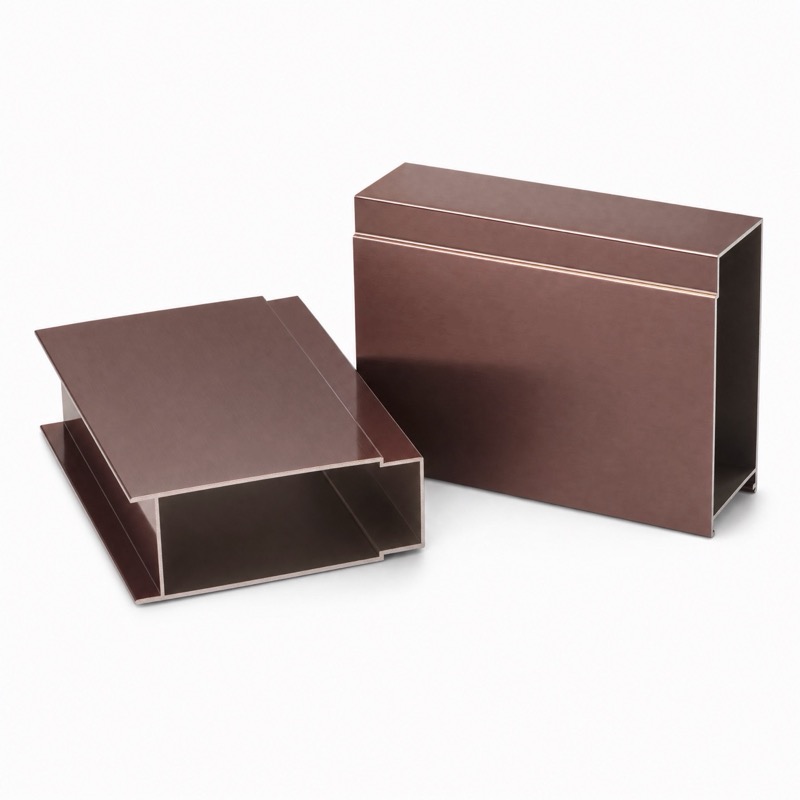
Powder coating is one of the most widely used aluminum finishing methods for architectural and industrial products. It applies a dry powder to the prepared aluminum surface, usually through electrostatic spraying. The coated profile is then cured in an oven, where the powder melts and forms a continuous protective film.
Powder coating provides broad color choice, strong visual consistency, and good resistance to weathering, moisture, and everyday use when the correct coating system is selected.
Powder-coated aluminum can be produced in many visual styles:
- Matte finishes
- Satin finishes
- Gloss finishes
- Fine-textured finishes
- Sand-textured finishes
- Metallic finishes
- Hammered finishes
- Wood-grain transfer finishes
- Custom RAL or project-specific colors
This flexibility makes powder coating particularly valuable for architectural systems, furniture, equipment housings, transportation components, and branded industrial products.
- Wide color selection
- Good coverage on complex profile shapes
- Durable protective film
- Suitable for textured and decorative surfaces
- High production efficiency
- Useful for indoor and outdoor applications
- Potentially lower material waste than conventional liquid spraying
- No solvent carrier is required in the powder itself
- Window and door profiles
- Curtain wall systems
- Balcony railings
- Fence and gate systems
- Solar panel frames
- Outdoor furniture
- Industrial machine guards
- Electrical enclosures
- Transportation components
- Retail and display profiles
Not every powder-coated finish provides the same weather resistance. For exterior architectural aluminum, performance requirements should match the project environment.
High-performance organic coating standards differentiate between normal, high-performance, and superior-performance levels. AAMA 2605-level coatings are associated with demanding exterior performance requirements, including a 10-year South Florida exposure test and thresholds for color retention, chalk resistance, gloss retention, salt spray, and humidity performance.
This matters for:
- Coastal construction
- High-UV regions
- High-rise façades
- Hotels and commercial landmarks
- Premium residential developments
- Long-life public infrastructure
For projects where appearance retention is commercially important, do not specify only a color. Specify the performance level, coating supplier approval, film thickness, gloss range, test requirements, and inspection criteria.
Liquid coating, often called wet painting, applies a liquid paint system to aluminum through spray equipment, pumps, or automated coating lines. The coating is then cured or baked to form a protective film.
Liquid coatings are particularly useful where a very smooth surface, special effect, complex color match, or advanced fluoropolymer system is needed.
- Very smooth appearance
- Excellent color matching potential
- Broad range of resin systems
- Suitable for complex shapes and large panels
- Available in high-performance fluoropolymer formulations
- Can provide premium architectural appearance
Common liquid coating chemistries include acrylic, polyester, polyurethane, and fluoropolymer systems.
Liquid-painted aluminum is frequently selected for:
- Curtain wall framing
- Premium window and door systems
- Aluminum façades
- Signage
- Flagpoles
- Outdoor architectural elements
- High-end equipment housings
- Complex fabricated components
Compared with powder coating, liquid coating may provide a smoother finish and more precise visual control. However, the best choice depends on the coating chemistry, application line capability, curing conditions, environmental controls, and the final performance requirement.
Electrophoretic coating, also called e-coating, applies coating particles to aluminum through an electrically assisted immersion process. The process can create a highly uniform coating film, including on complex shapes, edges, and recessed areas.
This finish is commonly used where uniform coverage and a refined appearance are important.
- Even coating thickness
- Good coverage in difficult-to-reach areas
- Smooth surface appearance
- Good corrosion resistance
- Suitable for clear, champagne, bronze, black, and other colors
- Useful for high-volume, consistent production
Electrophoretic coating is often used for architectural aluminum profiles, furniture, office partitions, shower enclosures, decorative trims, and consumer-product components.
For aluminum profiles with complex cavities or detailed cross-sections, electrophoretic coating can offer better film uniformity than some spray-applied solutions.
Plating deposits a thin layer of another metal onto aluminum. Depending on the process, aluminum may be plated with nickel, chrome, copper, brass, silver, gold-like finishes, or other metallic layers.
Because aluminum requires careful surface preparation before plating, this process is normally reserved for specialty decorative or functional uses rather than standard architectural extrusions.
- Automotive trim
- Motorcycle components
- Decorative hardware
- Specialty lighting
- Premium consumer products
- Aerospace components
- High-end display fixtures
Plating can create a distinctive metallic appearance, but it may involve more complex processing and higher cost. It is generally not the first choice for large-volume building profiles.
The best aluminum finish should be selected through a practical evaluation of exposure conditions, appearance goals, fabrication needs, budget, and maintenance expectations.
Ask where the aluminum profile will be installed or used.
- Indoor, dry environment
- Outdoor urban environment
- High-humidity area
- Coastal or marine area
- Industrial or chemical exposure area
- High-UV climate
- High-contact or abrasion-prone application
A powder-coated profile that performs well indoors may not be the right solution for a seaside hotel façade. Likewise, a premium fluoropolymer coating may be unnecessary for a protected internal machine frame.
If you want the natural appearance of aluminum to remain visible, anodizing is often the strongest option.
If you need solid colors, texture, wood grain, brand colors, or visual flexibility, powder coating or liquid coating may be more suitable.
Some processes should happen before finishing, while others can occur afterward with proper precautions.
Before final finishing, projects may require:
- Cutting
- CNC machining
- Drilling
- Punching
- Bending
- Welding
- Assembly preparation
- Deburring
Whenever possible, complete major fabrication before final coating. Post-finish drilling, cutting, or welding can expose raw aluminum edges and damage the surface.
A complete aluminum finish specification should include:
1. Aluminum alloy and temper
2. Surface preparation method
3. Finish type
4. Color code or approved physical sample
5. Gloss level or texture requirement
6. Coating thickness or anodic coating class
7. Outdoor durability requirement
8. Adhesion, corrosion, and weathering test expectations
9. Visual acceptance criteria
10. Packaging and protective-film requirements
This approach reduces confusion between buyers, designers, fabricators, finishers, and installers.
| Application | Recommended Finish | Why It Works |
|---|---|---|
| Interior office partition | Powder coating or anodizing | Clean appearance, color options, easy maintenance |
| Premium aluminum window | Anodizing, powder coating, or liquid fluoropolymer coating | Combines appearance with outdoor durability |
| Coastal façade | High-performance anodizing or superior exterior coating system | Better resistance to UV, humidity, and salt exposure |
| Solar panel frame | Anodizing or durable powder coating | Corrosion protection and long-term outdoor performance |
| Industrial machine frame | Mill finish or powder coating | Cost-effective and suitable for controlled environments |
| Decorative furniture | Brushed anodizing, powder coating, or electrophoretic coating | Strong visual appeal and good wear resistance |
| Transportation component | Powder coating, anodizing, or specialty plating | Depends on exposure, weight, and decorative needs |
| Consumer electronics enclosure | Brushed anodizing or bead-blasted anodizing | Premium metallic appearance with surface durability |
A finish should be evaluated using both visual and technical criteria. For export projects, a pre-production sample and approval process can prevent costly disputes later.
Before mass production, confirm:
- Color consistency against the approved sample
- Gloss level and texture
- Film thickness or anodic coating requirement
- Surface defects such as pinholes, dents, scratches, particles, and orange peel
- Adhesion performance
- Corrosion-resistance requirements
- Packaging method
- Protective film type
- Marking and labeling
- Batch traceability
For decorative architectural work, the supplier should also clarify acceptable variation between batches. Metallic finishes, anodized shades, wood-grain effects, and textured coatings may show slight variation under different lighting conditions.
One common project mistake is selecting an aluminum finish at the final stage, after extrusion dies, fabrication methods, accessory colors, and installation conditions have already been decided.
Finish selection should begin early because it can influence:
- Alloy selection
- Extrusion surface quality
- Fabrication sequence
- Tolerance planning
- Fastener compatibility
- Sealant selection
- Packaging design
- Project cost
- Production lead time
- Long-term maintenance planning
At Guangdong Dapeng Aluminum Industry Co., Ltd., our technical team works with customers before mass production to identify the suitable alloy, profile design, fabrication process, and surface treatment for each application. This integrated approach helps customers reduce rework, improve appearance consistency, and achieve more reliable project outcomes.
Whether you need mill-finish industrial aluminum profiles, anodized architectural extrusions, powder-coated window profiles, electrophoretic aluminum sections, or customized fabricated components, Guangdong Dapeng Aluminum Industry Co., Ltd. can support your project from profile development to export packaging.
Share your drawing, sample, required alloy, surface color, application environment, and order quantity. Our team can help evaluate the most suitable aluminum finish and develop a production solution that balances appearance, durability, manufacturability, and cost.
Contact us today to request a customized aluminum extrusion and surface treatment quotation for your next project.
The most durable aluminum finish depends on the application environment. For many exterior architectural applications, high-quality anodizing and superior-performance fluoropolymer coating systems are leading options. Anodizing is integrated into the aluminum surface, while advanced organic coatings can provide excellent color retention and weather resistance.
Neither finish is universally better. Anodizing is ideal when you want a metallic appearance, high surface hardness, and long-term resistance without peeling. Powder coating is often better when you need a wide choice of colors, textures, wood-grain effects, or customized decorative finishes.
Yes. Powder-coated aluminum is widely used outdoors for windows, doors, railings, solar frames, furniture, and industrial products. The key is choosing the correct pretreatment and coating performance grade for the local climate, UV exposure, humidity level, and corrosion risk.
For coastal locations, choose a finish designed for high humidity, salt exposure, and UV radiation. High-quality architectural anodizing or a superior exterior coating system is commonly specified. The supplier should confirm pretreatment quality, coating performance requirements, and testing standards.
A properly applied powder coating helps protect aluminum from moisture, pollutants, and environmental exposure. However, coating performance depends heavily on surface preparation, film thickness, curing control, edge coverage, installation quality, and maintenance.
Yes, anodized aluminum can be painted, but the surface must be properly cleaned and prepared to achieve good adhesion. In many cases, it is more efficient to determine the final finish before production rather than apply a second finish later.
Provide the profile drawing, alloy and temper requirement, quantity, length, finish type, color code, gloss level, intended application, environmental conditions, fabrication requirements, packaging needs, and target delivery market. An approved physical sample is recommended for projects with strict appearance requirements.
- [Orange Aluminum — Types of Aluminum Finishes and the Uses of Each]
- [Qualanod — Architectural Applications]
- [Aluminum Anodizers Council — Suggested Anodic Coating Specifications]
- [Aluminum Anodizers Council — Aluminum Association Designation System]
- [FGIA — Updated Suite of Finishes Documents for Aluminum Extrusions and Panels]


