


Views: 224 Author: Dapeng Aluminum Publish Time: 2026-10-03 Origin: Site


Content Menu
● Anodizing vs Powder Coating: Key Differences at a Glance
>> Decorative Anodizing vs Hard Anodizing
>> What Anodizing Does Not Solve
● What Is Powder Coating Aluminum?
>> Why Powder Chemistry Matters
● Anodizing vs Powder Coating: Detailed Performance Comparison
>> Appearance, Colors, and Surface Texture
>> Scratch and Abrasion Resistance
>> Outdoor Weathering and Color Stability
>> Thickness and Dimensional Tolerances
>> Anodizing vs Powder Coating Cost
● Three Overlooked Factors That Improve Finish Selection
>> 1. Alloy Consistency Influences Anodized Appearance
>> 2. Fabrication Sequence Changes the Result
>> 3. Electrical and Thermal Interfaces Need Separate Review
● Practical Application Scenarios
>> Architectural Window and Curtain-Wall Profiles
>> Industrial Aluminum Assemblies
>> Transportation and Renewable-Energy Components
● How to Specify an Aluminum Finish in Six Steps
● Discuss Your Aluminum Profile Requirements with Dapeng
>> Is anodizing better than powder coating for aluminum?
>> Which finish is better for outdoor aluminum profiles?
>> Can anodized aluminum be powder coated?
>> Does anodizing hide scratches and extrusion marks?
>> Can powder coating be repaired?
>> Which finish is more environmentally responsible?
Anodizing vs powder coating is more than a choice between metallic elegance and colorful protection. For aluminum profiles, the right finish affects corrosion resistance, outdoor appearance, dimensional tolerances, maintenance, and purchasing costs. Neither process is universally better: the best option depends on the application and how precisely the finish is specified.
At Guangdong Dapeng Aluminum Industry Co., Ltd., our focus on aluminum profile development, manufacturing, export, and customized processing gives us a practical starting point: match the surface treatment to the product's operating conditions, not simply its appearance.
This guide compares anodized and powder-coated aluminum and explains what buyers should specify before requesting production.
Anodizing creates an oxide layer from the aluminum surface itself. Powder coating adds a cured organic film over a prepared substrate.
That distinction explains most differences in appearance, wear behavior, dimensional impact, and repair.
| Comparison factor | Anodized aluminum | Powder-coated aluminum |
|---|---|---|
| Surface structure | Electrochemically formed aluminum oxide | Applied and cured organic coating |
| Appearance | Preserves metallic character | Offers opaque colors and varied textures |
| Color selection | Depends on alloy and coloring process | Broad selection of colors and gloss levels |
| Abrasion resistance | Hard anodizing suits demanding wear applications | Depends on formulation and service conditions |
| Outdoor durability | Depends on thickness, sealing, and coloring | Depends on resin, pretreatment, and curing |
| Dimensional impact | Requires allowance for oxide growth | Adds film thickness to coated surfaces |
| Visible repairs | Difficult to blend seamlessly | Touch-up is possible but may remain visible |
| Purchasing priority | Alloy, thickness, sealing, appearance | Pretreatment, powder grade, thickness, cure |
The most important buying principle is specification. A clearly defined finish is more valuable than a broad promise of "premium quality."
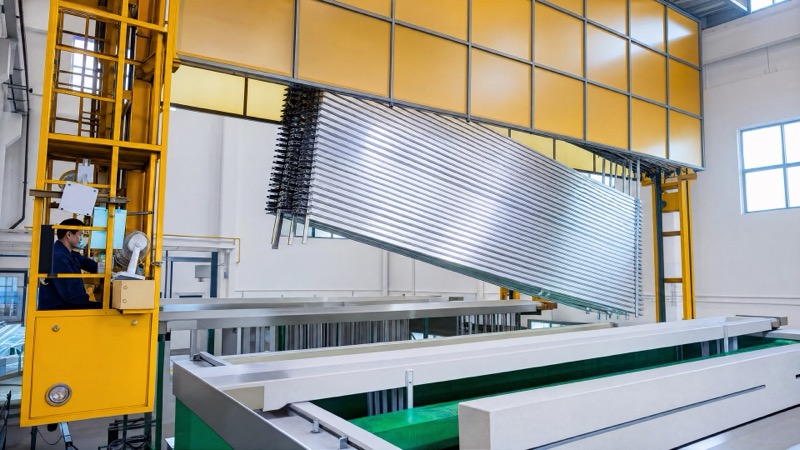
Anodizing is an electrochemical process that increases the thickness of aluminum's naturally occurring oxide layer. The aluminum component acts as the anode in an electrolyte bath.
The resulting layer forms from the substrate rather than sitting on it like paint. Conventional sulfuric acid anodizing creates a porous structure that can receive coloring treatments. Sealing then improves its protective properties.
Decorative anodizing is commonly selected for architectural profiles, furniture, trim, and visible industrial components.
Hard anodizing serves a different purpose. It produces a thicker oxide layer for applications where wear resistance is particularly important.
The Aluminum Anodizers Council lists these reference ranges:
- Type II sulfuric acid anodizing: approximately 1.8–25.4 micrometers.
- Type III hard anodizing: approximately 12.7–115 micrometers.
These ranges describe process categories, not universal purchasing requirements. Buyers must specify the thickness and performance needed for their particular component.
Anodizing does not automatically eliminate extrusion lines, scratches, or material inconsistencies. Surface preparation can modify appearance, but the transparent finish may still reveal substrate characteristics.
It also does not replace structural engineering. Alloy selection, temper, profile geometry, and fabrication remain responsible for the component's load-bearing performance.
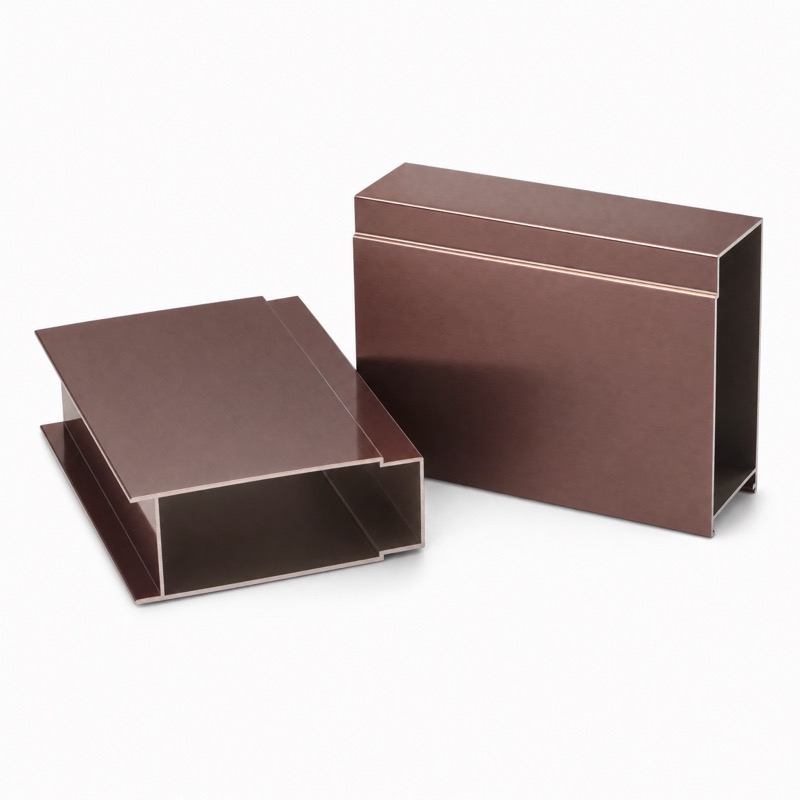
Powder coating applies dry coating particles to prepared aluminum, usually through electrostatic spraying. Heating melts and cures the powder into a continuous protective film.
A typical production sequence includes:
1. Cleaning and degreasing.
2. Surface pretreatment.
3. Rinsing and drying.
4. Powder application.
5. Curing.
6. Inspection.
Pretreatment and curing are essential. An attractive surface alone cannot prove that the coating will adhere properly or resist corrosion.
"Powder-coated aluminum" is not a complete technical description.
The Powder Coating Institute explains that epoxy and epoxy-containing hybrid coatings tend to chalk outdoors. They are generally unsuitable where long-term exterior appearance is important.
Polyester and acrylic formulations offer better ultraviolet stability. However, buyers should still request the specific product's performance classification rather than assume every polyester powder provides equivalent durability.
Anodizing is attractive when the design should retain aluminum's metallic character. Clear, bronze, black, and other finishes can create a refined appearance without completely hiding the substrate.
However, alloy composition and processing conditions influence color. Adjacent profiles should be assessed together, particularly on large façades.
Powder coating provides greater freedom for opaque colors, matte finishes, gloss levels, and textured surfaces. It often suits branded products, coordinated building systems, and decorative components.
My practical recommendation is to approve physical samples. Screen images and color codes cannot fully communicate texture, gloss, or acceptable batch variation.
Both finishes can protect aluminum, but neither should be described as corrosion-proof.
For anodizing, protection depends on suitable coating thickness, processing quality, and sealing.
For powder coating, protection depends on substrate preparation, pretreatment, film continuity, and correct curing. Damage that exposes the substrate can become a vulnerable location.
Coastal projects require particular care. Salt exposure, drainage, sheltered surfaces, and cleaning access all influence performance. Select a tested finishing system rather than relying on the process name.
Anodic oxide is hard, making anodizing attractive where surface abrasion matters. Hard anodizing is especially relevant to engineered wear applications.
Nevertheless, decorative anodizing and hard anodizing are not interchangeable.
Powder coating can provide useful resistance to handling damage and everyday contact. Its performance varies with formulation, thickness, and the type of loading.
Distinguish sliding wear from impact. A coating that performs well against abrasion may behave differently when struck, bent, or dented.
Anodizing can provide durable exterior service, but color stability depends on the coloring process. Buyers should specifically request exterior-suitable, lightfast finishes.
Powder coating is not inherently unsuitable for sunlight. Exterior-grade formulations are designed for outdoor exposure.
For architectural projects, AAMA 2603, 2604, and 2605 identify different organic-coating performance levels. AAMA 611 addresses anodized architectural aluminum.
Request evidence for the specified system. A standard appearing on a quotation is not, by itself, proof that the supplied product meets it.
Anodizing converts part of the aluminum surface into oxide while producing outward growth. Precision components therefore require a process-specific dimensional allowance.
Powder coating adds a film over the surface. This can affect mating features, channels, threads, and assembly clearances.
For either process, identify:
- Dimensions measured before and after finishing.
- Threads and bores requiring masking.
- Sliding or interference-fit surfaces.
- Electrical contact points.
- Acceptable rack or suspension marks.
These details matter especially for customized industrial profiles and machined assemblies.
Anodized surfaces benefit from regular washing with mild soap and thorough rinsing. Strong acids, strong alkalis, and aggressive abrasives can damage the finish.
Powder-coated surfaces should be cleaned according to the coating supplier's instructions.
Neither finish guarantees invisible repairs. Re-anodizing may be necessary for severely damaged anodized parts. Powder-coating touch-up can improve appearance, but color and gloss may differ, and repair performance may not equal the original coating.
There is no reliable rule that one process is always cheaper.
Costs depend on profile geometry, surface area, quantity, finish requirements, handling, masking, inspection, and packaging.
Compare quotations using identical requirements. A standard finish and a high-performance exterior system are not equivalent purchases.
For export projects, also consider replacement costs, transport damage, maintenance access, and the expense of correcting a finish after installation.
Anodizing reveals characteristics of the underlying aluminum. Alloy chemistry and material condition can influence color and visual uniformity.
For adjacent architectural components, specify:
- Consistent alloy and temper requirements.
- Approved samples or mock-ups.
- Defined viewing conditions.
- Acceptable color variation.
- Traceability between production batches.
For powder coating, substrate consistency still matters, although an opaque coating can conceal some visual differences.
Decide when cutting, drilling, machining, and finishing will occur.
Finishing after machining can treat more newly exposed surfaces. Machining after finishing may leave exposed cut edges or damage the surrounding finish.
Neither sequence is automatically wrong. The correct choice depends on assembly requirements and service conditions.
Ask the supplier to identify untreated surfaces and explain how rack locations, deep recesses, and difficult-to-access areas will be handled.
Anodic oxide and organic powder coatings are electrically insulating surfaces. This matters for grounding points, conductive connections, and assembled equipment.
For heat-transfer components, the effect of a finish depends on the full design, including contact resistance and operating conditions. Avoid selecting a finish solely because it is advertised as suitable for a heat sink.
Mark conductive interfaces and critical contact surfaces on drawings, then validate the finished assembly.
The following examples illustrate selection logic; they are not claimed customer projects.
Choose anodizing when a metallic appearance is central to the design. Choose powder coating when coordinated colors and textures are more important.
For either option, define environmental exposure, applicable standards, appearance acceptance, and maintenance requirements.
For frequently handled covers or colored machine frames, powder coating may provide the preferred appearance.
For wear-sensitive parts, consider an appropriately specified anodizing process. Review dimensional growth, masking, and the suitability of the complete component before approval.
Avoid specifying one finish for every part.
Visible housings, structural profiles, grounding interfaces, and moving components may need different treatments. Select according to each component's actual exposure and function.
1. Define the environment: indoor, outdoor, coastal, chemical, or high-wear.
2. Identify the alloy, temper, geometry, and fabrication sequence.
3. Set appearance requirements using physical samples.
4. Specify thickness, masking, performance standards, and inspection criteria.
5. Request relevant reports, process records, and batch identification.
6. Approve first articles before authorizing full production.
Accelerated corrosion tests are useful quality indicators, but their test hours do not translate directly into guaranteed service years.
Likewise, a material approval does not automatically establish the quality of every production batch.
Guangdong Dapeng Aluminum Industry Co., Ltd. provides industrial and architectural aluminum profiles alongside customized processing services.
To discuss an anodizing or powder-coating requirement, send your profile drawings, alloy and temper requirements, application, destination market, expected quantity, and preferred appearance.
Include any mandatory standards, masking requirements, and environmental exposure details. This creates a clearer basis for reviewing finish suitability, manufacturing requirements, and quotation scope.
Neither is universally better. Anodizing suits metallic appearance and certain wear applications. Powder coating suits broad color selection and decorative coverage. Performance depends on the specified system.
Both can work outdoors. Specify an exterior-suitable anodizing and coloring process or a suitably rated powder-coating system, with appropriate preparation and inspection.
Yes, suitably prepared anodized surfaces can serve as a coating substrate. However, the pretreatment process must be compatible with the powder system. Do not assume any existing anodized finish is ready for coating.
Not reliably. Because anodizing preserves metallic character, substrate imperfections may remain visible. Surface preparation and sample approval are important.
Localized touch-up is possible, but appearance and durability may differ from the original coating. Agree on a repair procedure and acceptance criteria before delivery.
Neither deserves an unconditional ranking. Powder formulation, energy use, anodizing chemistry, wastewater treatment, material utilization, and service life all influence the environmental assessment.
- [Aluminum Anodizers Council — Anodizing Reference Guide]. Technical basis for anodizing categories, thickness ranges, and alloy-dependent appearance. [anodizing]
- [Aluminum Anodizers Council — Specifying Anodized Finishes on Aluminum]. Guidance on transparent finishes, sealing, lightfast coloring, and purchase-document requirements. [anodizing]
- [Powder Coating Institute — Frequently Asked Questions]. Technical guidance on pretreatment, cure temperature and time, powder chemistry, and outdoor weatherability. [powdercoating]
- [QUALICOAT — Specifications]. Framework for architectural coating requirements covering equipment, coating materials, and finished products. [qualicoat]
- [FGIA — Coatings and Finishes]. Publisher's catalogue of architectural aluminum coating and anodizing specifications. [store.fgiaonline]
- [Aluminum Anodizers Council — Anodized Aluminum FAQ]. Guidance on cleaning, chemical damage, sealing compatibility, and anodized substrates for subsequent painting. [anodizing]
- [FONNOV Aluminium — Anodizing Vs. Powder Coating]. Supplied comparison page used as the topic benchmark, not as the primary authority for technical claims. [fonnovaluminium]


