


Views: 231 Author: Dapeng Aluminum Publish Time: 2026-11-20 Origin: Site


Content Menu
● Aluminum vs. Steel Melting Point Chart by Grade
● Why Aluminum and Steel Alloys Melt Over a Range
>> Solidus and liquidus: Which number should you compare?
>> Why pure iron is not a proxy for carbon or stainless steel
● What the Melting Point Means for Extrusion, Casting, and Welding
>> Aluminum extrusion shapes a solid billet
>> Casting uses liquid metal; extrusion makes a different shape
>> Welding can weaken aluminum that never melts
● Three Engineering Checks a Melting Point Chart Cannot Replace
>> 1. Specify the part temperature, duration, and load
>> 2. Check whether the joint or finish fails first
>> 3. Separate normal operation from fire exposure
● How to Choose Between Aluminum and Steel for a Custom Profile
>> Request a custom aluminum extrusion review
>> 1. What is the melting point of aluminum in Celsius and Fahrenheit?
>> 2. What is the difference between the melting ranges of 6061 and 6063 aluminum?
>> 3. What is the melting point of mild steel?
>> 4. Does 316 stainless steel melt at a higher temperature than 304?
>> 5. Is aluminum melted during hot extrusion?
>> 6. Can I use the melting point to set a maximum service temperature?
Pure aluminum melts at about 660°C (1,221°F), while 304 stainless steel melts over a range of about 1,400–1,450°C (2,552–2,642°F). But if you're comparing materials for a machine frame, architectural profile, or battery enclosure, neither number tells you how hot the finished part can safely get. A part can lose strength, distort, or fail at a joint long before the metal starts to melt.
The aluminum vs. steel melting point comparison is most useful when you separate three questions: When does the alloy melt? How does fabrication change its properties? And what temperature can the finished assembly tolerate under load? This guide answers all three from the perspective of an aluminum extrusion manufacturer.
| Material | Melting point or range, °C | Melting point or range, °F | How to use the value |
|---|---|---|---|
| Pure aluminum | 660.3 | 1,220.6 | Elemental reference; not the melting point of every aluminum alloy |
| 6061 aluminum | ≈582–652 | 1,080–1,206 | Grade reference for a common structural extrusion alloy |
| 6063 aluminum | ≈616–654 | 1,140–1,210 | Grade reference for an alloy used in architectural and industrial profiles |
| Mild steel | ≈1,500 | ≈2,730 | Rough comparison only; verify the specific carbon steel grade |
| 304 stainless steel | 1,400–1,450 | 2,552–2,642 | Grade-specific melting range for a common stainless steel |
| 316 stainless steel | 1,375–1,400 | 2,507–2,552 | A different stainless grade with a lower published melting range |
| Pure iron | 1,538 | ≈2,800 | Elemental reference; not a substitute for steel-grade data |
The 6061 and 6063 Celsius ranges are rounded conversions from published Fahrenheit data. The values are for comparison, not for setting furnace temperatures, qualifying welds, or establishing service limits. For a like-for-like comparison, look at when melting begins in each alloy: 304 stainless steel starts melting about 784°C higher than 6063 aluminum.
Pure metals have a characteristic melting point at a given pressure. Most engineering alloys instead pass through a temperature interval in which solid and liquid coexist. The solidus is the temperature at which the first liquid appears during heating. The liquidus is the temperature at which the alloy becomes fully liquid.
That distinction changes how you read a datasheet. At approximately 600°C, 6061 is within its published melting interval, while 6063 is still below its published solidus. Yet that does not make a load-bearing 6063 profile suitable for operation at 600°C. "Still solid" describes the metal's physical state, not the capacity of the part.
Steel is an iron-based alloy. Carbon changes its melting behavior, and alloying elements such as chromium, nickel, and molybdenum help distinguish one stainless grade from another. The difference between 304 and 316 in the chart illustrates why "stainless steel" is not a precise enough specification for a thermal comparison.
The same principle applies to aluminum. The 6061 and 6063 ranges overlap, but 6061 begins melting at a lower temperature in the published data. That does not make 6063 the stronger alloy. Melting range and mechanical properties answer different questions, so compare them separately.
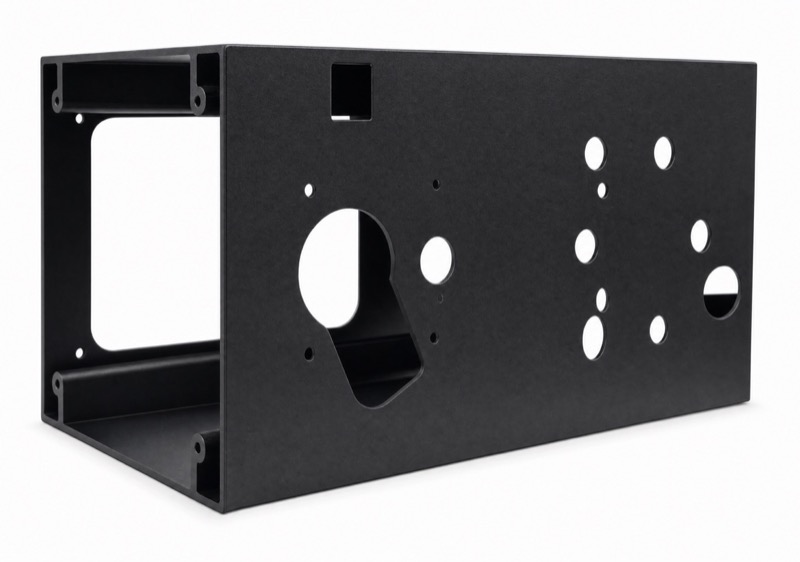
Hot extrusion does not require molten aluminum. A heated, softened billet is pressed through a die while remaining solid. The die forms a continuous cross-section that can incorporate channels, ribs, screw bosses, or hollow chambers. Those features can turn several separate pieces into one profile and reduce subsequent assembly work.
For procurement, the useful question is not "How close does the billet get to melting?" It is "Can this cross-section meet our tolerances and mechanical requirements after extrusion and finishing?" Mark critical dimensions on the drawing, particularly where a profile meets a seal, fastener, panel, or precision mounting surface. Then specify whether those dimensions apply before or after coating.
Casting takes advantage of liquid metal's ability to fill a mold. Extrusion is generally the more natural starting point when the part has a consistent cross-section along its length. For example, a long equipment rail with integrated mounting slots is a candidate for extrusion. A compact housing with features that change substantially in three dimensions may be a better candidate for casting or another process.
Compare the cost of the finished part rather than the price per kilogram. Tooling, machining, finishing, inspection, and assembly can change the economics. If a redesigned extrusion eliminates a bracket and two fastening operations, that saving belongs in the material comparison.
In fusion welding, metal melts locally to form the joint. The surrounding material can stay solid yet undergo changes that reduce its strength. This surrounding region is called the heat-affected zone, or HAZ. It matters in heat-treatable alloys such as 6061 and 6063 because welding heat can change the microstructure that gives the original temper its strength.
If a drawing calls for 6061-T6, do not assume the welded assembly retains the published T6 strength everywhere. Flag load-bearing welds early, check the design properties applicable to the joint, and assess whether an alternate joint location or mechanical connection would work better. Steel welds also require grade-specific review; a higher melting point does not guarantee an acceptable joint.
Consider a machine guard installed near a heater. A note that says "maximum temperature: 180°C" is incomplete. Does it refer to the surrounding air, the heater surface, or the hottest point on the guard? Is it a brief maintenance condition or a temperature the guard reaches every shift? Does a latch still need to operate during exposure?
For a useful specification, identify the heat source, estimate or measure the peak part temperature, and state how long the exposure lasts. Include any load the part must support and whether it must meet functional or dimensional requirements afterward. If the hottest location is unknown, that uncertainty is more important to resolve than the difference between two handbook melting points.
Imagine a long aluminum cover attached to a steel frame on a machine that heats and cools repeatedly. The cover and frame expand by different amounts. If both ends are rigidly constrained, temperature cycling can cause distortion or stress at the fasteners, even though neither metal is close to melting. A joint that permits controlled movement may be worth evaluating, provided it still meets the load and alignment requirements.
Now check the other materials in the assembly. A gasket may stop sealing, an adhesive may lose strength, or a coating may no longer meet its appearance requirements. Define failure in functional terms—such as leakage, binding, permanent deformation, or loss of alignment—so the validation test measures what the product actually needs to do.
A profile that performs well during routine operation is not automatically suitable as part of a fire-rated assembly. Aluminum alloys can lose load-bearing capacity below their melting range, and steel can also lose strength and stiffness long before it melts. Section geometry, connections, protection, and the way heat reaches the assembly all matter.
For a façade, partition, or load-bearing system with a fire requirement, request evidence that applies to the proposed configuration and the project's jurisdiction. Do not infer a fire-resistance rating from a bare-metal property or from a result for a different assembly. The relevant question is how long the specified system performs its required function under the applicable fire exposure.
Start with aluminum when lower mass and an integrated cross-section are priorities. For example, a machine enclosure rail can incorporate panel grooves and fastening features in one profile. Consider 6063 when extrudability and surface finish are central to the design. Consider 6061 when the profile must meet more demanding mechanical requirements, then check the exact temper, section, and joint design before committing.
Evaluate steel when the available envelope is small and stiffness is critical, or when elevated-temperature performance drives the design. Avoid treating an aluminum profile as a drop-in replacement for a steel section with identical dimensions. Instead, compare sections designed for the same load, span, mounting arrangement, and allowable deflection. A deeper or differently ribbed aluminum section may be a more useful comparison than an identical copy.
For a quotation that supports an engineering decision, send:
1. A dimensioned drawing or STEP file, with critical interfaces and tolerances identified.
2. The required alloy and temper, or permission to propose alternatives.
3. Normal and peak part temperatures, exposure duration, and expected loads.
4. The joining method, surface finish, and any sealing or fire-performance requirements.
5. Prototype and production quantities, along with the inspection documents you need.
Send your drawing and operating conditions to Guangdong Dapeng Aluminum Industry Co., Ltd. for a review of profile geometry, alloy and temper, machining requirements, and finish options. If you are replacing an existing steel part, include its drawing and the reason for the change—weight, assembly time, corrosion, or another constraint—so the comparison addresses the outcome you need.
Pure aluminum melts at approximately 660.3°C (1,220.6°F). Commercial alloys have their own melting ranges. Use the exact alloy designation when checking an extrusion, casting, or fabricated component.
6061 melts at approximately 582–652°C (1,080–1,206°F), while 6063 melts at approximately 616–654°C (1,140–1,210°F). The most notable difference is where melting begins. Their upper endpoints are much closer together.
About 1,500°C (2,730°F) is a useful rough reference, not a universal value. Mild steel describes a family of low-carbon steels. For an engineering decision, identify the grade and verify its melting range rather than using the melting point of pure iron.
No. The published range for 316 is approximately 1,375–1,400°C, compared with 1,400–1,450°C for 304. That difference does not determine which grade is better for corrosion resistance or high-temperature service.
No. The billet is heated to soften it, then forced through a die while solid. It is different from casting, in which the metal is melted and introduced into a mold.
No. Use grade-specific elevated-temperature properties and evaluate the complete assembly. Load, exposure time, thermal cycling, welds, fasteners, and finishes can limit performance well below the melting range.
- Royal Society of Chemistry, *Aluminium* and *Iron*, Periodic Table — elemental melting points and the distinction between pure-metal reference values and alloy data. [periodic-table.rsc]
- Hydro, *Alloy 6061* and *Alloy 6063* technical datasheets — published melting ranges, temper information, and fabrication considerations for extrusion alloys. [hydro]
- British Stainless Steel Association, *Melting Temperature Range for Stainless Steels* — grade-specific ranges for 304 and 316 and the distinction between melting behavior and service temperature. [bssa.org]
- *Aluminium Design and Construction* — approximate mild-steel comparison, aluminum alloy selection, and weld-region softening. [uceb]
- Hydro, *Custom Aluminum Extrusions in Michigan* and *North America Extrusion Technical Specifications* — solid-billet extrusion, die forming, and process controls affecting finished properties. [hydro]
- *Strength of MIG Welded Connections in Fire Exposed Aluminium Structures*, *Advanced Steel Construction* — experimental findings on welded and unwelded aluminum at elevated temperature. [ascjournal]
- European Aluminium, *Aluminium and Fire Safety* — distinction between material behavior and structural performance under fire exposure. [european-aluminium]


