


Views: 258 Author: Dapeng Aluminum Publish Time: 2026-10-08 Origin: Site


Content Menu
● 6061 vs. 6063 Aluminum Extrusions: The Practical Verdict
● Understanding 6061 and 6063: Alloy Chemistry and Temper
>> Why Both Alloys Belong to the 6000 Series
>> Why T5 and T6 Must Not Be Confused
● 6061-T6 vs. 6063-T6 Mechanical Properties
>> Yield Strength: Where 6061 Has the Advantage
>> Stiffness: Why Changing the Alloy May Not Reduce Sag
● An Illustrative Frame Calculation: Strength vs. Deflection
● Profile Geometry and Connections Can Determine the Winner
>> Section Orientation and Buckling
>> T-Slot Connections and Local Load Transfer
● Extrudability, Machining, and Surface Finish
>> Why 6063 Is Attractive for Custom Industrial Profiles
>> When 6061 Makes Sense for Machined Features
>> Anodizing and Cosmetic Requirements
● Welding, Corrosion, and Repeated Loading
>> Welded Frames Need Different Strength Assumptions
>> Corrosion Protection Includes the Joint Details
>> Fatigue Requires More Than a Tensile-Strength Comparison
● Total Cost: Compare Finished Frames, Not Aluminum Prices Alone
● A Practical Selection and Procurement Workflow
>> Step 1: Define the Operating Loads
>> Step 2: Identify the Governing Limit
>> Step 3: Compare Real Sections
>> Step 4: Review Manufacturing and Finish
>> Step 5: Establish Acceptance Requirements
>> Step 6: Validate the Assembly
● Discuss Your Industrial Frame With Guangdong Dapeng Aluminum
>> Is 6061 Aluminum Always Better for Load-Bearing Frames?
>> Can 6063-T6 Aluminum Support Heavy Loads?
>> Will 6061 Reduce Deflection Compared With 6063?
>> Should I Specify 6063-T5 or 6063-T6?
>> Which Alloy Is Better for Anodized T-Slot Frames?
>> Can I Use Unwelded T6 Strength Values After Welding?
Choosing between 6061 vs. 6063 aluminum extrusions for load-bearing industrial frames starts with one distinction: strength is not the same as stiffness. 6061-T6 generally offers higher resistance to permanent deformation. However, 6063-T6 can be an effective choice when profile geometry, dimensional accuracy, surface finish, and manufacturing efficiency matter more than maximum material strength.
My selection principle is straightforward: identify the frame's governing limitation before choosing its alloy. A heavy machine base, precision workstation, and conveyor enclosure may all use aluminum extrusions, but their performance requirements differ considerably.
For Guangdong Dapeng Aluminum Industry Co., Ltd., this comparison connects material selection with custom profile development, production, and downstream processing. The goal is performance at the assembly level—not simply a stronger number on a material datasheet.
Choose 6061-T6 as the starting point when high local stresses, heavily loaded brackets, or limited section dimensions make yield strength important.
Consider 6063-T6 when the design benefits from complex extrusion geometry, attractive anodized surfaces, or an established modular profile system—and calculations confirm adequate capacity.
Neither alloy automatically produces a better frame. A well-designed 6063 section can outperform a poorly configured 6061 section in deflection or stability.
| Selection factor | 6061-T6 | 6063-T6 |
|---|---|---|
| Resistance to yielding | Generally higher | Lower, but sufficient for many engineered frames |
| Elastic stiffness at identical geometry | Similar | Similar |
| Complex profile extrusion | Feasible; requires manufacturing review | Particularly favorable |
| Decorative anodizing | Less favorable for demanding cosmetic applications | Generally preferred |
| Welding | Weldable; account for local strength reduction | Weldable; account for local strength reduction |
| Best starting point | Strength-critical members and components | Geometry-driven, modular, and visible profiles |
This is a selection guide, not a load-rating table. Final capacity depends on the section, temper, connections, support conditions, and applicable design rules.
6061 and 6063 contain magnesium and silicon. These elements enable precipitation hardening: controlled heat treatment develops a microstructure that increases strength.
6061 also includes specified additions of copper and chromium. Its composition supports a useful combination of structural strength, corrosion resistance, and fabrication capability.
6063 is particularly valued for extrudability and surface quality. This makes it suitable for profiles with multiple channels, thin features, and visible surfaces.
An alloy designation alone does not define its mechanical properties.
- T5 means cooled from an elevated-temperature shaping process and artificially aged.
- T6 means solution heat-treated and artificially aged.
Consequently, "6063 aluminum" is an incomplete specification for a load-bearing frame. Buyers should identify the alloy, temper, product standard, and relevant wall thickness.
Comparing 6061-T6 with 6063-T5 can exaggerate the apparent difference between the alloys because it changes both chemistry and heat-treatment condition.
The following values illustrate published minimum properties for extruded products. They come from different supplier specification frameworks and are not universal guarantees or directly interchangeable design allowables.
| Property | 6061-T6 extruded profiles | 6063-T6 extrusions |
|---|---|---|
| Minimum yield strength in the referenced tables | 240 MPa | 170 MPa |
| Minimum ultimate tensile strength | 260 MPa | 205 MPa |
| Thickness coverage used here | Up to 25 mm | Up to 25 mm |
| Approximate elastic modulus | About 69–70 GPa | About 69 GPa |
| Approximate density | 2.70 g/cm³ | 2.70 g/cm³ |
The 6061 values reflect an EN-based material datasheet. The 6063 values reflect an extrusion supplier's published property limits.
Before approving production, verify the contractual standard and its current requirements. Do not substitute typical handbook values for guaranteed minimum properties.
Yield strength indicates resistance to permanent deformation.
6061-T6 is therefore attractive where a frame has highly stressed mounting points, compact support brackets, or restricted space for larger sections.
However, higher yield strength does not eliminate other failure modes. A member may buckle, a connection may slip, or a thin slot wall may deform before the main section reaches its nominal yield strength.
Both alloys have very similar elastic moduli. With the same geometry and loading, their elastic deflection will therefore be similar.
For a simply supported beam carrying a central point load:
δ=PL³/48EI
Here, P is load, L is span, E is elastic modulus, and I is the second moment of area.
For deflection-limited frames, increasing section depth, improving orientation, or shortening the unsupported span usually provides more benefit than changing alloy alone.
Consider an idealized, unwelded rectangular hollow member:
- Outside dimensions: 80 mm high × 40 mm wide.
- Uniform wall thickness: 4 mm.
- Simply supported span: 1,000 mm.
- Central static load: 2,000 N.
- Assumed elastic modulus: 69,000 MPa for either alloy.
With the 80 mm dimension vertical, the calculated second moment of area is approximately 711,339 mm⁴.
Elementary beam theory gives:
| Calculated result | Value |
|---|---|
| Maximum bending moment | 500,000 N·mm |
| Maximum nominal bending stress | 28.1 MPa |
| Midspan deflection | 0.68 mm |
Changing this unchanged section from 6063-T6 to 6061-T6 would increase its margin against yielding, but would barely change its calculated deflection.
If the application requires less than 0.5 mm of movement, the designer should investigate geometry or support changes.
This example is an analytical illustration—not a tested product rating. It excludes corner radii, connection flexibility, local buckling, dynamic loads, manufacturing tolerances, and code-based safety provisions.
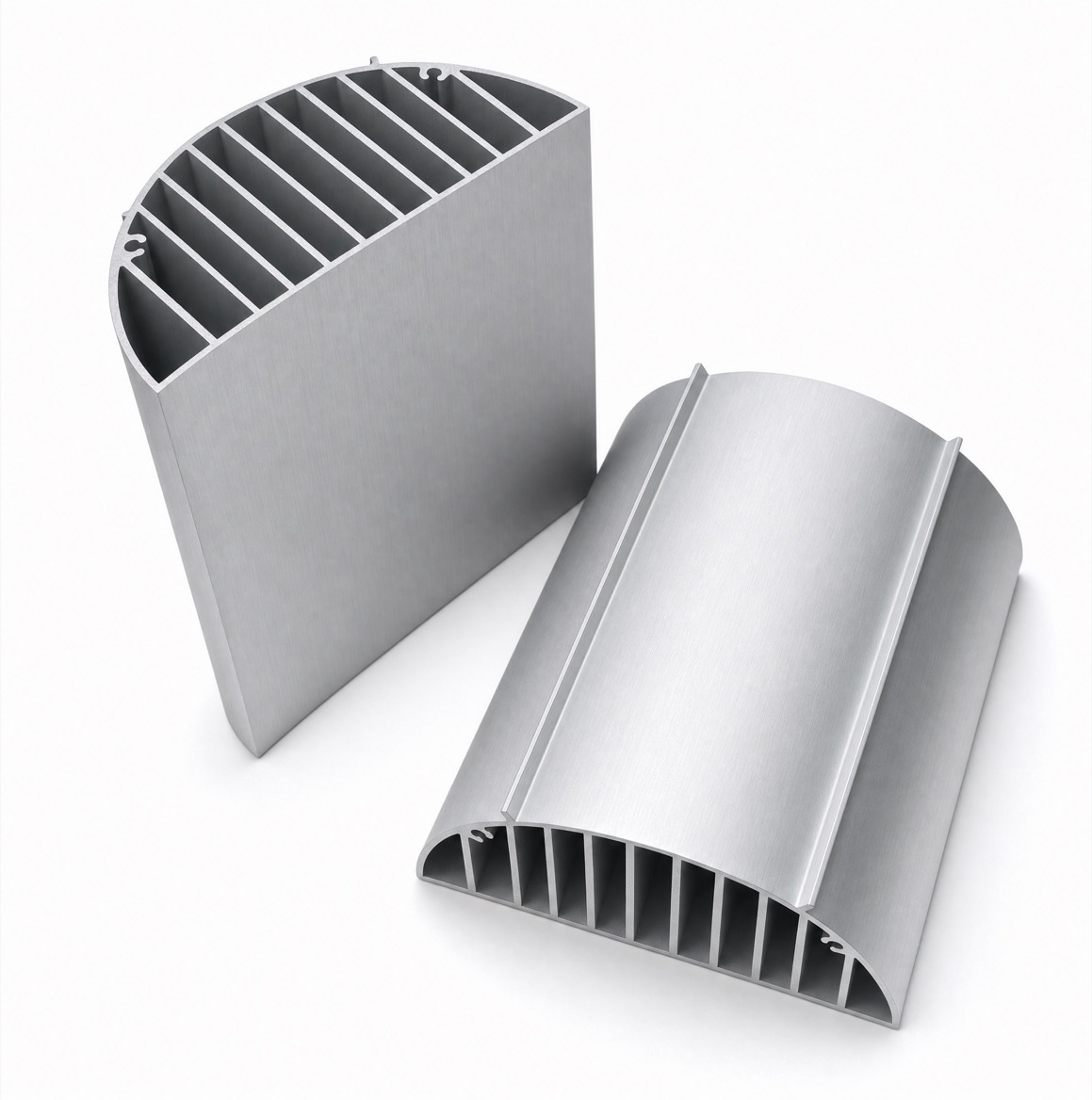
Material placed farther from the bending axis contributes more to bending stiffness. This explains why a deeper profile can be effective without a proportional increase in weight.
Compression members require additional checks. Long, slender columns may experience global buckling, while thin walls can buckle locally.
The useful question is not simply, "Which alloy is stronger?" It is, "Which alloy and section combination satisfies the governing limit?"
For modular industrial frames, examine the connections as carefully as the members.
Potential limitations include:
- T-nut pull-out.
- Slot-lip bending.
- Bracket rotation.
- Fastener slip.
- Bearing deformation around holes.
- Baseplate and anchor flexibility.
A published profile load chart may assume support and connection conditions unlike the actual installation. Verify those assumptions before applying its rating.
A hybrid design can also be practical: use an established 6063 profile system with separately engineered 6061 brackets or machined mounting components.
6063 combines good extrudability with high-quality surfaces. It is useful for integrated channels, enclosure interfaces, cable-management features, and visually exposed framing.
These features can reduce the need for separate components.
Nevertheless, every custom profile needs manufacturing review. Wall transitions, unsupported die features, enclosed cavities, and required tolerances affect feasibility.
Avoid assuming that any shape shown in a drawing can be extruded consistently.
6061-T6 is a useful candidate for components combining extrusion with substantial machining and structural loading.
Examples include mounting blocks, support members, and fixture components.
Machining accuracy still depends on stock condition, residual stresses, workholding, and the amount of material removed. The alloy designation alone does not guarantee flatness after machining.
6063 is generally preferred when decorative anodizing and consistent visible surfaces are priorities.
6061 can also be anodized, but should not be assumed to match 6063 cosmetically.
For appearance-critical assemblies, agree on sample panels, acceptable color variation, surface defects, and packaging requirements before bulk production.
Both alloys are weldable. However, welding can reduce strength in the heat-affected zone because the thermal cycle changes the precipitation-hardened condition.
Do not apply unwelded T6 properties throughout a welded assembly.
Review weld location, joint configuration, filler selection, heat input, distortion, and the applicable welded design provisions. Post-weld heat treatment is not an automatic or simple remedy for a finished frame.
Both alloys provide useful general corrosion resistance, but neither is immune to every environment.
Dissimilar-metal contact can create galvanic corrosion when an electrolyte is present. Outdoor installations, washdown equipment, and coastal applications deserve particular attention.
Consider drainage, water-trapping crevices, coating damage, compatible fasteners, and suitable electrical isolation.
For moving equipment, vibration, or repeated loading, evaluate stress ranges and connection details.
A higher yield strength does not establish a universal fatigue advantage. Holes, weld toes, abrupt section changes, and loose joints can govern service life.
Fatigue-critical or safety-critical frames require application-specific engineering review.
There is no reliable universal percentage price difference between 6061 and 6063 extrusions.
Actual quotations depend on profile complexity, tooling, order quantity, temper, tolerances, finishing, machining, and delivery requirements.
Compare:
1. Extrusion and tooling costs.
2. Material usage and cutting yield.
3. Machining and assembly time.
4. Inspection and finishing.
5. Packaging and freight.
6. Maintenance and replacement implications.
A more expensive profile may lower assembly cost by integrating useful features. Conversely, specifying higher strength where deflection governs may add cost without solving the problem.
Document static loads, acceleration, vibration, maintenance loads, and foreseeable abnormal conditions.
Specify allowable deflection separately from strength requirements.
Check yielding, deflection, global and local buckling, connection capacity, and fatigue where relevant.
Request section drawings, area, mass per meter, second moments of area, and section moduli about both principal axes.
Confirm extrusion feasibility, machining allowances, critical tolerances, anodizing expectations, and assembly interfaces.
The purchase specification should identify:
- Alloy and temper.
- Applicable product standard.
- Required mechanical-property documentation.
- Drawing revision and dimensional tolerances.
- Surface-treatment requirements.
- Traceability and inspection expectations.
Straightness, twist, cut length, and slot dimensions can directly affect assembly quality.
Where appropriate, use prototype measurements, connection tests, and representative load testing to check the design assumptions.
Testing complements engineering analysis; it does not replace required safety checks.
Guangdong Dapeng Aluminum Industry Co., Ltd. focuses on aluminum profile development, manufacturing, export, and customized downstream processing.
Send your profile drawing, intended loads, unsupported spans, connection method, finish requirements, annual quantity, and destination-market specifications.
Request a comparison of feasible 6061 and 6063 options, including temper, section geometry, tolerances, processing, and inspection requirements. Structural acceptance should remain with the responsible qualified engineer.
No. It generally offers higher yield strength, but geometry, deflection, buckling, and connections may govern the frame. A validated 6063 design can be entirely appropriate.
Yes, when the selected section and complete assembly provide adequate capacity. "Heavy" alone is insufficient: span, load direction, supports, and connection details must also be defined.
Not significantly at identical geometry and loading. Their elastic moduli are similar. Increasing section stiffness or reducing span is usually more effective.
Specify the temper that meets the verified mechanical and manufacturing requirements. Do not treat T5 and T6 as interchangeable or approve substitutions without review.
6063 is generally favored for complex extrusions and decorative anodizing. Nevertheless, confirm the specific profile system's structural properties and connection ratings.
Not throughout the welded assembly. Evaluate the heat-affected zone and use appropriate welded design properties and qualified fabrication procedures.
1. thyssenkrupp Materials Services. *Material Data Sheet: EN AW-6061*, June 2018. Extruded-profile minimum properties, chemistry, physical properties, and processing guidance. [ucpcdn.thyssenkrupp]
2. Hydro. *Alloy 6063*, revised June 2026. Extruded mechanical-property limits, temper definitions, anodizing response, corrosion considerations, and manufacturing characteristics. [hydro]
3. ESAB University. *The HAZ in Aluminum Welds*. Explanation of precipitation hardening and welding-related changes in local material strength. [esab]
4. The Aluminum Association. *Industry Standards*. Alloy designation, heat-treatment principles, and standards resources. [aluminum]
5. Aluminum Extruders Council. *Aluminum Extrusion Tolerances*. Guidance on industry tolerance references and dimensional measurement. [aec]
6. STRUCTURE magazine. *The 2020 Aluminum Design Manual*. Overview of aluminum structural design provisions and supporting design resources. [structuremag]


