


Views: 288 Author: Dapeng Aluminum Publish Time: 2026-10-22 Origin: Site


Content Menu
● 6061 vs. 7075 Aluminum: Which Should You Choose?
● 6061-T6 vs. 7075-T6 Aluminum Properties
>> How Alloy Composition Creates the Difference
● Strength vs. Stiffness in Robotic Arm Components
>> Why Stronger Aluminum Does Not Eliminate Deflection
>> When Profile Geometry Delivers More Value
● An Illustrative Robotic Arm Bending Comparison
● Fatigue Resistance Under Repeated Robotic Motion
>> Inspect the Details That Initiate Cracks
● Corrosion, Surface Protection, and Temper Selection
>> Why 6061 Often Suits Exposed Structures
>> When to Consider 7075-T73 or T7351
● Manufacturing 6061 and 7075 Robotic Arm Parts
>> Extrusion and Profile Design
>> CNC Machining and Dimensional Stability
>> Welding and Mechanical Assembly
● Cost Comparison: Evaluate the Finished Component
● A Practical Material Selection and Validation Workflow
>> 1. Define the Complete Load Envelope
>> 2. Identify the Governing Requirement
>> 3. Compare Manufacturable Alternatives
>> 4. Specify Material and Inspection Requirements
● Conclusion: Match the Alloy to the Limiting Requirement
● FAQ
>> 1. Is 7075 Aluminum Always Better for High-Stress Robotic Arms?
>> 2. Will Replacing 6061 With 7075 Improve Positioning Accuracy?
>> 3. Can 6061-T6 Be Used for Load-Bearing Robotic Components?
>> 4. Can 7075 Robotic Arm Components Be Welded?
>> 5. Does 7075 Aluminum Reduce Robotic Arm Weight?
>> 6. What Should Buyers Include in a Material Request?
Choosing between 6061 vs. 7075 aluminum for high-stress robotic arm components requires more than comparing strength figures. A robotic arm must support payloads, survive repeated acceleration, maintain positioning accuracy, and remain economical to manufacture. The right alloy depends on which requirement actually limits the design.
My starting point is stiffness: will the component bend too much before it approaches its strength limit? If so, changing from 6061 to 7075 may deliver less improvement than expected. If permanent deformation is the main concern and space is restricted, 7075 becomes much more compelling.
For manufacturers such as Guangdong Dapeng Aluminum Industry Co., Ltd., this comparison connects material selection with extrusion design, precision machining, surface protection, and export procurement.
Choose 6061-T6 when your robotic arm design prioritizes corrosion resistance, weldability, practical profile geometry, and controlled production costs.
Choose 7075-T6 when a compact, non-welded component needs substantially higher resistance to yielding. Consider 7075-T73 or T7351 when stress-corrosion resistance deserves greater priority than maximum strength.
Neither alloy is automatically the best material for an entire robot. A practical design may combine a 6061 structural link with a separately machined 7075 joint bracket.
The important distinction is between:
- Strength-limited parts, which risk permanent deformation.
- Stiffness-limited parts, which deflect excessively under working loads.
- Fatigue-limited parts, which accumulate damage through repeated motion.
Each problem requires a different engineering response.
The following values are representative room-temperature properties for preliminary comparison. They are not guaranteed purchasing minimums or approved design allowables.
Actual properties depend on product form, thickness, temper, grain direction, and the applicable material specification.
| Property | 6061-T6 aluminum | 7075-T6 aluminum | Robotic arm significance |
|---|---|---|---|
| Typical tensile strength | 310 MPa | 572 MPa | Resistance to tensile failure |
| Typical yield strength | 276 MPa | 503 MPa | Resistance to permanent deformation |
| Elastic modulus | 68.9 GPa | Approximately 71 GPa | Elastic bending resistance |
| Density | 2.70 g/cm³ | Approximately 2.80 g/cm³ | Mass at equal volume |
| Brinell hardness | Approximately 95 HB | Approximately 150 HB | Local indentation resistance |
| Thermal conductivity | Approximately 167 W/m·K | Approximately 130 W/m·K | Heat spreading around motors |
| General corrosion resistance | Usually better | More protection-sensitive | Environmental durability |
| Conventional fusion welding | Generally suitable with engineering controls | Generally unsuitable | Assembly options |
These figures explain the central trade-off: 7075 offers substantially higher strength, but its elastic modulus remains close to that of 6061.
6061 is an aluminum-magnesium-silicon alloy. It offers a useful balance of structural performance, corrosion resistance, and manufacturing flexibility.
7075 uses a zinc-magnesium-copper alloying system. Its composition and heat treatment produce much higher strength, but introduce greater concerns around welding and stress-corrosion cracking.
The temper designation therefore matters as much as the alloy number. "7075 aluminum" alone is not a complete engineering specification.
Strength determines how much stress a component can withstand before yielding or failing. Stiffness determines how much it elastically deforms under load.
For an ideal cantilever beam carrying a tip load:
δ=FL3/3EI
Here, F is force, L is unsupported length, E is elastic modulus, and I is the section's second moment of area.
Because the alloys have similar elastic moduli, an identical 7075 component bends only slightly less than its 6061 equivalent under the same elastic load.
Switching alloys does not automatically resolve positioning error, vibration, or long settling times.
For a long robotic arm link, I would examine the cross-section before recommending a stronger alloy.
Potential improvements include:
- Increasing section depth in the main bending direction.
- Using a closed section for improved torsional resistance.
- Adding ribs around concentrated load paths.
- Reducing unsupported length where possible.
- Improving joint and bearing support.
A well-designed 6061 profile can be more effective than a poorly proportioned 7075 part. However, every geometry change must also respect mass, clearance, local buckling, and manufacturing constraints.
Consider a simplified solid rectangular link:
- Unsupported length: 300 mm.
- Width: 30 mm.
- Bending depth: 20 mm.
- Static tip load: 200 N.
- Ideal rigid support.
Its second moment of area is 20,000 mm⁴. Elementary beam theory gives a maximum nominal bending stress of approximately 30 MPa.
Using the representative elastic moduli above, estimated tip deflection is:
| Material | Approximate tip deflection |
|---|---|
| 6061-T6 | 1.31 mm |
| 7075-T6 | 1.27 mm |
This is an illustrative calculation, not a customer case study or a validated robot design.
Both nominal stresses are well below the listed typical yield strengths, yet either deflection could exceed the application's positioning allowance. In this situation, the primary problem is geometry rather than material strength.
A real analysis must additionally include component self-weight, acceleration, torsion, joint compliance, stress concentrations, and emergency-stop loading.
Robotic arms experience repeated starts, reversals, payload changes, and braking events. A component that passes a static stress check can still develop fatigue cracks.
7075 commonly offers higher smooth-specimen fatigue strength than 6061. However, laboratory fatigue figures cannot be treated as guaranteed component life.
For example, Kaiser reports approximately 158 MPa for 7075-T6/T651 under a specified reversed-stress test at 500 million cycles. That figure is not a universal allowable stress for a machined robotic bracket.
Finished-part fatigue performance also depends on:
- Stress range and mean stress.
- Hole geometry and corner radii.
- Machining marks and surface treatment.
- Material orientation and residual stress.
- Corrosion and actual duty cycles.
Bolt holes, thread roots, pocket corners, and abrupt thickness transitions deserve particular attention.
My recommendation is to review these features before simply upgrading the alloy. Larger fillets, improved load distribution, and better surface control can address local weaknesses that higher bulk strength alone cannot eliminate.
Critical components should undergo fatigue assessment using representative loading and suitable material data, followed by testing appropriate to their consequences of failure.
6061 generally provides better corrosion resistance and lower stress-corrosion susceptibility than 7075-T6.
That makes it attractive for exposed links, support structures, and equipment operating around humidity or occasional cleaning fluids.
It is not immune to corrosion. Crevices, trapped moisture, aggressive chemicals, and contact with dissimilar metals still require attention.
Stress-corrosion cracking involves a susceptible material, sustained tensile stress, and a damaging environment.
Kaiser identifies improved stress-corrosion resistance for 7075-T73 and T7351 compared with T6 and T651. Its typical rod-and-bar data lists approximately 434 MPa yield strength for T73/T7351, versus 503 MPa for T6/T651.
This illustrates a deliberate trade: lower peak strength for improved resistance to a specific failure mechanism.
Anodizing or other protective finishes can help manage exposure, but they do not replace appropriate temper selection. Specify coating thickness, sealing, masking, and fit requirements rather than requesting only an "anodized finish."
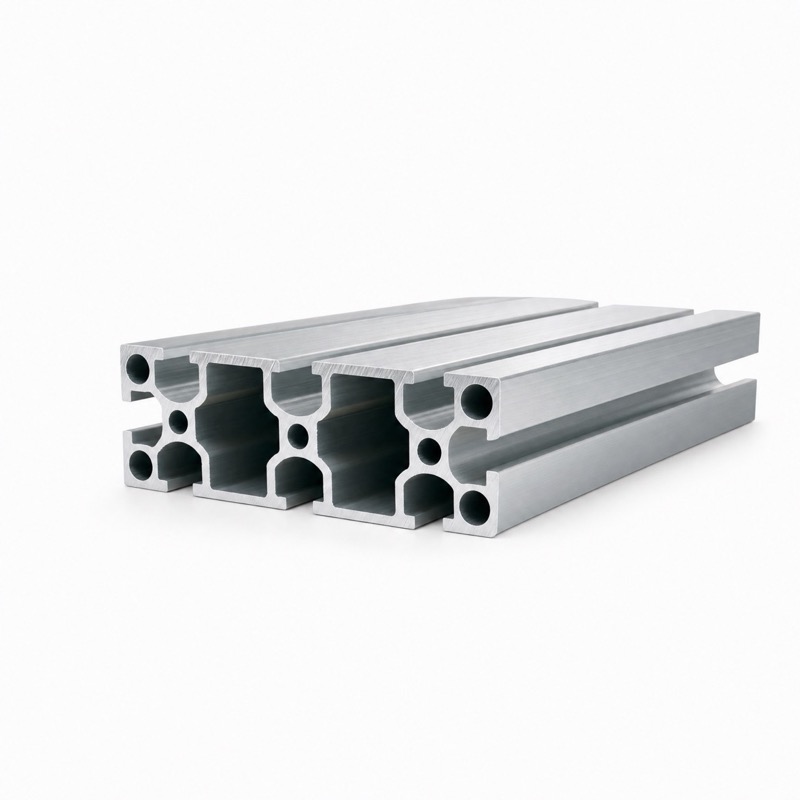
6061 is a practical starting point for many structural profiles, including links that incorporate mounting features or cable-routing space.
7075 can also be extruded. However, a profile that is feasible in 6061 should not automatically be assumed equally practical or economical in 7075.
Confirm alloy-specific tooling requirements, dimensional capability, available sizes, heat treatment, and production quantities before freezing the design.
Both alloys can be machined into accurate robotic components. Machining performance depends on tooling, workholding, stock condition, and geometry—not hardness alone.
For heavily pocketed parts, discuss stress-relieved stock and a staged machining sequence. Removing substantial material can release residual stress and distort bearing bores or mounting faces.
Inspect critical dimensions after the relevant machining and finishing operations, not just before coating.
6061 supports conventional welding, but welding changes the heat-affected zone. Do not apply unwelded T6 properties across a welded joint without appropriate assessment.
7075 is generally unsuitable for conventional fusion-welded structural assemblies because of cracking and property-loss concerns.
For 7075 joints, consider bolted or other qualified mechanical connections. Check bearing stress, tear-out, thread engagement, preload, and fatigue rather than relying solely on the parent material's tensile strength.
7075 generally costs more than 6061, but a universal price premium would be misleading. Quotations depend on stock form, dimensions, quantity, certification, processing, and availability.
Compare total finished-part cost, including:
- Material and machining allowance.
- Tooling and setup.
- Surface treatment.
- Inspection and documentation.
- Scrap, rework, and delivery risk.
A 7075 part may justify its premium if it solves a genuine packaging or strength constraint.
Conversely, paying for 7075 provides limited value when the part remains stiffness-limited and its geometry cannot change. Also remember that 7075 is slightly denser: an identical-volume replacement is not lighter.
Document payload, reach, acceleration, braking, tool offset, and foreseeable abnormal loads. Include loads generated by the arm's own moving mass.
Determine whether yield, deflection, fatigue, buckling, joint performance, or environmental durability controls the design.
Evaluate actual sections and connection details. Compare a feasible 6061 design with a feasible 7075 design—not just two material cards.
State the alloy, temper, product form, applicable specification, and required certification. Identify critical dimensions and any additional inspection justified by risk.
Use engineering analysis and representative testing to check load capacity, displacement, repeatability, and durability. Test the assembled load path because joint compliance can dominate overall behavior.
Safety-critical approval should remain with the responsible engineering team.
6061-T6 is a strong starting point for robotic arm structures that need practical profiles, corrosion resistance, weldability, and cost control.
7075-T6 becomes attractive for compact, non-welded components where resistance to yielding is decisive. T73 or T7351 may offer a better balance when stress-corrosion risk matters.
For a project discussion with Guangdong Dapeng Aluminum Industry Co., Ltd., submit your drawings, payload, reach, motion conditions, environment, annual quantity, and required documentation. Request a manufacturability review that confirms alloy availability, profile feasibility, machining requirements, and inspection scope before approving production.
No. It offers higher strength, but 6061 may be more suitable when stiffness, welding, corrosion resistance, or cost controls the design.
Not necessarily. Their elastic moduli are similar. Accuracy also depends on profile geometry, joint stiffness, bearings, drives, and control behavior.
Yes, provided the actual design satisfies strength, deflection, fatigue, and environmental requirements. "Load-bearing" does not automatically require 7075.
Conventional fusion welding is generally unsuitable for structural 7075 parts. Mechanical assembly is usually a more practical starting point, subject to joint validation.
Only if redesign removes sufficient material while meeting every performance requirement. At identical volume, 7075 is slightly heavier than 6061.
Include alloy and temper, drawings, product form, tolerances, loading conditions, finish, quantity, material certification, and inspection requirements.
- [AZoM — "Aluminium / Aluminum 6061 Alloy (UNS A96061)"]. Supports the representative 6061 mechanical and physical properties, machining characteristics, and welding discussion. [azom]
- [Kaiser Aluminum — "Rod & Bar Alloy 7075," Technical Data, KA-RBH-7075-8.10]. Primary manufacturer data supporting the 7075 property comparison, specified fatigue-test value, temper differences, corrosion ratings, and extruded product availability. [online.kaiseraluminum]
- [Xometry — "7075 Aluminum Alloy: Composition, Properties, Strength, and Common Uses"]. Written by Megan Conniff; updated by Dr. Mahder Tewolde, August 19, 2026. Supports alloy composition, relative corrosion behavior, welding limitations, and material-selection considerations. [xometry]


