


Views: 264 Author: Dapeng Aluminum Publish Time: 2026-11-14 Origin: Site



Content Menu
● Why Source Aluminum Round Discs from China?
● 10 Aluminum Round Disc Sourcing Candidates in China
>> 1. Guangdong Dapeng Aluminum Industry Co., Ltd. — OEM Engineering for Mixed Aluminum Projects
>> 2. Guangdong Yonglijian Aluminum Co., Ltd. — Profile and Fabrication Partner
>> 3. Henan Huawei Aluminum Co., Ltd. — Deep-Draw Blanks with a Published Capacity Claim
>> 4. Henan Haomei Aluminum Co., Ltd. — Cookware, Lighting, and Sign Blanks
>> 5. Jinan Huachuang Aluminum Industry Co., Ltd. — CC and DC Route Comparison
>> 6. Yongsheng Aluminum — Custom Cold-Rolled Circles
>> 7. Shanghai Metal Corporation — Catalog Sourcing for Standard Circles
>> 8. Kailong Aluminum — Induction Cookware Components
>> 9. Shenzhen GYJ Aluminum Industry Co., Ltd. — Custom Circle Sizes
>> 10. Henan Mingtai Al. Industrial Co., Ltd. — Rolled Feedstock for a Qualified Converter
● Capacity, MOQ, and Certification Comparison
● Buyer's Guide: How to Qualify an Aluminum Round Disc Supplier
>> Write a Specification for the Part You Need to Make
>> Match the Compliance Documents to the End Use
>> Insider Tip: Approve the Production Route, Not Just the Golden Sample
>> Run the RFQ, Pilot, and Shipment as Separate Gates
● Conclusion: Start with the Drawing and a Traceable Pilot Lot
>> 1. How can I tell whether a supplier's ISO 9001 certificate is current and covers my order?
>> 2. How can I detect a downgrade from 3003 to a cheaper alloy or a different temper?
>> 3. Should I specify DC material for every deep-drawn cookware blank?
>> 4. Why is a mixed-size order sometimes subject to several MOQs?
>> 5. What should I do if a production lot passes incoming inspection but cracks during drawing?
A reliable aluminum round disc supplier can show that the material you approve in a sample is the material you will receive six months later. That takes more than a good-looking blank or a current ISO certificate. Start with four questions: Who controls the factory and its subcontractors? Can the technical team adapt the blank to your forming process? Can quality control trace a finished pallet back to its input coil? And can production commit to a repeatable lead time for your specific alloy, temper, and diameter?
This guide compares ten sourcing candidates, not ten independently audited disc factories. A published disc range carries more weight than an equipment list for unrelated products. Entries that primarily make profiles or rolled feedstock, or that may use partner factories, are identified separately. The guide is published by Guangdong Dapeng Aluminum Industry Co., Ltd., which appears first. The order is editorial, not a ranking by output, price, or independently measured quality.
| Selection criterion | Evidence to request | What it tells you |
|---|---|---|
| Factory identity and certification | Business license, production address, certificate number and scope, subcontractor list | Whether the quoted work is performed at the site you qualified |
| Engineering and OEM support | Drawing review, tooling proposal, trial plan, and change-control procedure | Whether the supplier can support a new part rather than simply quote a diameter |
| Quality control and traceability | Lot-specific mill test report, press inspection records, and pallet labels | Whether you can isolate a suspect batch instead of holding the whole shipment |
| Lead-time stability | Recent on-time delivery records for comparable products and a production allocation plan | Whether quoted lead time reflects both material availability and a press slot |
| Product compliance | Destination-specific documentation and applicable test reports | Whether the evidence covers your alloy, finish, end use, and market |
China offers buyers access to rolling mills, specialist blanking suppliers, tooling services, and downstream fabricators. The National Bureau of Statistics reported 45.016 million tonnes of electrolytic aluminum output in 2025, up 2.4% year over year. For a more recent view, NBS figures reported in November 2026 put January–October primary aluminum output at 38.85 million tonnes, up 3.5% year over year. These are upstream production figures, not aluminum disc output or exports. Chalco's 2025 annual report, published in 2026, provides broader industry context but likewise does not establish a disc-specific market size.
Two regions are particularly useful starting points. Gongyi and the wider Zhengzhou area in Henan have a concentration of flat-rolled aluminum operations and circle suppliers. The Foshan–Zhaoqing area in Guangdong offers a different mix: profile manufacturing, surface finishing, and downstream fabrication. A cookware buyer may start with a dedicated circle line in Henan; a buyer sourcing discs alongside machined profiles may also want to qualify a Guangdong partner. The cluster helps you identify candidates, but the actual production route still decides whether a supplier fits the job.
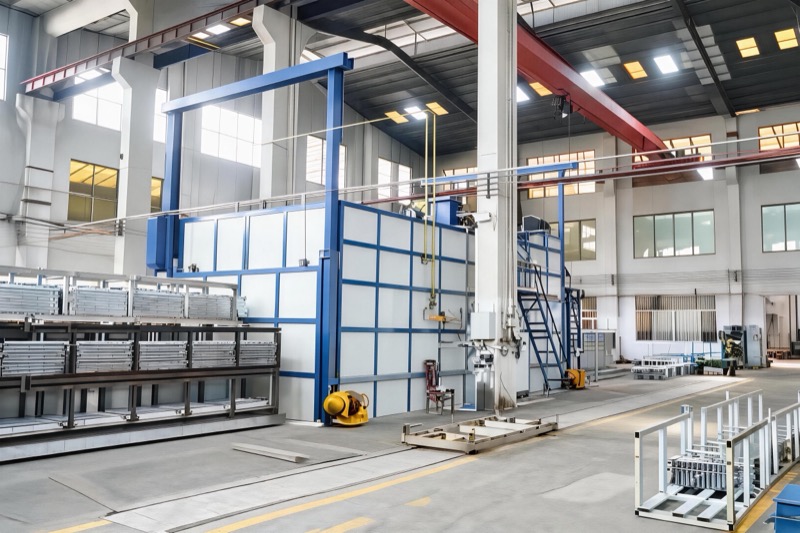
Founded in 2001, Dapeng operates a reported 42,000-square-meter site in Sihui, Guangdong. Its predecessor, Dali Lianfa Rolling Mill, made aluminum plate products, primarily cookware discs. Its current public profile emphasizes aluminum profiles, rolled sheet and strip, finishing, and deep processing. It describes continuous annealing equipment, spectrometers, mold development, and technical support from prototyping to production. Its served sectors include construction and industrial applications; the profile does not identify its largest disc export markets.
Dapeng is a candidate for small and midsize brands that want an engineering discussion before committing to tooling or production volumes, particularly when an order combines round blanks with other custom aluminum parts. Its value proposition is coordinating drawing review, tooling, and process development. Test flexibility and communication during the RFQ: give the team a drawing revision and ask for a single response covering feasibility, tolerance trade-offs, prototype timing, and any outsourced steps. Before ordering discs, confirm the current blanking location, available dies, pilot MOQ, and production-lot forming results. Dapeng's historical cookware-disc experience and its current extrusion equipment should not be read as proof of dedicated disc capacity today.
Founded in 1986, Yonglijian focuses on architectural, decorative, and industrial aluminum profiles. Its published capabilities include melting and casting, extrusion, finishing, thermal-break processing, and door and window fabrication. It reports more than 100,000 tonnes of annual profile production and lists projects in Singapore, Qatar, Kenya, and Australia. Those references show its architectural project footprint, not its disc sales markets. The company reports an ISO quality management certification.
Yonglijian belongs near the front of a shortlist for assemblies that combine fabricated aluminum systems and components. Its public site does not establish a dedicated disc line. If it offers a bundled quote that includes circles, ask it to name the blanking plant, disclose which party issues the material documentation, and explain who owns corrective action if a disc lot fails.
Established in 2001, Huawei lists aluminum discs for cookware, lighting, automotive, HVAC, and electronics applications. Its catalog gives an indicative 80–1,200 mm diameter range for selected deep-draw products, while a trade profile cites 90–1,200 mm and reports annual circle capacity of 8,000 tonnes. The difference is a reason to confirm the exact tooling and gauge combination rather than relying on the outer limits of either range. The same profile describes an export-oriented business but does not break out disc shipments by destination. For OEM work, request a quote against your alloy, temper, dimensions, finish, and forming test. Confirm the manufacturing site and the amount of capacity it can actually allocate to your SKU.
Haomei lists 1050, 1060, 1070, and 3003 circles for cookware, lighting, road signs, and industrial stamping. It reports more than 200,000 tonnes of overall annual capacity across aluminum products and describes thickness, tensile, surface, and chemistry checks. That figure is not a circle-line rating. Its public materials describe global supply without identifying leading disc export destinations; the founding year was not verified in the sources reviewed. For OEM blanks, ask which tooling is already available and whether the quoted finish, burr limit, and flatness can be achieved together at your gauge.
Huachuang publishes discs in alloys including 1050, 1060, 1100, 3003, 5052, and 6061, and lists a diameter range of 50–1,360 mm. It offers both continuous-cast (CC) and direct-chill-cast (DC) material routes and describes customization and design services. Its product page establishes a Jinan operation and a wholesale disc offering, but not an independently verified founding year or leading country markets. If both routes are proposed, run each through the same forming tool and compare earing, split rate, and surface defects. Do not approve a route substitution based only on matching alloy and temper labels.
Yongsheng advertises custom cold-rolled aluminum circles, making it a candidate for buyers specifying blank diameter, gauge, and surface condition. The circle page reviewed does not establish the contracting entity's founding year, principal export markets, dedicated output, or minimum order quantity. Ask the seller to identify its full registered name and production address and list which operations it controls: annealing, blanking, edge finishing, inspection, and packing. This is especially useful when a quote looks competitive but does not define who is responsible for the final blank specification.
Shanghai Metal Corporation lists aluminum circles and discs alongside aluminum slugs, making it a sourcing candidate for buyers evaluating multiple blank formats. Its disc listing does not establish the founding year of the production entity, the principal disc markets, or whether a single plant makes all quoted sizes. Treat it as a catalog supplier unless the particular plant is disclosed. For a custom order, require the quote to name the manufacturer and prohibit unapproved plant changes after qualification. Also distinguish a flat disc from a slug intended for impact extrusion; the catalog can cover both, but the purchasing specifications should not.
Kailong advertises induction aluminum circle products for cookware. Its public listing identifies the application but does not establish a verified legal founding year, principal destination markets, or the full scope of its OEM work. Start by asking exactly what the quote covers: a plain aluminum blank, a separate induction component, or a pre-bonded assembly. If bonding is included, specify which party is responsible for validating bond integrity and base flatness after forming and thermal cycling. That distinction affects both part acceptance and the division of warranty responsibility.
Shenzhen GYJ publishes a circle range and identifies a Shenzhen head office. The pages reviewed did not verify its founding year, principal disc export markets, or circle production address. Treat the office and production site as separate until the seller provides evidence linking them. For a custom project, ask for the stocked die range, available finishes, press location, gauge-specific tolerances, and a sample packing label. A trial in a standard diameter does not establish that a new tool will meet the same burr and flatness limits.
Mingtai was founded in 1997 in Gongyi and reports 1.4 million tonnes of annual sheet, strip, and foil capacity in its Aluminium Stewardship Initiative profile. The listing identifies a manufacturing certification scope for specified operations at its Gongyi site. Mingtai is relevant to sheet and coil buyers, including those who want to nominate an upstream mill and qualify a separate blanking plant. The sources reviewed do not establish a dedicated disc program or leading disc export markets. For this arrangement, have the mill and converter agree on the division of responsibility for incoming coil quality, pallet traceability, and replacement material.
Compare the output a supplier can allocate to your exact part, not the tonnage it can produce across all products. MOQ means minimum order quantity; ask for it per alloy, temper, thickness, diameter, and finish. A supplier willing to accept a one-tonne mixed order may not accept five 200 kg lines under the same conditions.
| Candidate | Public capacity or scope | Disc MOQ | Certification evidence and next check |
|---|---|---|---|
| Dapeng | Disc output not verified; historical circle production and current sheet/profile processing described | Request pilot and repeat MOQ | ISO 9001 and GRS reported; verify site, scope, and validity. |
| Yonglijian | More than 100,000 t/year of profiles, not discs | Confirm whether a disc quote is available | ISO quality management certification reported; verify the actual disc plant separately. |
| Huawei | 8,000 t/year of circles reported in a trade profile | Request per SKU | Request current, site-specific certificates and verify the capacity figure. |
| Haomei | More than 200,000 t/year across products, not circles alone | Request per SKU | ISO quality management reported; obtain the certificate and scope. |
| Huachuang | Disc tonnage not verified; CC and DC routes advertised | Request by route and size | ISO certification claimed; verify which site and activities it covers. |
| Yongsheng | Dedicated circle output not verified | Request stock-die and new-tool MOQ | Request a certificate tied to the quoted plant. |
| Shanghai Metal | Dedicated circle output not verified | Request by item and source plant | Request the manufacturing site's evidence, not just the seller's. |
| Kailong | Induction-circle output not verified | Request separately for blanks and assemblies | Verify which site performs any bonding and inspection. |
| Shenzhen GYJ | Dedicated circle output not verified | Request by tooling and gauge | Obtain the production address before checking certificates. |
| Mingtai | 1.4 million t/year of sheet, strip, and foil; not disc output | Request coil MOQ and a separate converter MOQ | ASI lists a Gongyi manufacturing scope; do not assume it covers the converter. |
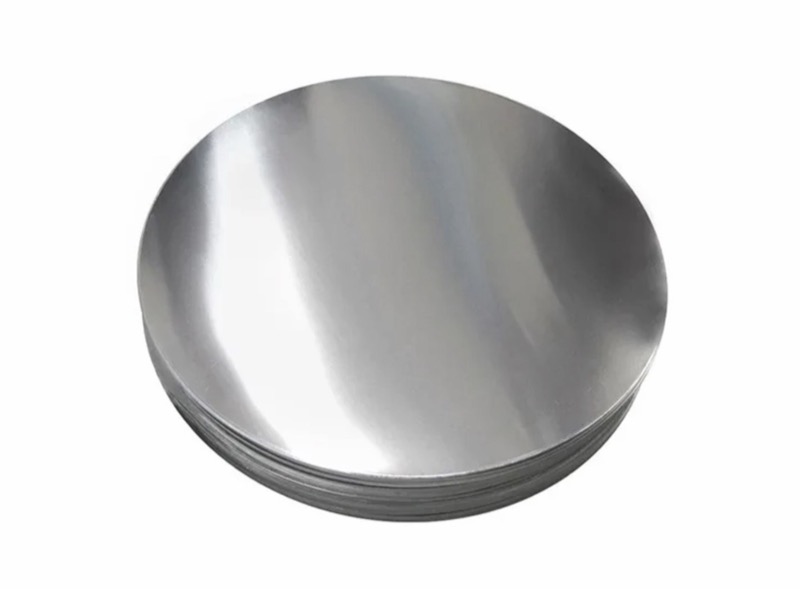
An aluminum round disc, also called an aluminum circle or round blank, is typically purchased for a downstream operation such as drawing, spinning, stamping, or machining. Suppliers publish 1050, 1060, and 1100 for applications such as cookware and lighting; 3003 is another common candidate for cookware and formed components. Catalogs also list 5052 and 6061 for some applications, but a grade offered in disc form is not necessarily suitable for your forming operation. Specify the alloy and temper together. For example, a trial with annealed 3003-O is not a basis for accepting 3003-H14 against the same forming approval.
Define thickness and diameter tolerances, maximum burr height, burr orientation if relevant, flatness measurement, finish, and which face is cosmetic. For a drawn component, add the required mechanical properties and an acceptance test using a representative tool. ASTM B209/B209M covers flat sheet, coiled sheet, and plate; referencing it for the input material does not, by itself, define blank diameter, edge quality, or forming acceptance. Put those requirements on the drawing or purchase specification.
- For EU cookware, start with the applicable food-contact framework and good manufacturing practice requirements. EN 602:2026 addresses chemical composition for wrought aluminum semi-finished products intended for food-contact articles. It does not, by itself, establish that finished cookware, including any coating, meets all applicable release or migration requirements. Check the rules for the destination and the finished product's intended conditions of use.
- For electrical components, determine whether the finished equipment is in scope for RoHS. If the blank is incorporated into covered equipment, request the material declarations or test evidence needed for the finished product's technical documentation. RoHS is not a universal aluminum quality or environmental certificate.
- For CE marking, ask which EU legislation applies to the product being placed on the market. Do not use a generic request for a "CE certificate" as an acceptance criterion for a bare disc. For a recycled-content claim, verify the relevant certification scope and shipment documentation separately from alloy and forming performance.
A shortcut that creates problems later is approving a hand-selected sample and writing the purchase order around its diameter, thickness, and alloy alone. A supplier may meet those three values using a different coil source, rolling route, or annealing practice, yet the replacement lot may behave differently in the same die. Even good chemistry and tensile results do not tell you how tall the ears will be—the uneven rim that develops during drawing—or how much extra trim your line will need. Suppliers offering both CC and DC blanks make route control an explicit question for the RFQ.
Make the pilot order do the work. Request production-representative blanks, retain the original pallet labels, and ask the supplier to trace a randomly selected package back to its coil and mill test report. For a drawing trial, preserve the rolling-direction reference where practical. Record earing, split rate, wrinkles, and the trim allowance needed after forming. If two routes pass, approve both by name; if only one passes, make changes to the mill, route, annealing practice, or blanking plant subject to written approval. This protects against both unauthorized material substitution and the more ordinary problem of a technically compliant lot that performs poorly on your line.
1. Verify the factory before paying a tooling deposit. Match the registered entity, invoice issuer, production address, and certificate holder. If they differ, document why. Ask for a live walkthrough from incoming coil to press, inspection, and packing, and confirm which of those operations are outsourced.
2. Quote tooling and production separately. Have each bidder state die ownership, maintenance responsibility, tool storage, sample lead time, and the MOQ for the validation lot and repeat runs. Ask when the production lead-time clock starts: drawing approval, die completion, payment, or material availability.
3. Test representative samples. Agree on how samples will be selected, what batch documents will accompany them, and how your plant will measure acceptance. For substitution risk, verify chemistry using a method appropriate to the elements and grade, then check temper through the agreed mechanical and forming tests. A chemical match alone does not verify temper.
4. Compare cost per accepted part. Suppose supplier A charges 3,000 per tonne and yields 92% usable material, while supplier B charges 3,100 and yields 97%. In the same currency, the effective material cost before scrap credit is about 3,261 versus 3,196 per usable tonne. Add freight, duty, inspection, and any recoverable scrap value before making the award.
5. Specify export packing and import responsibilities. Define separators or protective film where appropriate, moisture protection, maximum pallet weight, and pallet-level lot labels. Have your customs broker check tariff classification, origin documentation, and any applicable trade measures for the actual product and destination. China Customs Chapter 76 figures cover aluminum and articles thereof broadly; they do not isolate round-disc exports.
The strongest long-term supplier is the one that can reproduce your approved forming result, trace a failed lot, and notify you before changing the process. Compare at least two suppliers against the same drawing and pilot test. Include a dedicated circle producer if discs are your primary purchase; include a broader fabrication partner if engineering support and a mixed aluminum assembly matter more.
For a feasibility review from Guangdong Dapeng Aluminum Industry Co., Ltd., send your drawing, alloy and temper, thickness, diameter, end use, trial quantity, and estimated annual demand. Ask for a written response that separates current production capability, any subcontracted steps, tooling costs, and the tests needed before a repeat order.
Request the certificate number, issuing body, registered name, site address, scope, and expiry date. Check the record in IAF CertSearch where available. If you cannot find it, contact the issuing body using independently obtained contact details. A current certificate for an extrusion plant or sales office is not evidence that a different blanking plant is covered.
Tie the finished pallet to the original coil and its mill test report before looking at a test result. On the pilot and subsequent risk-based checks, use laboratory chemistry testing suitable for the specified grade and separate mechanical or forming tests to verify temper and performance. A document that cannot be matched to the material shipped is not a lot-level control.
Not by default. Define the forming outcome first, then qualify the route. If both CC and DC are offered, compare them at the same gauge and temper on the same tool, with the same lubricant and settings. Record the results separately and require change approval even if both materials carry the same nominal alloy designation.
Each item may need its own die setup, input coil, annealing batch, or packing run. Ask whether the supplier can combine items that share an alloy, temper, and gauge while still quoting separate tooling and labeling. Have the supplier identify the economic constraint for each line; changing to a stocked diameter may reduce the minimum without changing the material specification.
Quarantine the affected lot, retain failed parts and unused blanks, and document which pallets, tools, and press settings were involved. Run retained approved material under the same conditions to help separate a material change from a tooling, setup, or lubrication issue. Then ask the supplier to compare input coils, mechanical results, annealing records, and blanking conditions against the approved pilot. Define the corrective action before releasing replacement material.
- National Bureau of Statistics of China — 2025 national statistical communiqué, published in 2026; use it for national production context. [stats.gov]
- General Administration of Customs of China — imports and exports by HS section and division; use Chapter 76 for broad trade context, not disc-specific volumes. [english.customs.gov]
- Aluminium Stewardship Initiative — member and site certification information; use it to check the stated scope of a facility. [aluminium-stewardship]
- IAF CertSearch — accredited management-system certificate validation. [iafcertsearch]
- European Commission — food-contact materials requirements and conformity assessment resources. [food.ec.europa]


