


Views: 294 Author: Dapeng Aluminum Publish Time: 2026-10-31 Origin: Site


Content Menu
● Why Source Aluminum Extrusion Rails From China?
>> Manufacturing Clusters Support More Than Extrusion
>> What Recent Market Data Actually Shows
● Selection Criteria: How These Manufacturers Were Shortlisted
>> Five Questions That Matter More Than Marketing Claims
● Supplier Comparison: Capacity, MOQ, and Certification Evidence
● The Top 10 Aluminum Extrusion Rail Manufacturers in China
>> 1. Guangdong Dapeng Aluminum Industry Co., Ltd.
>> 8. Guangdong Haomei New Material Co., Ltd.
>> 9. Wellste
● Technical Buying Guide: Specify the Rail Before Comparing Prices
>> Choose Alloy and Temper Together
>> Define the Correct Tolerance Framework
>> Avoid Blanket CE and RoHS Requests
● The Overlooked Pitfall: A Perfect Short Sample Can Hide a Poor Production Rail
● Common Sourcing Problems and How to Prevent Them
● Factory Verification, Sampling, and Logistics
>> Verify the Actual Manufacturing Route
>> Use a Three-Stage Sampling Process
>> Calculate Landed Cost Before Issuing the Order
● FAQs
>> 1. How Can I Check Whether a Manufacturer's ISO Certificate Has Expired or Been Suspended?
>> 2. Can I Replace 6061-T6 With 6063-T6 if the Supplier Says Both Are Suitable?
>> 3. Why Can a Rail Pass Sample Inspection but Fail During Assembly?
>> 4. Should Every Aluminum Extrusion Rail Supplier Provide CE and RoHS Certificates?
>> 5. How Can I Negotiate a Small Trial Order Without Creating an Uncompetitive Long-Term Price?
Choosing an aluminum extrusion rail manufacturer is not simply a matter of comparing prices per kilogram. For procurement managers, the real challenge is finding a supplier that can repeatedly deliver the correct alloy, consistent rail geometry, reliable surface treatment, and documentation that matches the finished product.
China offers a broad supplier base, from large extrusion groups serving construction and transportation projects to more flexible manufacturers supporting customized industrial profiles. However, a large factory is not automatically the right partner for a smaller original equipment manufacturer, and an attractive sample does not guarantee stable production.
This guide compares ten Chinese manufacturers worth considering for aluminum extrusion rail projects. It examines manufacturing scale, customization potential, technical suitability, and the verification work buyers should complete before placing an order.
Here, "aluminum extrusion rail" includes industrial framing rails, mounting rails, architectural tracks, and customized extruded rail sections. It does not imply that every listed company manufactures complete precision linear-motion systems or certified railway infrastructure.
China's advantage lies partly in the concentration of extrusion, tooling, finishing, and downstream manufacturing capabilities.
Guangdong is particularly relevant. Xingfa, Fenglu, JMA, Weiye, and Guang Ya operate within the province's aluminum manufacturing ecosystem. Their published capabilities cover architectural profiles, industrial extrusions, machinery, and transportation applications. Shandong provides another sourcing base, with Huajian in Linqu and Orient Aluminium offering extrusion and surface-treatment operations.
For buyers, this concentration creates opportunities to source an integrated package rather than purchase extrusion, machining, finishing, and packaging separately. Nevertheless, the supplier should identify which processes it performs internally and which it subcontracts.
China's General Administration of Customs reports that exports of "unwrought aluminium and aluminium products" reached approximately 6.134 million tonnes in 2025, compared with 6.665 million tonnes in 2024—a decline of 8.0%. This is a broad customs category, not an aluminum extrusion rail market total.
For a more product-focused outlook, MarketsandMarkets' *China Aluminum Extrusion Market (2025–2030)* projects market value rising from approximately USD 53.19 billion in 2025 to USD 77.79 billion in 2030. These figures are commercial research estimates covering aluminum extrusions generally, not measured sales of extrusion rails alone.
The practical implication is straightforward: China remains a substantial sourcing market, but neither national export volume nor a market forecast proves that an individual factory can meet a particular rail specification.
This is a procurement shortlist, not an independently audited ranking of China's ten largest rail manufacturers.
The selection considers publicly available company information, disclosed manufacturing capabilities, industrial relevance, customization scope, and the availability of information buyers can verify. No factory visits, comparative laboratory tests, or customer-reference interviews were conducted for this article.
Guangdong Dapeng Aluminum Industry Co., Ltd. appears first because this guide is prepared for its website. Its placement does not establish independently proven superiority over the other manufacturers.
1. Can the factory manufacture the specified rail geometry?
Review cross-section limits, available presses, wall-thickness feasibility, straightness control, and machining requirements.
2. Can it demonstrate material and process traceability?
Ask for billet identification, chemistry results, heat-treatment records, inspection reports, and shipment-level traceability.
3. Can it provide current, relevant certification?
Check the certificate holder, manufacturing address, scope, issuer, and current status—not merely a logo on a website.
4. Can it support the required development process?
Evaluate drawing review, tooling ownership, sample approval, revision control, and responsibility for design changes.
5. Can it repeat the result commercially?
Request a production schedule, capacity allocation, quality agreement, and clearly defined corrective-action procedure.
OEM manufacturing means producing to the buyer's specification. ODM support involves a greater supplier contribution to design. Buyers should confirm the actual engineering deliverables rather than treating these labels as interchangeable.
The capacity figures below describe company-wide capabilities, not dedicated aluminum extrusion rail capacity or available production slots. They are supplier-published figures unless otherwise stated.
"RFQ" means a project-specific quotation is required. No comparable, verified rail-specific MOQ was established for these ten suppliers from the reviewed sources.
| Manufacturer | Established | Published manufacturing scale | Rail-specific MOQ | Certification evidence or verification status |
|---|---|---|---|---|
| Guangdong Dapeng Aluminum Industry Co., Ltd. | 2001, according to its About Us listing | 42,000 m² site reported; annual extrusion tonnage not confirmed | RFQ | Website advertises ISO 9001; request current certificate and scope |
| Xingfa Aluminium | 1984 | Approximately 1 million tonnes/year published capacity | RFQ | Public reporting discusses management systems; verify the supplying plant's current certificates |
| Fenglu Aluminium | 1990 | More than 100 extrusion lines; presses up to 20,000 tonnes | RFQ | Obtain current certificates for the production site and required processes |
| JMA Aluminium | 1993 | Approximately 300,000 tonnes/year published output | RFQ | Public certificate pages include older ISO editions; updated evidence required |
| Weiye Aluminium | 1992 | Approximately 700,000 tonnes/year published capacity | RFQ | Request current site-specific certificates and relevant product testing |
| Guang Ya Aluminium | 1996 | Approximately 300,000 tonnes/year published capacity | RFQ | Confirm current certificates, scope, and nominated manufacturing base |
| Huajian Aluminium Group | 2000 | Approximately 800,000 tonnes/year published capacity | RFQ | Company lists ISO 9001, IATF 16949, ISO 14001, ISO 45001, and ISO 50001 |
| Guangdong Haomei New Material | 2004, legal entity | Integrated extrusion and downstream processing; comparable current tonnage not established here | RFQ | Request current certificates for the contracting entity and supplying facility |
| Wellste | 1996 | Approximately 100,000 tonnes/year and 35 extrusion lines published | RFQ | Website contains a legacy ISO reference; verify current certification directly |
| Orient Aluminium | 2002 | Approximately 60,000 tonnes/year and 22 extrusion lines published | RFQ | Website lists older ISO editions; current certificates required |
Sources for the comparison: Dapeng, Xingfa, Fenglu, JMA, Weiye, Guang Ya, Huajian, Haomei's exchange filing, Wellste, and Orient Aluminium. Published scale figures and historical certificate references should not be interpreted as verified current availability or certification status.
Dapeng's About Us search listing identifies the company as established in 2001, located in Sihui, Guangdong, with a reported site area of 42,000 square meters. Its product pages describe customized aluminum profiles and OEM services. These details provide a starting point for supplier qualification, although its homepage also references industry experience beginning in 1986; buyers should distinguish company incorporation from predecessor or team experience.
- Core focus: Customized industrial and architectural aluminum profiles.
- Main market orientation: International OEM customers; a verified country-by-country sales breakdown was not available.
- OEM/ODM fit: Drawing-based profiles and related customization, with design responsibility and downstream processing confirmed during quotation.
- Suitable buyer profile: Small and medium-sized brands seeking coordinated technical communication and a customized supply arrangement.
Dapeng is worth evaluating as a value-oriented alternative to very large extrusion groups. Its proposed advantage for smaller brands is flexibility: direct drawing discussions, coordinated revisions, and support across customized profile requirements.
Those advantages should be demonstrated rather than assumed. Request a named technical contact, an agreed drawing-review deadline, tooling terms, trial-order conditions, and a complete quotation. "Cost-effective" should mean competitive delivered cost and acceptable yield—not merely the lowest initial price.
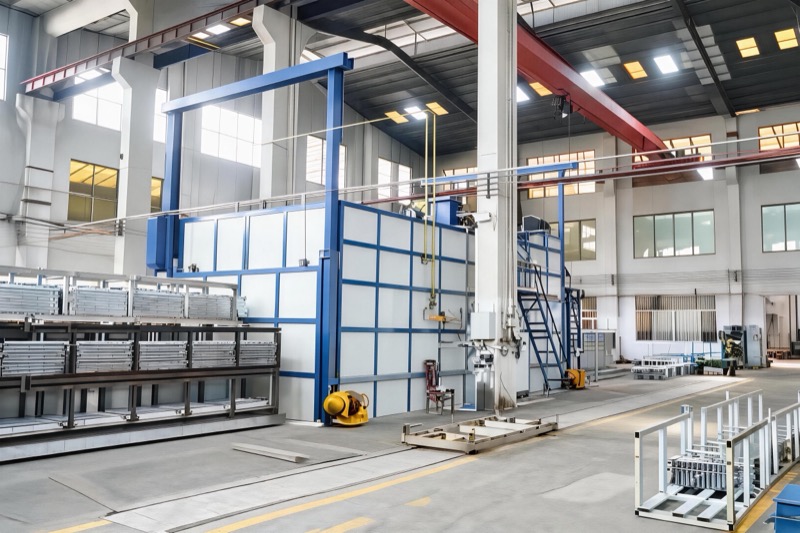
Founded in 1984 and headquartered in Foshan, Xingfa publishes an annual production capacity of approximately one million tonnes. Its portfolio includes architectural profiles, industrial applications, transportation, electronics, and machinery.
- Core strength: Large-scale, diversified extrusion manufacturing.
- Main markets: Domestic and international architectural and industrial customers.
- OEM/ODM focus: Engineered profile development for construction, machinery, and transportation applications.
- Suitable buyer profile: Buyers planning substantial repeat demand or multiple related profile families.
Xingfa's scale makes it relevant to long-term programs requiring a broad manufacturing base. However, buyers should identify the actual production plant, account team, and machining route before relying on group-level capabilities. Confirm that a relatively small rail program will receive adequate tooling and engineering attention.
Fenglu was founded in 1990 and describes more than 100 extrusion lines, including presses rated at 20,000, 12,500, and 10,000 tonnes. Its published capabilities emphasize complex and large-sized extrusion profiles.
- Core strength: Large-section extrusion and broad press capability.
- Main markets: Architectural and industrial sectors; precise geographic sales shares were not confirmed.
- OEM/ODM focus: Customized cross-sections and fabricated aluminum products.
- Suitable buyer profile: Projects involving large rail sections or geometries that exceed smaller presses' practical capabilities.
Press size alone does not prove finished rail accuracy. Ask Fenglu to review the complete section, rail length, critical interfaces, and finishing sequence. For machined mounting rails, acceptance should focus on the final datum surfaces rather than the unmachined extrusion.
JMA states that it has manufactured aluminum profiles since 1993 and publishes annual output of approximately 300,000 tonnes. Its product range includes architectural systems and custom industrial extrusions.
- Core strength: Combined architectural and industrial profile production.
- Main markets: Domestic and export construction and industrial customers.
- OEM/ODM focus: Custom extrusion sections and profiles used in building and industrial assemblies.
- Suitable buyer profile: Buyers combining functional rail requirements with visible architectural finishing.
One important qualification issue is document freshness. JMA's public certificate pages include references to ISO 9001:2008 and ISO 14001:2004. Those historical references do not establish current certification. Request updated documents and verify the actual manufacturing entity.
Founded in 1992, Weiye publishes an annual production capacity of approximately 700,000 tonnes. Its industrial profile page identifies applications including rail transit, building materials, and electronics, and reports exports to more than 30 countries and regions.
- Core strength: High-volume profile manufacturing with industrial application coverage.
- Main markets: China and export markets across more than 30 countries and regions, according to the company.
- OEM/ODM focus: Industrial and architectural extrusion development.
- Suitable buyer profile: Repeat rail programs requiring established production infrastructure.
For rail projects, ask which base will produce the profiles and which operations will remain at that base. A consistent manufacturing route can simplify inspection planning, color matching, and corrective-action responsibility.
Guang Ya was founded in 1996 and publishes approximately 300,000 tonnes of annual capacity. It describes integrated research, design, manufacturing, and sales operations for architectural and industrial profiles, with applications including machinery, electronics, and rail transportation.
- Core strength: Broad application coverage and integrated profile development.
- Main markets: Domestic and global architectural and industrial customers.
- OEM/ODM focus: Customized sections and project-oriented aluminum solutions.
- Suitable buyer profile: Buyers needing profile development connected to a wider assembly or construction system.
Qualification should establish the boundary between supplying an extrusion and engineering a complete rail assembly. Confirm whether accessories, fasteners, machining, and assembly testing are included or remain the buyer's responsibility.
Huajian identifies its founding year as 2000 and its location as Linqu, Shandong. Its official site publishes annual aluminum capacity of approximately 800,000 tonnes and describes an integrated production chain covering alloy manufacturing, tooling, extrusion, and deep processing.
- Core strength: Manufacturing scale, integrated processing, and laboratory infrastructure.
- Main markets: China and more than 100 countries and regions, according to the company.
- OEM/ODM focus: Building and industrial profiles, including downstream processing.
- Suitable buyer profile: Buyers managing multiple profile families or larger annual sourcing programs.
Huajian also lists several management-system certifications and laboratory credentials. These are useful qualification leads, but buyers should still check certificate validity, laboratory test scope, and whether the nominated production facility falls within the relevant certification.
Haomei's legal entity was established on August 20, 2004, according to a 2026 Shenzhen Stock Exchange filing. Its official website describes applications in buildings, rail transit, electromechanical machinery, electronics, and automotive lightweight materials.
- Core strength: Integration of aluminum alloy development with downstream industrial applications.
- Main markets: Domestic and international construction, transportation, and industrial sectors.
- OEM/ODM focus: Engineered aluminum profiles and application-specific downstream development.
- Suitable buyer profile: Projects where material performance and industrial engineering matter more than access to a standard catalog.
Use particular care when identifying this supplier. Several unrelated aluminum businesses use similar English names. Match the quotation, bank beneficiary, business license, and technical documents to the correct legal entity and stock code, 002988.
Wellste presents itself as a custom extrusion manufacturer operating since 1996. Its website publishes 35 extrusion lines and approximately 100,000 tonnes of annual capacity, alongside anodizing and coating capabilities.
- Core strength: Custom extrusion-oriented product offering.
- Main markets: International custom-profile customers; audited geographic sales shares were not established.
- OEM/ODM focus: Drawing-based extrusions and associated finishing.
- Suitable buyer profile: Buyers seeking a custom-profile sourcing route rather than a large architectural systems supplier.
The website contains a legacy ISO reference, which makes direct certificate verification important. Confirm current certification, the factory address, the production route, and whether any machining or finishing will be subcontracted.
Orient Aluminium states that it began in 2002 and publishes approximately 60,000 tonnes of annual capacity across 22 extrusion lines. Its listed facilities include anodizing, electrophoresis, powder coating, PVDF coating, and thermal-break production.
- Core strength: Extrusion combined with multiple finishing processes.
- Main markets: Architectural and industrial profile customers; detailed geographic market shares were not verified.
- OEM/ODM focus: Customized profile sections and finishing requirements.
- Suitable buyer profile: Buyers comparing a Shandong-based supply option with Guangdong manufacturers.
Its published certification references include older ISO editions. Before qualification, request current certificates and obtain written confirmation of rail-specific tolerances, alloy availability, and inspection methods.
A drawing that says only "aluminum" leaves too much room for substitution.
| Material option | Typical procurement consideration | Main trade-off |
|---|---|---|
| 6063 | Complex profiles and visible anodized rails | Often selected for extrusion quality and appearance rather than maximum strength |
| 6061 | Structural or machined rails | Higher strength and machining suitability than 6063, with a different cosmetic anodizing response |
| 6082 | Engineered structural and transportation sections | Strong mechanical performance, but section complexity and quenching capability require attention |
Hydro's technical information distinguishes 6061's structural and machining applications from 6063's finishing advantages. Its 6082 guidance also highlights structural applications and limitations when extruding thin-walled sections. Final selection must follow the applicable design calculations and material standard.
Specify the temper as well as the alloy. Require chemistry and mechanical-property evidence linked to the production batch. Hardness testing can support process control, but it should not be treated as a complete substitute for specified material acceptance tests.
European Aluminium's ordering guide distinguishes general extruded profiles under EN 755 from precision profiles in alloys 6060 and 6063 under EN 12020. It identifies EN 755-2 for mechanical properties, EN 755-9 for general profile dimensional and form tolerances, and EN 12020-2 for relevant precision-profile tolerances.
Do not specify "EN 12020 precision" indiscriminately for every alloy.
The purchase drawing should separately define:
- Cross-sectional dimensions.
- Straightness over the full supplied length.
- Local straightness over a defined gauge length.
- Twist.
- Slot and mating-interface geometry.
- Machined hole positions.
- Final inspection datums.
- Whether acceptance occurs before or after finishing.
CE marking is not a universal aluminum quality certificate or environmental label. It applies only where relevant legislation requires it. The European Commission explicitly states that CE marking must not be used on products outside its applicable scope.
RoHS concerns restricted substances in electrical and electronic equipment. Material evidence may be required when a rail becomes part of an in-scope product, but a generic aluminum extrusion is not automatically subject to a standalone "RoHS certification" requirement.
Ask suppliers for documents appropriate to the actual product, destination, and end use—not a collection of unrelated certificates.
One technically important acceptance trap is approving a short, unmachined sample for a long, heavily machined rail.
Machining can release residual stresses introduced during quenching, causing an initially straight component to distort. A technical report available through the U.S. Department of Energy's research repository documents this relationship in age-hardening aluminum alloys.
The purchasing safeguard is to approve the manufacturing sequence, not just the cross-section:
1. Produce samples at the intended production length.
2. Apply the intended heat-treatment and machining route.
3. Inspect after releasing the part from machining fixtures.
4. Complete the specified surface treatment.
5. Recheck critical dimensions and assembly fit.
6. Repeat the approval if a major process change occurs.
A part that meets dimensions while forcibly clamped is not necessarily acceptable in its free state. Record the inspection support conditions in the quality agreement.
| Risk | What to require |
|---|---|
| Alloy or temper substitution | Batch-linked chemistry, mechanical test results, and material identification |
| Reduced wall thickness | Drawing-based inspection of critical walls and cross-sectional features |
| Attractive sample but unstable production | Full-length pilot approval and a documented production control plan |
| Uncontrolled subcontract finishing | Approved subcontractors, process specifications, and final inspection responsibility |
| Unclear tooling ownership | Written ownership, storage, maintenance, modification, and replacement terms |
| Misleading capacity claims | Available production slots and dated delivery commitments |
| MOQ misunderstandings | Separate quantities by profile, alloy, length, color, and finishing batch |
| Quotation omissions | Itemized tooling, extrusion, machining, finishing, packaging, and freight costs |
Recycled content should not automatically be treated as inferior material. The purchasing issue is whether the finished alloy meets the agreed chemistry, properties, cleanliness, and traceability requirements.
Request the legal company name, business license, factory address, and production flowchart. During an audit or live video review, follow the proposed rail through tooling, extrusion, heat treatment, inspection, machining, finishing, and packaging.
Check whether the machinery shown is located at the contracted facility. If critical processes are subcontracted, identify the subcontractor and allocate quality responsibility in writing.
1. Engineering review: Approve drawings, alloy, temper, finish, tolerances, and inspection methods.
2. First-article review: Test the intended section and full-length behavior using the proposed production route.
3. Pilot shipment: Check repeatability, packaging protection, documentation, and arrival condition before scaling up.
Samples should represent production conditions. If a sample receives special machining or manual correction, document whether that process will also apply to regular orders.
Compare cost per accepted finished rail, not extrusion price alone.
Include tooling, processing, scrap assumptions, packaging, freight, insurance, destination handling, inspection, and potential duties. For U.S.-bound orders, the Department of Commerce's published aluminum extrusion proceedings demonstrate why product scope and trade-remedy exposure require specialist review. Do not assume an ordinary tariff quotation captures all applicable liabilities.
Long rails also require an agreed packaging design. Define bundle support, surface separation, end protection, lifting points, and handling limits. Validate the package through a pilot shipment rather than relying on photographs of unrelated exports.
The right Chinese aluminum extrusion rail manufacturer depends on the application, order pattern, engineering complexity, and qualification requirements.
Large groups such as Xingfa, Fenglu, and Huajian offer substantial published manufacturing scale. More customization-oriented candidates, including Dapeng, deserve consideration where a buyer needs a coordinated drawing-to-production relationship and practical support for a developing product range.
For Guangdong Dapeng Aluminum Industry Co., Ltd., the strongest purchasing case is not an unsupported claim of being the largest or cheapest. It is the opportunity to demonstrate responsive technical communication, clear customization terms, and consistent delivery against an agreed specification.
Send Dapeng your rail drawing, intended application, alloy and temper, finish requirements, annual demand, trial-order quantity, and destination market. Request a manufacturing proposal that separates tooling, processing, inspection, packaging, and delivery commitments so the offer can be compared objectively.
Obtain the certificate number, issuing certification body, legal company name, manufacturing address, and scope.
Search IAF CertSearch and compare the returned information with the supplier's documents. Review the status, not just the printed expiry date: a certificate can be suspended or withdrawn before that date. If the certificate cannot be located, seek clarification from the issuer and the database rather than treating absence alone as conclusive proof of fraud.
Also confirm that the certificate covers the factory and processes supplying your order.
Not without engineering approval.
The alloys have different strength, machining, and finishing characteristics. Hydro identifies 6061 as a structural and machined-profile option and 6063 as more favorable where surface finish and anodizing appearance are priorities. The same section made from a different alloy may therefore require renewed design verification.
Ask the responsible engineer to review loads, deflection, joints, fatigue exposure, and the specified mechanical properties before approving substitution.
The sample may not represent production length, final machining, finishing, or actual assembly constraints. Residual-stress release during machining is one documented mechanism that can change geometry.
Use full-length, finished samples and inspect functional interfaces with representative mating components. Define measurement datums and support conditions before testing.
No. Start with the finished product's legal classification and destination market.
CE marking applies only under relevant legislation. RoHS addresses electrical and electronic equipment and associated substance restrictions, not every standalone aluminum component.
Where material compliance is required, obtain evidence linked to the supplied alloy, coating, and relevant component configuration—not an unrelated certificate bearing the supplier's name.
Separate one-time development costs from recurring unit costs.
Ask for distinct quotations covering tooling, first articles, a pilot batch, and volume production. Clarify whether the minimum applies per profile, alloy, color, or finishing run.
For the trial, consider reducing nonessential variations while retaining critical functional requirements. Put future pricing assumptions, die ownership, and revision charges in writing. A small trial is useful only if its manufacturing route can be repeated at the intended production volume.
- China General Administration of Customs — 2025 export quantity and value table:
http://english.customs.gov.cn/Statics/7367d7db-7fbd-42a5-8f75-442a7f989e64.html
- MarketsandMarkets — *China Aluminum Extrusion Market (2025–2030)*:
[https://www.marketsandmarkets.com/Market-Reports/geography/aluminum-extrusion-market/China]
- European Aluminium — *How to Order Aluminium According to European Standards*:
- Hydro — 6061 extrusion alloy guidance:
- Hydro — EN AW-6082 technical datasheet:
- U.S. Department of Energy research repository — *Overcoming Residual Stresses and Machining Distortion*:
[https://www.osti.gov/servlets/purl/922073
- IAF CertSearch — Accredited certificate verification:
[https://www.iafcertsearch.org/]
- European Union — CE marking requirements:
- European Commission — RoHS Directive guidance:
[https://environment.ec.europa.eu/topics/waste-and-recycling/rohs-directive_en]
- U.S. Federal Register — Aluminum extrusions from China, published determination:
- Dapeng: [https://www.dapeng-alu.com/aboutus.html]
- Xingfa: http://en.xingfa.com/about.html
- Fenglu: [https://www.fenglualu.com/Company-Profile.html]
- JMA: [https://jma-aluminum.com/]
- Weiye: [https://www.weiye-alu.com/en/about]
- Guang Ya: [https://www.guangyaal.com/en/join.html]
- Huajian: [https://www.huajianal.com/about/]
- Haomei: [https://www.haomei-alu.com/]
- Wellste: [https://www.wellste.com/]
- Orient Aluminium: [https://www.orientaluminium.com.cn/]


