
English


Views: 210 Author: Dapeng Aluminum Publish Time: 2026-09-29 Origin: Site


Content Menu
● Steel vs. Aluminum at a Glance
● Strength, Stiffness, and Weight
>> Is aluminum weaker than steel?
>> How much lighter is aluminum?
>> What about fatigue and impact?
● Corrosion and Outdoor Service
>> What happens when aluminum touches steel?
● Temperature, Conductivity, and Fire
>> Which material handles heat better?
● Manufacturing and Design Freedom
>> When do custom aluminum extrusions help?
● Total Cost and Sustainability
>> Is steel cheaper than aluminum?
>> Is aluminum more sustainable than steel?
● How to Choose for Your Application
>> Match the material to the job
>> Three checks buyers often miss
>> A practical specification checklist
>> Is aluminum always one-third the weight of steel?
>> Is steel always stronger than aluminum?
>> Can aluminum replace steel in a load-bearing frame?
>> Which is better for outdoor use?
>> Is aluminum easier to fabricate than steel?
>> Does recycling make aluminum the greener choice?
Steel vs. aluminum is not a contest with one universal winner. Steel often suits projects where stiffness, heavy loads, or high temperatures dominate. Aluminum becomes compelling when lower weight, corrosion resistance, and custom profile geometry can improve the finished assembly. The right choice depends on the alloy, shape, environment, and total project cost—not just the price of a kilogram of metal.
The table uses ASTM A36 carbon steel and 6063-T5 aluminum extrusion as illustrative examples. They represent specific grades and product forms, not every steel or aluminum product.
| Decision factor | Aluminum | Steel |
|---|---|---|
| Density | About 2.70 g/cm³ for 6063 | About 7.85 g/cm³ for A36 |
| Elastic modulus | Approximately 69 GPa for 6063 | Approximately 200 GPa for A36 |
| Yield-strength example | At least 110 MPa for certain 6063-T5 extrusions up to 12.5 mm thick | About 250 MPa for commonly specified A36 products |
| Corrosion approach | Forms a protective oxide layer, but still needs protection in some environments | Carbon steel usually needs a coating in corrosive service; stainless steel behaves differently |
| Shape-making advantage | Extrusion can combine channels, ribs, and mounting features in one profile | Broad availability of plate, tube, beams, and fabricated sections |
| Typical purchasing question | Can a redesigned profile reduce weight or assembly work? | Does a standard steel section meet the load and budget efficiently? |
Do not compare these numbers without checking the governing specification. Strength requirements vary with product form, thickness, temper, and design standard. A supplier's material certificate and the project engineer's calculations matter more than a generic comparison chart.
The honest answer is: which aluminum and which steel? An A36 steel section and a 6063-T5 extrusion have different specified strengths, but neither represents its entire material family. Aluminum alloying and heat treatment change mechanical properties substantially. Likewise, steel grades range far beyond ordinary carbon steel.
Strength describes when a material yields or breaks. Stiffness describes how much it bends under a load. Buyers sometimes focus on yield strength when deflection is the actual design problem.
For equal-length members with the *same cross-section*, steel's elastic modulus of roughly 200 GPa makes it much stiffer than aluminum at roughly 69 GPa. Yet equal-shape comparisons can mislead. An aluminum profile can be redesigned with a deeper section, internal ribs, or strategically placed walls to increase bending stiffness while retaining a weight advantage.
A practical sequence is:
1. Define the load, span, support points, and permitted deflection.
2. Select a steel section and an aluminum profile that meet the same requirements.
3. Check connection strength, buckling, and local wall behavior.
4. Compare the weight and installed cost of the complete assemblies.
Never replace a steel beam with an aluminum beam solely by multiplying its weight by a density ratio. The new shape may need different dimensions, connections, or reinforcement.
At equal volume, 6063 aluminum's density of about 2.70 g/cm³ is roughly 34% of A36 steel's 7.85 g/cm³. That translates to an approximate 66% mass reduction for identical volumes. It does not promise a 66% reduction for two designs that carry the same load.
Consider an equipment frame. Lighter members may make handling and installation easier, but their reduced stiffness could require larger profiles or extra bracing. The meaningful result is the weight of the approved frame—not the density of one sample coupon.
Repeated vibration, reversing loads, and sudden impacts deserve their own review. Material selection must account for the actual joint and geometry, including weld toes, drilled holes, and sharp corners. A strong base metal cannot compensate for a poor fatigue detail.
For transport frames and industrial machinery, ask the designer to specify the expected load cycles and inspection plan. Request validation of the finished component or assembly where failure would have serious consequences. Avoid treating a published tensile-strength figure as a fatigue-life guarantee.
Aluminum does not develop the red iron-oxide rust associated with carbon steel. Its surface naturally forms an oxide layer that helps protect it in many ordinary environments. That does not make every aluminum alloy corrosion-proof.
Chloride exposure, trapped moisture, aggressive chemicals, and unsuitable joints can still cause damage. Marine and coastal projects need an alloy, finish, drainage strategy, and maintenance plan appropriate to their exposure. Stainless steel is also distinct from ordinary carbon steel: its corrosion performance depends on grade and service conditions.
For architectural profiles, finishes such as anodizing or powder coating can address appearance and exposure requirements. A finish should be specified by measurable acceptance criteria—not merely by a color name.
A mixed-metal assembly needs closer attention than either material alone. Where dissimilar metals make electrical contact in the presence of moisture, galvanic corrosion may become a risk. The severity depends on the environment, relative exposed areas, coatings, and connection design.
For an aluminum profile attached to a steel support, review:
- Whether water can enter and remain in the joint.
- Whether a suitable isolating barrier is needed.
- Whether the selected fasteners suit both materials and the environment.
- Whether coatings remain effective after drilling, cutting, and installation.
- Whether the assembly can be inspected and maintained.
Fastener advice for one roofing or façade system should not be copied automatically into another project. Confirm the full connection design with the responsible engineer or corrosion specialist.
Steel generally provides the more suitable starting point for components exposed to sustained high temperatures, but operating-temperature limits depend on grade, loading, and the relevant design rules. Aluminum loses useful mechanical performance well before melting; quoting melting points alone does not establish safe service temperature.
Thermal movement matters even at ordinary outdoor temperatures. A typical linear expansion coefficient for aluminum alloys is around 21–24 × 10⁻⁶ per °C, compared with about 10.8–12.5 × 10⁻⁶ per °C for ordinary steel. Austenitic stainless steels can differ from that steel range.
For example, using 23 × 10⁻⁶ per °C, a 6 m aluminum member subject to a 50°C temperature rise would lengthen by about 6.9 mm if free to expand. A comparable ordinary-steel member using 12 × 10⁻⁶ per °C would lengthen by about 3.6 mm. These are illustrative calculations, not joint-clearance specifications. Fixing points, restraints, and the actual temperature range determine the detail.
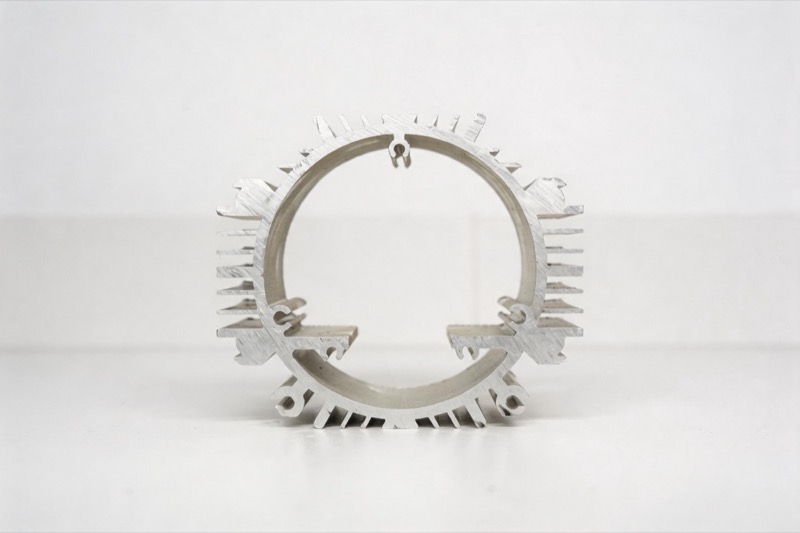
Aluminum is also useful where transferring heat is the goal, such as some heat-sink and thermal-management components. Where heat transfer is unwanted—for example, through a building envelope—a metal's conductivity becomes a design issue. The whole assembly, including thermal breaks, matters more than the bare metal alone.
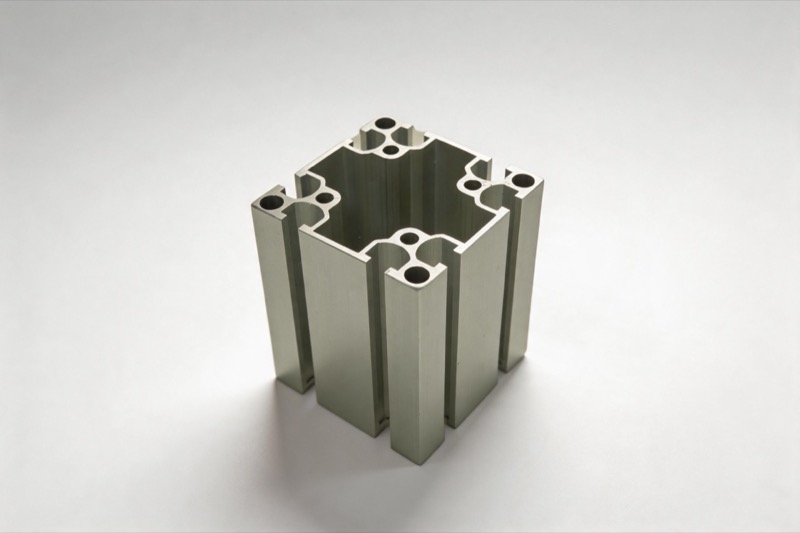
An extrusion die can produce a consistent cross-section with features that would otherwise require several separate parts. For suitable volumes and geometries, that may reduce secondary fabrication or simplify assembly.
Imagine a machine enclosure rail that needs a cable channel, a fastening slot, and a mounting face. Instead of purchasing three components and joining them, a designer might incorporate those functions into one custom aluminum extrusion. It still needs checks for wall thickness, tolerance, manufacturability, and tool cost.
Steel may be the more direct choice when standard beams, plate, or tube already meet the requirement. A fabricated steel frame can be practical for large, heavily loaded structures, particularly when a new extrusion die would not be justified.
For either material, evaluate the production route rather than assuming one is always easier to machine or weld:
- Cutting and machining: Review tolerances, burr control, part size, and expected volume.
- Joining: Confirm weld design or mechanical fasteners for the selected alloy and temper.
- Finishing: Specify appearance, coating performance, and exposed cut-edge treatment.
- Inspection: Agree on dimensions, surface criteria, and required test records before production.
At Guangdong Dapeng Aluminum Industry Co., Ltd., our role as an aluminum-profile manufacturer is to help customers evaluate industrial profiles, architectural profiles, and custom deep-processing requirements against their drawings and application needs. A credible proposal should state what is specified and what still needs engineering confirmation—not claim that aluminum automatically replaces steel.
A comparison of raw-metal prices alone rarely settles a B2B purchasing decision. Material prices change, while the finished part also carries costs for tooling, cutting, machining, finishing, freight, installation, and maintenance.
Use a total-cost comparison with the same design life and functional requirements:
| Cost category | Question to ask |
|---|---|
| Material and tooling | What are the quoted alloy, grade, minimum order quantity, and tooling charges? |
| Fabrication | How many operations and purchased parts does each design require? |
| Delivery and installation | Do mass, package size, or on-site handling change the cost? |
| Protection and upkeep | What coatings, inspections, repairs, or replacements are expected? |
| End of life | Can components be separated and directed into appropriate recycling streams? |
A custom extrusion may have an upfront tooling expense but reduce part count in repeat production. Conversely, a readily available steel section may avoid that investment entirely. Obtain like-for-like supplier quotations rather than relying on an unsourced claim that one metal always costs a fixed percentage more.
Neither material has a universal environmental advantage. The answer depends on recycled content, production route, electricity source, product life, transport, and the amount of material needed to do the job.
Aluminum recycling can require substantially less production energy than making primary aluminum. In one International Aluminium Institute comparison, modeled energy demand was 186 GJ per tonne for global primary production and 8.3 GJ per tonne for recycled production—about 95.5% less. That is a comparison of specified production routes, not proof that every aluminum component has a lower footprint than every steel component.
Steel is also repeatedly recyclable without losing its inherent material properties. Both materials therefore deserve a project-level assessment. If emissions influence procurement, ask suppliers for the declared product and production boundaries behind their figures, then compare components that meet the same performance target.
Use these starting points, then validate the design:
| Application | Strong starting option | What could change the choice? |
|---|---|---|
| Heavy, stiffness-critical support | Structural steel | Weight limits, corrosion exposure, or an optimized aluminum design |
| Modular industrial frame | Aluminum extrusion | High concentrated loads or a low-volume design already served by standard steel |
| Architectural trim or exposed profile | Finished aluminum extrusion | Impact demands, connection details, or project-specific fire requirements |
| Transport component | Engineered aluminum or steel | Fatigue, crash requirements, weight targets, and joining method |
| Outdoor mixed-metal assembly | Either, with a designed interface | Persistent moisture, fastener selection, and maintenance access |
These are decision prompts, not approvals for structural or safety-critical use.
1. Compare assemblies, not bars. A profile's mass may fall while brackets, reinforcement, or additional fasteners increase. Put both complete bills of materials beside the drawings.
2. Review the longest member in its hottest condition. Thermal movement can govern slots, seals, and façade joints even when room-temperature strength is adequate.
3. Inspect the interface between materials. A well-chosen aluminum alloy can still underperform if a wet steel connection creates an avoidable corrosion problem.
Before requesting a quotation, provide:
1. Function: Loads, span, vibration, and permissible deflection.
2. Environment: Indoor or outdoor use, moisture, salt exposure, and temperature range.
3. Geometry: Drawings, critical dimensions, wall thicknesses, and mating parts.
4. Material: Proposed alloy and temper or steel grade, if already selected.
5. Finish: Appearance expectations and measurable coating requirements.
6. Quantity: Prototype needs, annual volume, and delivery schedule.
7. Verification: Required standards, inspection records, and tests.
If you are weighing a steel assembly against a custom aluminum profile, send Guangdong Dapeng Aluminum Industry Co., Ltd. your drawing, application conditions, and target quantity. Request a review of profile geometry, material options, finishing, and deep-processing requirements. Have the final design approved by the engineer responsible for its performance.
Only when comparing approximately equal volumes of common alloys. A redesigned aluminum part may use more material to meet the same stiffness or load requirement. Compare finished assemblies.
No universal statement covers every grade and temper. Ordinary structural steel is often stronger and stiffer than common architectural aluminum extrusions, but the actual comparison must identify both specified materials and product forms.
Potentially, but it is not a direct substitution. The designer must check strength, deflection, buckling, joints, fatigue, and applicable requirements using the proposed aluminum geometry.
It depends on exposure and maintenance. Aluminum's oxide layer helps in many environments; protected carbon steel and suitable stainless-steel grades are also options. Coastal and wet mixed-metal connections require particular care.
It depends on the part and process. Aluminum extrusion offers considerable freedom for repeated cross-sectional features. Standard steel sections may be simpler to source and fabricate for other designs.
Not automatically. Recycled aluminum can save substantial production energy compared with primary aluminum, while steel is also repeatedly recyclable. Compare the materials at the same functional performance and with clearly defined production data.
- FONNOV Aluminium, "[Steel vs. Aluminum: Which is Best for Your Parts]." Comparison article used to establish the topic and identify issues requiring more application-specific guidance.
- The Aluminum Association, "[Industry Standards]." Alloy families, heat treatment, and architectural or structural uses of 6xxx-series extrusions.
- The World Material, "[Aluminum 6063-T6 T5; AA 6063 Aluminum Alloy Properties]." Density, thermal properties, and thickness-dependent extrusion property tables.
- AZoM, "[ASTM A36 Mild/Low Carbon Steel]." Illustrative A36 density, yield strength, and elastic modulus.
- Aluminum Extruders Council, "[Aluminum Extrusion Manual]." Extrusion design, fabrication, finishes, and tolerances.
- AEP Span, "[Aluminum Design Guide / Installation Supplement]." Thermal movement and mixed-metal corrosion considerations; its installation advice is product-specific.
- Engineering ToolBox, "[Linear Thermal Expansion Coefficients of Materials]." Illustrative expansion-coefficient ranges.
- International Aluminium Institute, "[Aluminium Recycling Saves 95% of the Energy Needed for Primary Aluminium Production]." Production-energy figures and stated comparison boundaries.
- World Steel Association, "[Circular Economy]." Steel reuse and recyclability.


