


Views: 282 Author: Dapeng Aluminum Publish Time: 2026-08-15 Origin: Site


Content Menu
● Steel vs. Aluminum at a Glance
>> Is Steel Stronger Than Aluminum?
>> Strength-to-Weight Ratio Changes the Decision
>> Stiffness: The Often-Missed Factor
● Aluminum vs. Steel Weight Comparison
>> Why Lightweight Aluminum Matters
>> Example: Material Choice for a Mobile Equipment Frame
● Corrosion Resistance: Aluminum vs. Steel
>> Steel Requires Environment-Specific Protection
>> Important Limitation: Aluminum Is Not Suitable for Every Environment
● Steel vs. Aluminum Cost Comparison
>> Initial Cost Is Only One Part of the Equation
>> Lifecycle Cost Is the Better Measurement
● Fabrication and Design Freedom
>> Aluminum Extrusion Enables Integrated Design
>> Steel Is Excellent for Heavy Fabrication
● Sustainability and Recycling Considerations
● How to Choose Between Steel and Aluminum
>> 1. Define the Real Load Case
>> 2. Assess Weight Sensitivity
>> 3. Review the Operating Environment
>> 4. Compare Manufacturing Routes
>> 5. Calculate Lifecycle Cost
● Why Work With Guangdong Dapeng Aluminum Industry Co., Ltd.?
>> Is steel stronger than aluminum?
>> Is aluminum lighter than steel?
>> Is aluminum more corrosion resistant than steel?
>> Is aluminum more expensive than steel?
>> Which is better for outdoor structures: aluminum or steel?
>> Can aluminum replace steel in industrial frames?
>> Which aluminum alloy is best for structural applications?
Choosing between steel vs. aluminum is not simply a question of which metal is stronger or cheaper per kilogram. The right choice depends on the application's load requirements, weight targets, operating environment, fabrication method, lifecycle cost, and delivery expectations.
From our experience supporting industrial and architectural aluminum profile projects, the best material decision starts with the complete component requirement—not a single material-property number. Aluminum alloy profiles can reduce structural weight, simplify assembly, and offer strong corrosion performance, while steel remains a highly capable option for applications that prioritize absolute stiffness, high load capacity, or low initial material cost.
This guide compares aluminum vs. steel across strength, weight, corrosion resistance, cost, fabrication, sustainability, and real-world application needs.
| Comparison Factor | Aluminum | Steel |
|---|---|---|
| Density | About 2.7 g/cm³ | About 7.8–7.9 g/cm³ |
| Relative weight | Around one-third the weight of steel by volume | Significantly heavier |
| Strength | Varies greatly by alloy and temper | Generally higher absolute strength and stiffness |
| Strength-to-weight ratio | Excellent for lightweight structures | Good, but weight is higher |
| Corrosion resistance | Naturally forms a protective oxide layer | Carbon steel usually needs coating or galvanizing |
| Stiffness | Lower modulus; larger sections may be needed | Higher stiffness at the same geometry |
| Forming and extrusion | Excellent, especially for complex profiles | Often requires welding, rolling, machining, or fabrication |
| Initial material cost | Often higher than carbon steel | Carbon steel is often lower cost |
| Lifecycle cost | Can be competitive due to lower maintenance and weight | May rise with corrosion protection and maintenance |
| Recyclability | Highly recyclable without major property loss | Highly recyclable |
The short answer: steel is often the better choice when maximum stiffness and high absolute strength are the primary requirements. Aluminum is often the stronger business choice when reduced weight, corrosion resistance, profile complexity, appearance, and long-term operating value matter.
In terms of absolute tensile strength, yield strength, and stiffness, many steel grades are stronger than common aluminum alloys. Carbon steel and alloy steel are widely used in heavy structures, machinery frames, bridges, pressure systems, and high-load components because they can carry substantial loads with relatively compact cross-sections.
However, the question "is steel stronger than aluminum?" is incomplete without considering alloy grade, heat treatment, shape, loading direction, and component design.
For example, high-strength aluminum alloys can achieve strength levels suitable for demanding industrial and transportation applications. Aluminum alloy selection is especially important:
- 6063 aluminum is commonly chosen for architectural profiles, decorative applications, frames, doors, windows, and heat sinks
- 6061 aluminum offers a balanced combination of strength, machinability, weldability, and corrosion resistance
- 6082 aluminum is frequently used where higher structural strength is needed
- 7075 aluminum provides very high strength for specialized applications, although its corrosion and welding characteristics require careful evaluation
Some aluminum alloys can reach yield-strength levels comparable to mild steel, but this does not mean aluminum and steel are interchangeable. Designers must assess the specific grade, temper, geometry, connection method, and safety factor for the application.
Aluminum's major advantage is its strength-to-weight ratio. Its density is approximately 2.7 g/cm³, while steel is roughly 7.8–7.9 g/cm³. In practical terms, aluminum is about one-third the density of steel.
This difference can transform a component's performance:
- A lighter transport body can increase payload capacity
- A lighter machine guard can be easier to install and adjust
- A lighter solar mounting component can reduce support loads
- A lighter curtain wall system can lower building dead load
- A lightweight aluminum extrusion can improve manual handling and assembly efficiency
An aluminum section may need a larger profile than a steel section to achieve similar stiffness. Yet the finished aluminum part can still offer a major weight reduction because of the material's lower density.
Strength and stiffness are not the same.
Strength indicates how much stress a material can withstand before permanent deformation or failure. Stiffness indicates how much a material resists bending or deflection under load.
Steel has a much higher elastic modulus than aluminum. This means that, with identical dimensions and the same load, an aluminum component generally bends more than a steel component.
For this reason, aluminum structural design often uses:
- Larger section depths
- Ribs and internal webs
- Hollow multi-cavity profiles
- Optimized wall thickness
- Reinforced connection zones
- Purpose-designed extrusion geometry
This is where custom aluminum extrusion becomes especially valuable. Instead of using a simple flat bar or standard tube, engineers can create a profile that places material where it contributes most to stiffness and load transfer.
Weight is often the first deciding factor in the aluminum vs. steel comparison.
A cubic volume of aluminum weighs substantially less than the same volume of steel. That difference affects more than the part itself—it influences logistics, installation, energy use, supporting structures, and user experience.
For export-oriented projects, lower component weight can create value throughout the supply chain:
- Reduced freight weight for finished products and assemblies
- Easier container loading and handling
- Lower installation labor requirements
- Less demand on lifting equipment
- Reduced load on foundations, brackets, and supporting structures
- Improved energy efficiency for moving equipment and vehicles
In transportation applications, every kilogram matters. Aluminum is widely used in vehicle bodies, rail components, trailers, ship structures, bicycles, and aerospace systems because lowering mass can support payload, handling, and energy-efficiency goals.
In construction, aluminum profile systems are widely used for window frames, curtain walls, doors, partitions, railings, sunshades, and modular building components. Their low weight makes large-scale installation more manageable while allowing refined visual details.
Consider a mobile industrial equipment enclosure. If the frame must be relocated frequently, assembled on site, or mounted on a moving platform, aluminum profiles may offer meaningful operational advantages.
A modular aluminum extrusion system can provide:
- Lower total equipment weight
- T-slots for flexible installation of panels and accessories
- Reduced welding requirements
- Faster assembly and modification
- Clean, corrosion-resistant surfaces
- Easier disassembly for maintenance or relocation
A welded steel frame may still be preferable where exceptional rigidity, impact resistance, or very high point loads are required. The correct answer depends on the real operating conditions.
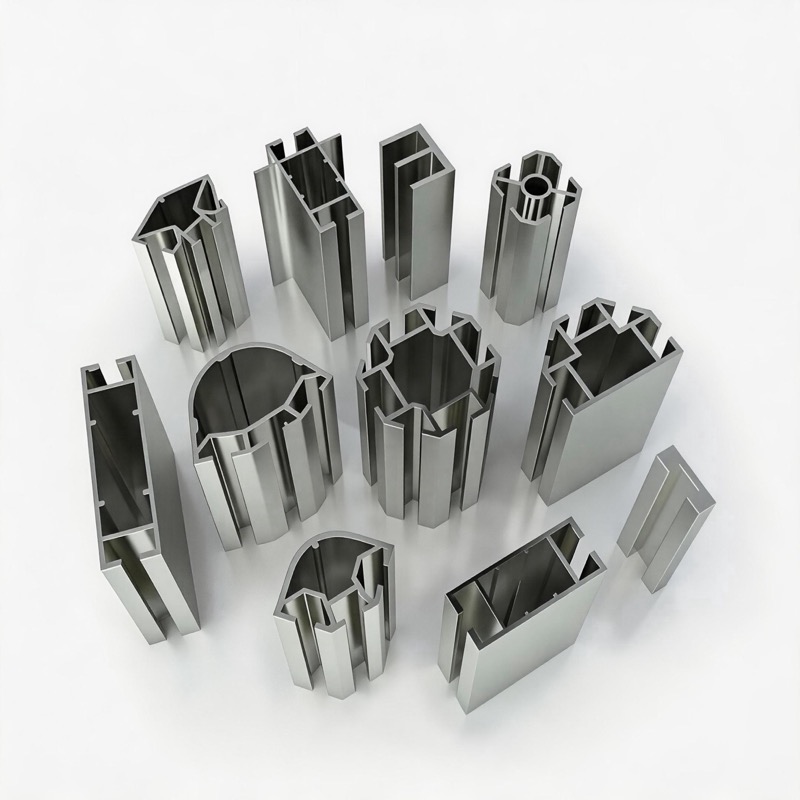
Aluminum does not rust in the same way as carbon steel because it contains no iron. When exposed to oxygen, aluminum naturally forms a thin oxide layer that helps protect the surface from further oxidation.
This natural behavior gives aluminum strong performance in many outdoor, humid, and industrial environments. Aluminum can also receive additional surface treatments to improve appearance, wear resistance, color stability, and environmental performance.
Common aluminum finishes include:
- Mill finish for general industrial use
- Anodizing for enhanced surface hardness and decorative appearance
- Powder coating for color, weatherability, and design flexibility
- PVDF coating for high-performance architectural exterior applications
- Mechanical polishing or brushing for decorative finishes
Carbon steel is vulnerable to rust when exposed to moisture and oxygen. Protective coatings are usually required, particularly in outdoor, coastal, chemical, or high-humidity environments.
Common steel protection methods include:
- Painting
- Powder coating
- Hot-dip galvanizing
- Electro-galvanizing
- Plating
- Use of stainless steel grades
Stainless steel offers much stronger corrosion resistance than carbon steel, but its material cost can be substantially higher. In some applications, aluminum can provide a more balanced combination of corrosion performance, weight reduction, appearance, and fabrication flexibility.
Aluminum is corrosion resistant, but it is not immune to corrosion. Certain environments require careful design and alloy selection, including:
- Marine or salt-spray exposure
- Alkaline concrete contact
- Strong acids or alkalis
- Dissimilar-metal connections
- Crevices that retain water and contaminants
When aluminum contacts more noble metals in the presence of an electrolyte, galvanic corrosion may occur. Proper isolation materials, drainage design, compatible fasteners, sealants, and coatings are essential.
Carbon steel is often less expensive than aluminum on a raw-material basis. This makes steel attractive for basic structural parts, high-volume fabricated components, and projects with limited upfront budgets.
But the lowest purchase price does not always produce the lowest total project cost.
A meaningful steel vs. aluminum cost comparison should include:
| Cost Factor | Aluminum Consideration | Steel Consideration |
|---|---|---|
| Raw material | Often higher than carbon steel | Often lower for carbon steel |
| Tooling | Extrusion dies can be cost-effective for custom profiles | Fabrication tooling varies by process |
| Fabrication | Can integrate functions into one extrusion | May require cutting, welding, drilling, and coating |
| Surface treatment | Often optional in non-decorative indoor uses | Usually essential for carbon steel in corrosive conditions |
| Shipping | Lower weight can reduce transport cost | Higher weight can increase freight cost |
| Installation | Easier handling may reduce labor and equipment needs | Heavier members may require more lifting capacity |
| Maintenance | Often lower in corrosion-prone environments | Coatings may need inspection and repair |
| End-of-life value | Highly recyclable | Highly recyclable |
When selecting materials for a long-term project, evaluate the total cost of ownership:
1. Material purchase price
2. Design and tooling cost
3. Fabrication and finishing cost
4. Packaging and export freight cost
5. Installation labor and equipment cost
6. Maintenance and replacement cost
7. Recovery and recycling value
For example, a powder-coated carbon steel frame may appear inexpensive at the beginning. If it is installed outdoors in a humid or coastal environment, however, coating damage and corrosion repair can become ongoing costs. A properly specified aluminum profile system may have a higher initial cost but reduce maintenance and replacement needs over its service life.
Aluminum is highly suitable for extrusion. This manufacturing process makes it possible to produce long, continuous profiles with complex cross-sections.
A custom aluminum extrusion can combine several functions into one profile:
- Structural load-bearing walls
- Internal ribs
- Screw ports
- T-slots
- Cable channels
- Drainage paths
- Cover grooves
- Thermal-break zones
- Decorative faces
- Assembly features
This integration can reduce the number of parts, simplify assembly, and improve visual consistency.
For architectural aluminum profiles, extrusion supports modern window, door, facade, louver, railing, and shading systems. For industrial aluminum profiles, it supports modular workstations, safety enclosures, automation frames, conveyors, machine guards, battery housings, and photovoltaic structures.
Steel remains a leading material for welded structures. It is highly practical for large, thick, heavily loaded components and can be cut, bent, rolled, welded, machined, and assembled through a wide range of processes.
Steel is often the practical selection for:
- Heavy equipment frames
- Large structural beams
- High-load supports
- Industrial platforms
- Warehouse racking
- Pressure vessels
- Heavy-duty brackets
- Impact-prone machinery components
The best material is not the one with the longest list of advantages. It is the one that performs reliably within the required cost, safety, manufacturing, and service-life parameters.
Both aluminum and steel are recyclable materials. Aluminum has a particularly important advantage because recycled aluminum can be remelted and reused with a very large reduction in energy demand compared with producing primary aluminum.
The International Aluminium Institute reports that recycled aluminum required about 8.3 gigajoules per tonne in 2019, compared with 186 gigajoules per tonne for primary aluminum production—a 95.5% energy saving.
This does not mean aluminum is automatically the lower-impact material in every project. Environmental performance depends on:
- Recycled content
- Alloy choice
- Product weight
- Product lifespan
- Energy use during operation
- Transport distance
- Maintenance requirements
- End-of-life recovery rate
For lightweight transport equipment, aluminum can create operational savings over many years. For stationary high-load structures, steel may remain the more efficient engineering choice. A responsible material decision should evaluate the whole lifecycle.
Use the following process before specifying steel or aluminum for a new product.
Identify static load, dynamic load, impact load, vibration, fatigue cycles, deflection limit, and required safety factor. Do not select material based on tensile strength alone.
Ask whether reducing weight will improve payload, installation speed, transport cost, energy use, or usability. If the answer is yes, aluminum deserves close consideration.
Consider moisture, salt spray, UV exposure, chemicals, temperature swings, abrasion, and dissimilar-metal contact. The surface finish and connection design should match the environment.
Determine whether a custom aluminum extrusion can eliminate welding, reduce machining, integrate channels, or simplify final assembly. For complex, repeatable profiles, extrusion may create significant value.
Include finishing, freight, installation, maintenance, and expected service life. The cheapest raw material is not always the least expensive solution.
Guangdong Dapeng Aluminum Industry Co., Ltd. provides aluminum alloy solutions for customers who need reliable quality, practical engineering support, and export-ready manufacturing capabilities.
Our product and service scope includes:
- Industrial aluminum profiles
- Architectural aluminum profiles
- Custom aluminum extrusion
- Deep processing and precision cutting
- Drilling, punching, CNC machining, and assembly support
- Surface finishing options
- Customized packaging for international shipment
- Technical support for profile development and material selection
For customers comparing steel vs. aluminum, our team can help evaluate profile geometry, alloy options, surface treatment, fabrication feasibility, and export packaging needs before production begins.
Contact Guangdong Dapeng Aluminum Industry Co., Ltd. today to discuss your aluminum profile drawings, samples, target application, and performance requirements. We can help you develop a practical, high-value aluminum solution for your industrial, architectural, transportation, or new-energy project.
Generally, steel has higher absolute strength and stiffness than common aluminum alloys. However, aluminum offers an excellent strength-to-weight ratio, and properly designed aluminum profiles can meet demanding structural requirements while substantially reducing total weight.
Yes. Aluminum has a density of about 2.7 g/cm³, while steel is roughly 7.8–7.9 g/cm³. Aluminum is therefore about one-third the density of steel.
In many environments, yes. Aluminum naturally forms a protective oxide layer, while carbon steel usually needs coating, galvanizing, or painting to prevent rust. However, marine, chemical, and dissimilar-metal environments require proper aluminum alloy selection and design precautions.
Aluminum often costs more than carbon steel per unit of raw material. However, its lower weight, corrosion resistance, simpler assembly potential, and lower maintenance needs can make aluminum more cost-effective over the full lifecycle of a project.
It depends on the load, environment, and maintenance plan. Aluminum is often a strong choice for lightweight, corrosion-resistant outdoor systems. Galvanized or coated steel may be better for highly rigid, high-load structures where weight is less important.
In many cases, yes—especially for machine guards, workstations, automation enclosures, conveyors, modular frames, and lightweight equipment structures. For very high loads, high impact, or strict deflection limits, steel may remain the better choice.
6061 and 6082 are common choices for structural aluminum applications because they provide a useful balance of strength, corrosion resistance, and machinability. The final selection should consider the specific load, fabrication method, surface treatment, and environment.
1. [Eagle Aluminum — Steel vs. Aluminum: Strength, Weight & Price Comparison]
2. [ASM International — Aluminum and Aluminum Alloys Subject Guide]
3. [ScienceDirect Topics — Aluminum Overview]
4. [Treatstock / ASM Handbook Material Reference — Aluminum and Aluminum Alloys]
5. [Aluminum Association — Industry Standards]
6. [Aluminum Association — Sustainability and Recycling]
7. [International Aluminium Institute — Aluminium Recycling Energy Savings]
8. [IOP Science — Review of Corrosion-Resistant Metastable Aluminum Alloys]


