


Views: 298 Author: Dapeng Aluminum Publish Time: 2026-08-07 Origin: Site


Content Menu
● What Are Metal Finishes vs Surface Finishes?
● Why Finish Aluminum Extrusions at All?
● Core Types of Metal Finishes for Aluminum Extrusions
>> 1. Anodizing: Durable Oxide Layer for Architecture and Solar
>> 2. Powder Coating: Color Flexibility and High Durability
>> 3. Wet Painting: Flexible but Less Robust Than Powder
>> 4. Sublimation (Wood-Grain and Decorative Patterns)
>> 5. Plating: Metal-on-Metal Finish for Premium Components
● Core Types of Surface (Mechanical) Finishes
>> 6. Brushing and Graining: Linear Texture with Defect Removal
>> 7. Grinding: Smoothing for Functional Flatness
>> 8. Mill Finish: Raw Extruded Surface
>> 9. Blasting: Cleaning and Uniform Matte Texture
● How to Select the Right Finish: A Practical Framework
● Comparative Overview of Common Aluminum Extrusion Finishes
● Emerging Trends in Aluminum Extrusion Finishing
● Practical Project Scenarios and Recommendations
>> 1: Coastal Curtain Wall System
>> 2: Industrial Machine Frames and EV Battery Racks
>> 3: Retail Fixtures and Store Systems
● How Guangdong Dapeng Aluminum Supports Finish Selection
● Discuss Your Finish Strategy with Our Technical Team
● FAQ
When you specify aluminum extrusions for a façade, industrial machine frame, or EV battery enclosure, the finish you choose often determines service life, maintenance cost, and visual impact. As a manufacturer focused on R&D, production and export of aluminum profiles, we regularly help project teams compare metal finishes (coatings and treatments applied onto aluminum) with surface or mechanical finishes (processes that remove or texture the aluminum surface itself).
This guide explains the difference between these categories, breaks down the most common options, and offers practical selection criteria based on real project experience in building, transportation, industrial manufacturing, and new energy sectors.
From an engineering perspective:
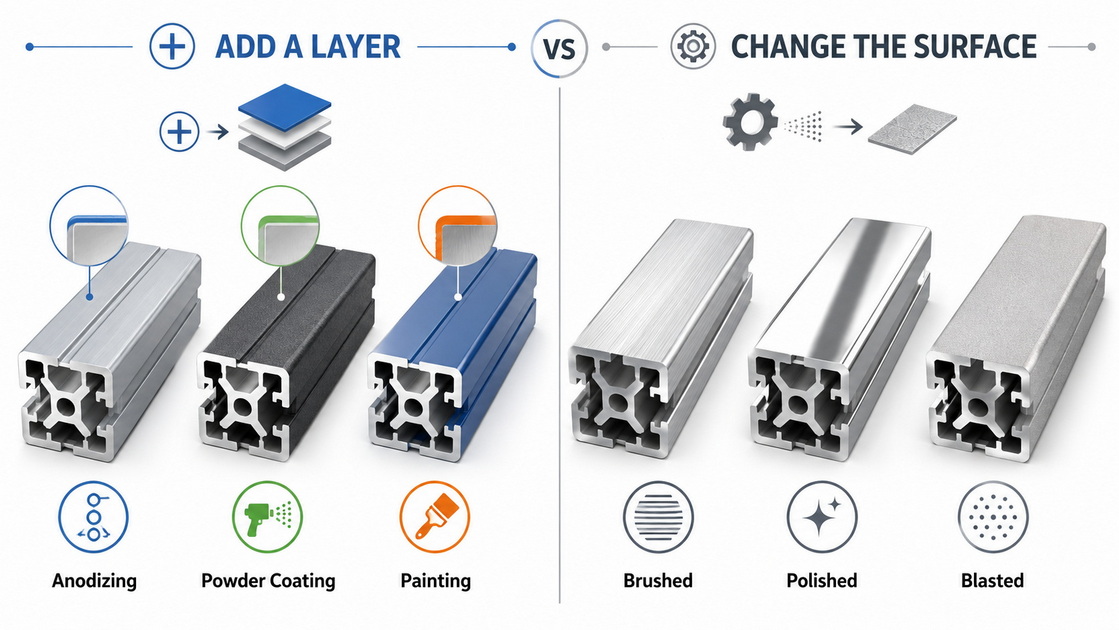
- Metal finishes (applied coatings) add a protective or decorative layer over the aluminum, improving corrosion resistance, durability, or color appearance.
- Surface finishes (mechanical finishes) alter or remove the aluminum surface layer itself to change texture, gloss, or prepare profiles for further coating.
In practice, you will often combine both. For example, a brushed mechanical finish followed by clear anodizing is common for premium architectural profiles.
Key concept:
- Metal finishes = add a layer (anodizing, powder coating, plating, paint, sublimation).
- Surface finishes = remove or mechanically texture a layer (brushing, grinding, polishing, milling, blasting).
Raw, mill-finish aluminum straight from the extrusion press is functional but not optimized for:
- Corrosion resistance in coastal, high-humidity or polluted environments.
- UV stability and color consistency for exterior façades and claddings.
- Mechanical wear on sliding components, handrails or industrial frames.
- Aesthetics and branding, where specific texture and color are part of design intent.
Finishing processes allow you to:
- Extend the service life of profiles.
- Reduce maintenance and repainting cycles.
- Align the extrusions with architectural language and corporate identity.
- Achieve functional surfaces, such as low-friction, anti-glare or easy-clean profiles.
Anodizing is an electrochemical process that converts the aluminum surface into a hard, corrosion-resistant oxide layer. The profile is submerged in an acid bath and an electric current is applied.
Benefits:
- Excellent corrosion resistance for window frames, curtain walls, solar mounting structures, and outdoor profiles.
- Stable color and matte metallic sheen, with popular options such as clear satin, black, bronze, nickel, and brite-dip finishes.
- Integrates with mechanical pre-finishes (e.g., brushed + clear anodized) for premium textures.
Typical applications:
Façade systems, architectural trims, corner guards, EV charging posts, new energy racks and frames.
- From project experience: For coastal building façades and solar frames, we consistently recommend anodizing when clients want a balance of clean metallic appearance and long-term corrosion performance without thick paint layers.
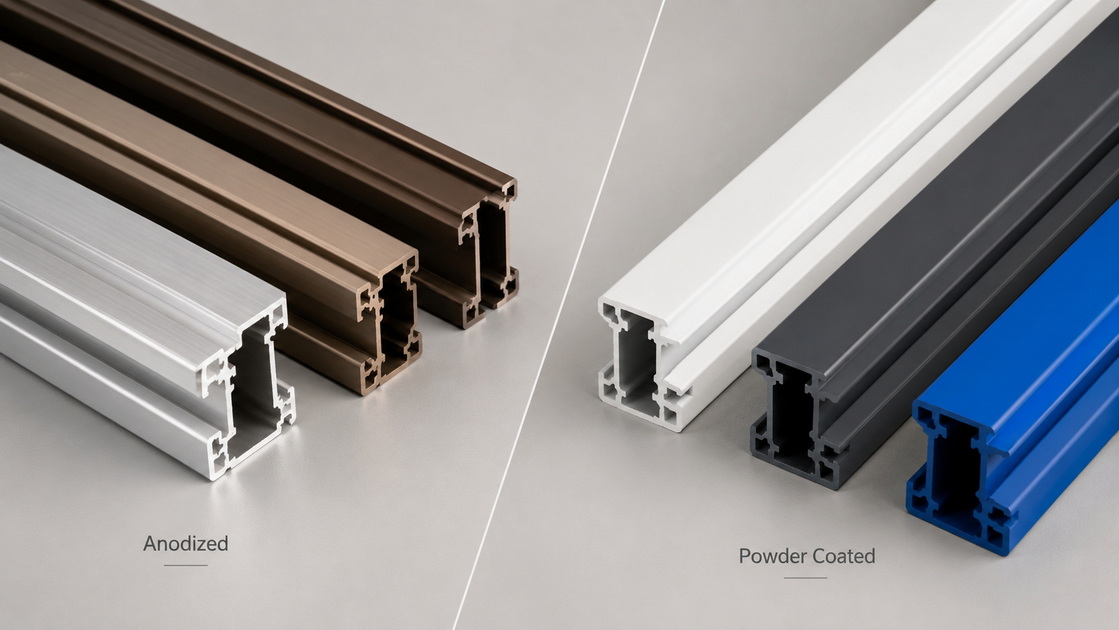
Powder coating applies a dry, electrostatically charged powder to the aluminum surface, followed by curing in an oven to form a continuous polymer film.
Benefits:
- Wide color range, gloss levels and textures (smooth, fine-textured, metallic, etc.).
- High impact and abrasion resistance, suitable for railings, balustrades, transport components.
- Good coverage on complex profiles with multiple cavities and intricate shapes.
Typical applications:
Handrails, balcony railings, signage frames, industrial machine guards, consumer-facing profiles where color is critical.
Painting aluminum uses a wet paint system applied via sprayer or pump, then dried or baked.
Benefits:
- Flexible color matching for small batches or touch-up work.
- Lower capital requirement compared to full powder coating lines.
Considerations:
- Generally less durable than powder coating in high-wear or outdoor environments.
- Requires careful surface preparation to avoid peeling or uneven film thickness.
We see wet painting mainly for interior trims, non-critical parts, or small-volume custom colors where powder coating isn't feasible.
Sublimation involves applying a base powder coat, then pressing a patterned film onto the profile. Under heat, the pattern transfers into the coating, creating wood-grain or other decorative effects.
Benefits:
- Realistic wood-like appearance without sacrificing aluminum's strength and dimensional stability.
- Design flexibility for retail fixtures, decorative panels, and outdoor components.
Typical applications:
Stackable slatwall systems, decorative façade elements, architectural trims mimicking natural materials.
Plating covers the aluminum extrusion with an additional metal layer, such as nickel, chrome, silver or gold. This can be achieved via electroplating (using electric current) or electroless plating (using autocatalytic chemistry).
Benefits:
- High-end metallic appearance with specific reflectivity or color tone.
- Can improve wear resistance and electrical properties in specialized applications.
Typical applications:
Decorative trims, display systems, specialty industrial components where aesthetic and functional metal layers are required.
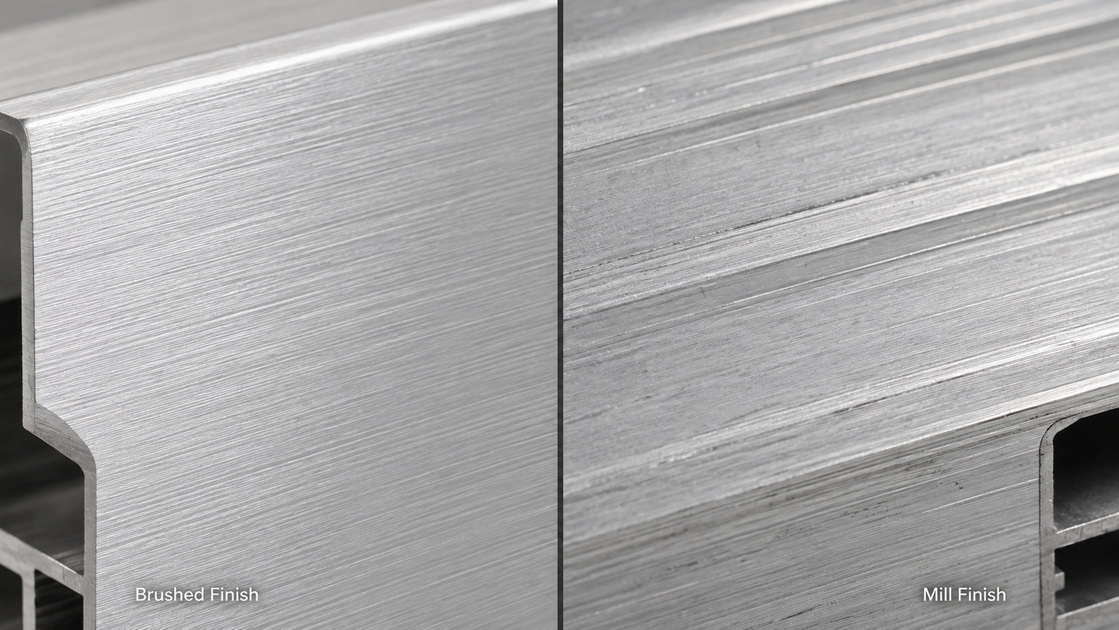
A brushed or grained finish is produced using specialized brushing wheels that remove a thin layer of material and create a uniform linear pattern.
Benefits:
- Removes minor scratches, nicks and extrusion lines.
- Creates directional textures that reduce glare and add perceived quality.
- Often used as a pre-treatment before anodizing, resulting in durable, high-end surfaces.
Typical applications:
Visible trims, architectural details, store fixtures, consumer-facing profiles where touch and visual texture matter.
Grinding uses abrasive tools to smooth the aluminum surface to a defined level of roughness.
Benefits:
- Reduces surface roughness for mating surfaces, sealing interfaces, and mechanical assemblies.
- Prepares profiles for tight fit and improved mechanical performance.
Common in industrial frames, machinery extrusions, and precision structural components.
A mill finish is the natural surface condition of aluminum after passing through the extrusion die, rolling mill or drawing process.
Characteristics:
- Visible tool marks and extrusion lines.
- Rougher feel, dull gray appearance.
When it works:
- Hidden parts, interior structural elements, or components that will later be coated, bonded or encapsulated.
- Projects where budget and functional performance matter more than aesthetics.
Abrasive blasting propels particles like sand, glass beads, steel grit, water or dry ice at high pressure to clean and texture the surface.
Benefits:
- Efficient removal of contaminants, oxides and previous coatings.
- Creates a uniform matte texture that can be left as-is or used as a base for coatings.
Used in industrial, automotive and structural aluminum where both cleanliness and controlled roughness are required.
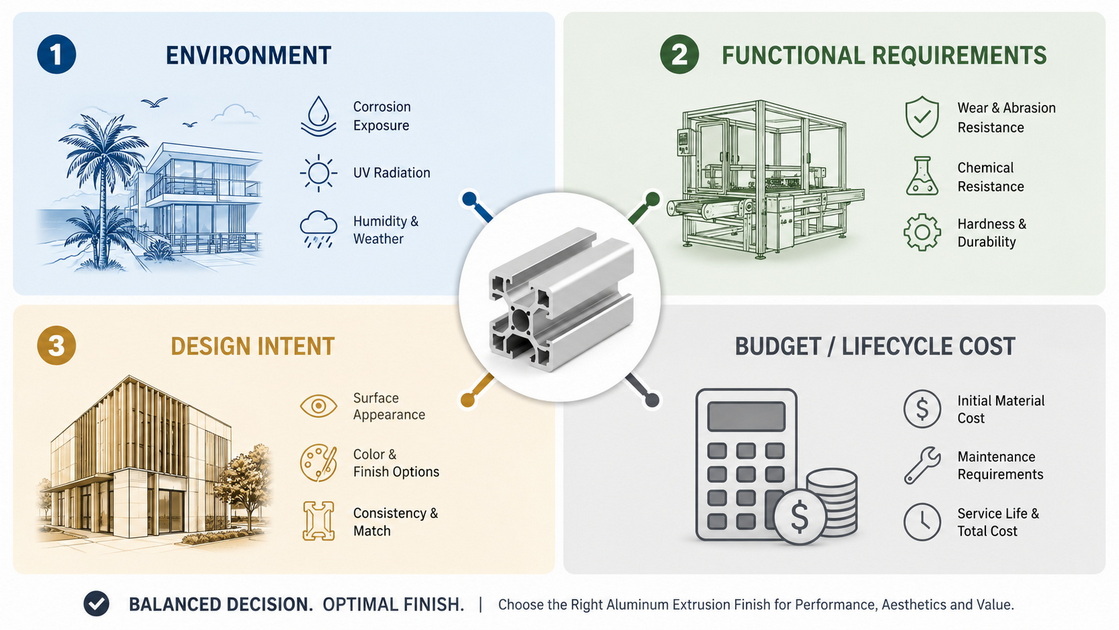
When advising architects, engineers and procurement teams, we recommend evaluating finishes using four practical dimensions:
1. Environment and exposure
- Indoor vs outdoor, coastal vs inland, high UV, humidity and pollution levels.
- For harsh outdoor conditions, anodizing or high-performance powder/PVDF coatings are preferred.
2. Functional requirements
- Corrosion resistance, abrasion resistance, friction level, cleanability.
- Sliding components may need smoother surfaces; façades may need UV-resistant finishes.
3. Design intent
- Color, gloss, texture, alignment with architectural style.
- Powder coating and sublimation offer the broadest design freedom; brushed anodized gives a premium metallic look.
4. Budget and lifecycle cost
- Initial finishing cost vs expected lifespan, maintenance cycles and replacement cost.
- Mill finish can be sufficient for hidden industrial parts; higher-end finishes pay off in reduced long-term maintenance for façades and public infrastructure.
| Finish type | Visual effect | Protection level | Typical applications |
|---|---|---|---|
| Mill finish | Dull gray, tool marks | Low | Hidden parts, internal structures, coated laters |
| Brushed + anodized | Linear texture, matte metallic sheen | Medium–High | Façade trims, premium architectural profiles |
| Anodized | Matte metallic, stable color | Medium–High | Windows, solar frames, outdoor structures |
| Powder coated | Solid color, variable gloss | High | Railings, signage, building components |
| Painted | Custom color, thinner film | Medium | Interior trims, small batches, touch-ups |
| Sublimation | Wood-grain or patterned finish | High (over powder) | Decorative façades, retail fixtures |
| Plated | Bright metallic, chrome/nickel/gold | Medium–High (case-specific) | Decorative trims, specialty industrial parts |
| Blasted | Uniform matte, textured surface | Medium (base + topcoat) | Industrial and structural aluminum, pre-coating |
From recent market analyses and customer projects, we see three notable trends:
- Advanced oxide coatings: Technologies such as micro-arc oxidation create ceramic-like oxide layers that are significantly harder than conventional anodizing, improving wear resistance for high-stress components.
- Wood-grain and natural material aesthetics: Sublimation and transfer printing are widely adopted for decking systems, façades and interior cladding, enabling aluminum to visually replicate wood while retaining its structural advantages.
- Sustainability and low-carbon production: More projects specify finishes compatible with recycled aluminum and lower-energy processes, balancing aesthetics with environmental performance.
For export-focused projects, we proactively discuss local environmental regulations, VOC limits and durability standards to align finishing choices with the target market.
- Requirements: High corrosion resistance, stable color over 20+ years, low maintenance.
- Recommended: Brushed + clear anodized or high-performance powder coating (or PVDF).
- Reasoning: Anodized finishes provide durable oxide protection; powder/PVDF offer thicker barriers against salt and UV.
- Requirements: Functional structure, often hidden, cost-sensitive, occasional chemical exposure.
- Recommended: Mill finish or blast + protective coating where exposure demands it.
- Reasoning: Mill finish is cost-effective for non-visible parts; targeted coatings are used on areas facing aggressive environments.
- Requirements: Strong visual identity, tactile quality, durable yet decorative finishes.
- Recommended: Brushed aluminum + anodizing, powder-coated color schemes, or wood-grain sublimation for slatwall and decorative trims.
- Reasoning: Combination of mechanical texture with coating delivers high perceived quality and robust performance in high-traffic environments.
As a modern aluminum profile manufacturer with integrated R&D, production and export capabilities, Guangdong Dapeng Aluminum Industry Co., Ltd. supports clients through:
- Application-specific consulting: Matching finishes to exposure, structural requirements and local standards across building, industrial, transport and new energy projects.
- Custom extrusion and deep processing: Designing profiles that optimize finish performance, including edges, drainage paths and assembly interfaces.
- Stable quality control: From surface preparation to finishing line inspection, we maintain consistent film thickness, adhesion, color uniformity and defect removal.
- Global logistics and compliance: Experience in delivering finished profiles to multiple regions, considering regional codes, environmental regulations and customer preferences.
If you're evaluating finishes at the specification stage, our technical team can review drawings, environment data and aesthetic goals to propose a finish package with clear lifecycle expectations.
Choosing the right finish is not just an aesthetic decision—it's a performance, maintenance and budget strategy. If you're planning a new façade system, industrial frame or new energy project and need to align design intent, environmental exposure and lifecycle cost, our engineers can help:
- Review your drawings and environmental conditions.
- Recommend finish combinations (e.g., brushed + anodized or blasted + powder coated).
- Provide samples and technical data for specification and approvals.
Contact Guangdong Dapeng Aluminum Industry Co., Ltd. to schedule a consultation or request finish samples tailored to your project.
Q1: What is the main difference between metal finishes and surface finishes for aluminum extrusions?
Metal finishes add a coating or metal layer onto the aluminum to improve corrosion resistance, durability or color, while surface finishes remove or texture the aluminum surface itself to change roughness, appearance or prepare it for further treatment.
Q2: Which finish is best for coastal architectural projects?
For coastal façades and curtain wall systems, anodizing or high-performance powder/PVDF coatings are commonly recommended because they provide robust resistance to salt spray, UV and humidity when applied over properly prepared surfaces.
Q3: When is a mill finish acceptable?
Mill finish is widely used for hidden or internal structural components, or where the aluminum will later be encapsulated or coated, and visual appearance is not critical, making it a cost-effective choice.
Q4: Can I combine mechanical and metal finishes on the same profile?
Yes. It is common to apply a brushed or blasted mechanical finish first, then follow with anodizing or powder coating to achieve both a specific texture and enhanced durability.
Q5: How should I decide between powder coating and wet painting?
Use powder coating when you need high durability, thick and uniform films and outdoor performance, especially for railings or exposed frames. Wet painting is more suitable for small-batch custom colors or interior trims where extreme durability is not required.
1. Eagle Mouldings – "Metal Finishes vs Surface Finishes for Aluminum Extrusions"
[https://eagle-aluminum.com/metal-finishes-vs-surface-finishes-for-aluminum-extrusions/] [eagle-aluminum]
2. Monarch Metal – "Metal Finish vs. Surface Finish in Metal Fabrication"
[https://www.monarchmetal.com/blog/metal-finish-vs-surface-finish-in-metal-fabrication/] [monarchmetal]
3. Light Metals Coloring – "Types of Aluminum Finishes | Coatings & Surface Options"
[https://www.lightmetalscoloring.com/different-types-of-aluminum-finishes] [lightmetalscoloring]
4. Shengxin Aluminium – "Finishes For Aluminum Extrusions: Match Your Project To The Right Coating"
[https://www.shengxinaluminium.com/finishes-for-aluminum-extrusions-match-your-project-to-the-right-coating_n684] [shengxinaluminium]
5. TBK Metal – "Aluminium Finishes: Types, Applications, and Benefits"
[https://www.tbkmetal.com/aluminium-finishes-types-applications] [tbkmetal]
6. MMG Extrusions – "Choosing the Right Finish for Your Aluminum Extrusion"
[https://mmgextrusions.com/resources/choosing-right-finish-for-aluminum-extrusion] [mmgextrusions]
7. SinoExtrud – "Aluminum extrusion surface finish standards?"
[https://sinoextrud.com/aluminum-extrusion-surface-finish-standards] [sinoextrud]
8. Wrisco – "5 Types of Aluminum Finishes and When to Use Them"
[https://www.wrisco.com/5-types-of-aluminum-finishes-when-to-use-them] [wrisco]
9. Timesavers – "Types of Metal Finishes"
[https://timesaversinc.com/blog/types-of-metal-finishes] [timesaversinc]
10. Shengxin Aluminium – "Aluminum Extrusion Market Trends: What Supply Chain Shifts Signal Next"
[https://www.shengxinaluminium.com/aluminum-extrusion-market-trends-what-supply-chain-shifts-signal-next_n790] [shengxinaluminium]


