


Views: 228 Author: Dapeng Aluminum Publish Time: 2026-11-02 Origin: Site


Content Menu
● Start With a Functional Specification, Not a Target Price
● Understand the Total Cost of Custom Aluminum Extrusion Profiles
● Choose the Right Aluminum Alloy and Temper
>> When 6063 Is a Practical Starting Point
>> When 6061 Deserves Consideration
● Reduce Extrusion Costs Through Better Profile Design
>> Balance Wall Thickness Before Reducing Weight
>> Integrate Features That Remove Later Operations
● Use Multiple Specifications Without Multiplying Complexity
● Specify Tolerances and Finishes Where They Matter
>> Apply Tight Tolerances Selectively
>> Match the Finish to Exposure and Appearance
● Compare Standard Profiles With Fully Custom Extrusions
● A Practical Budget Example: Compare Finished Parts
● Manage Tooling, Order Quantities, and Delivery Together
>> Clarify Die Ownership and Revision Responsibility
>> Ask About Minimums by Process
● Prevent Quality Problems Before Volume Production
● Prepare a Quotation Request That Suppliers Can Answer Accurately
● Conclusion: Build the Budget Around the Finished Product
>> 1. Are custom aluminum extrusion profiles always more expensive than standard profiles?
>> 2. Which aluminum alloy is best for an affordable custom profile?
>> 3. Can thinner walls reduce extrusion costs?
>> 4. What is the minimum order quantity for custom aluminum extrusions?
>> 5. How can I compare quotations from different manufacturers?
>> 6. What should I approve before mass production?
Choosing custom aluminum extrusion profiles within budget starts with a simple principle: buy the performance your application needs, not specifications it will never use. The lowest price per kilogram is not always the lowest cost per finished component. Tooling, machining, finishing, packaging, and rejected parts can change the final calculation.
For buyers comparing multiple specifications, the challenge is balancing design flexibility with predictable spending. A practical approach connects every requirement to its purpose: strength, appearance, assembly, durability, or compliance.
This guide explains how to compare affordable custom aluminum profiles, identify unnecessary costs, and prepare a quotation request that produces meaningful supplier comparisons.
Before requesting prices, define what the profile must accomplish. Otherwise, suppliers may quote different alloys, tolerances, finishes, and processing levels under the same product description.
Prepare a short application brief covering:
- Intended use and installation environment.
- Loads, spans, and attachment points.
- Cross-sectional dimensions and finished lengths.
- Mating components and assembly methods.
- Visible surfaces and appearance expectations.
- Initial quantity and estimated repeat demand.
- Required testing, documentation, and delivery destination.
Separate requirements into essential, preferred, and optional categories.
For example, a mating slot may need close dimensional control, while a concealed external surface may not need a premium cosmetic finish. This distinction helps protect function without paying for unnecessary precision everywhere.
A useful purchasing metric is cost per accepted finished component, rather than extrusion price alone.
Your comparison should include the following categories:
| Cost category | What to clarify before ordering |
|---|---|
| Material and extrusion | Alloy, temper, profile weight, and pricing basis |
| Tooling | Die charges, trials, revisions, ownership, and maintenance |
| Fabrication | Cutting, drilling, tapping, milling, and deburring |
| Surface treatment | Finish specification, coverage, and inspection criteria |
| Quality assurance | Sampling, testing, documentation, and acceptance rules |
| Packaging and delivery | Protection, freight, insurance, and import charges |
Ask whether machining, finishing, and packaging are included or charged separately. Also confirm whether the quotation covers the ordered quantity or allows an agreed delivery variation.
A transparent quotation makes trade-offs visible. An incomplete quotation simply postpones the cost discussion.
Alloy 6063 is widely used for architectural profiles and visible industrial components because it combines good extrudability, corrosion resistance, and surface-finishing characteristics.
Typical applications include window frames, door sections, decorative profiles, and various tubular shapes.
However, choosing 6063 should follow a performance review—not an assumption that every architectural-looking component has the same requirements.
Alloy 6061 is commonly considered for structural and machined components where its mechanical properties and fabrication characteristics are useful.
It may suit equipment supports, transportation components, and parts requiring substantial secondary machining.
Do not upgrade automatically. A higher-strength alloy does not automatically solve excessive deflection; profile geometry and section properties also matter.
Specify the temper alongside the alloy. Heat-treatment condition affects mechanical properties, and subsequent welding or fabrication can change local performance. Load-bearing applications require engineering verification of the finished component.
Thinner walls reduce material consumption, but extremely thin sections can make extrusion more difficult. Abrupt transitions between thick and thin areas can also contribute to distortion and surface defects.
The better starting point is balanced wall thickness with smooth transitions.
Ask the manufacturer to review:
- Thick-to-thin junctions.
- Deep, narrow channels.
- Unsupported projecting features.
- Sharp internal corners.
- Hollow sections and internal webs.
- Features that complicate die construction.
Do not eliminate hollows simply because they add tooling complexity. A hollow profile may provide useful stiffness or replace several assembled components. Evaluate the complete design.
Custom extrusion can create continuous grooves, channels, and locating features directly in the cross-section.
These features may reduce downstream machining or simplify assembly. For example, an integrated locating groove may replace a separately machined reference feature.
However, extrusion does not create every finished detail. Cross-holes, localized pockets, and many threaded features still require secondary processing.
Compare the cost of the integrated design with the operations it actually removes.
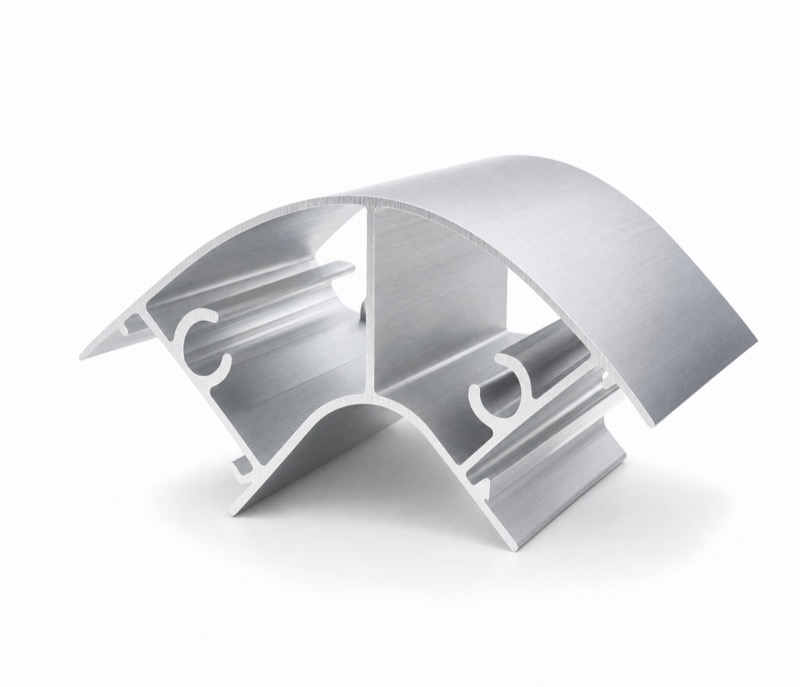
A broad product range does not need a completely different profile for every model.
One useful strategy is to create a profile family: several products share a common cross-section while using different cut lengths, hole patterns, or finishes.
This approach can simplify:
- Die management.
- Material planning.
- Component identification.
- Replacement-part stocking.
- Purchasing and repeat ordering.
For example, equipment frames of different lengths may share one extrusion design, provided the section remains suitable for each loading condition.
Where different cross-sections are necessary, standardize compatible fasteners and connection interfaces. Design variety should serve customer needs rather than create avoidable production complexity.
A blanket demand for unusually tight tolerances can increase manufacturing difficulty without improving the product.
Identify critical dimensions on the drawing. These may include connection slots, sealing interfaces, alignment surfaces, or dimensions controlling assembly fit.
Also address straightness, twist, flatness, and cut-length tolerance where relevant. A profile can meet its cross-sectional dimensions yet still create assembly problems if these characteristics are overlooked.
Agree on an applicable dimensional standard and any exceptions. Confirm whether inspection occurs before or after finishing, since coating thickness can affect mating features.
Mill finish, anodizing, and powder coating serve different needs. None should be selected solely by appearance or an assumption that it is always cheapest.
Consider exposure, cleaning, corrosion requirements, visible surfaces, and mating dimensions.
For anodizing or powder coating, specify the required treatment rather than requesting a vague "high-quality finish." Define color, texture, relevant thickness requirements, and acceptable appearance.
An approved sample helps establish expectations, especially for components installed next to one another.
Before paying for a new die, ask whether an existing section can meet the requirement.
A standard profile may be attractive for prototypes, low-volume projects, and applications where the geometry is flexible.
Custom tooling becomes more attractive when a dedicated section reduces weight, machining, fasteners, or assembly labor across sufficient production volume.
The decision should compare complete production routes:
1. Standard profile plus additional fabrication.
2. Modified existing profile, where technically practical.
3. New custom extrusion with integrated features.
Include expected repeat orders in the calculation, but do not justify tooling against demand that has not been reasonably established.
Consider a hypothetical order for 1,000 finished components:
| Expense | Option A: Lower extrusion price | Option B: Simplified fabrication |
|---|---|---|
| Extruded material | $4,000 | $4,400 |
| Tooling | $600 | $900 |
| Machining | $2,000 | $900 |
| Finishing | $800 | $800 |
| Packaging and freight | $700 | $700 |
| Total | $8,100 | $7,700 |
| Cost per component | $8.10 | $7.70 |
These figures illustrate a purchasing method; they are not market prices or a company quotation.
Option B costs more for material and tooling but saves $1,100 in machining, producing a $400 overall reduction.
The next question is whether the machining savings are technically achievable. Request a process review before treating them as guaranteed.
If rejection rates differ, divide each total by the number of accepted components rather than the ordered quantity.
Before approving tooling, establish:
- Who owns the die.
- Where it will be stored.
- What maintenance is included.
- How long it will be retained.
- Who pays for design changes.
- Whether replacement or transfer is possible.
Separate supplier corrections from buyer-requested changes. A late drawing revision can affect tooling, samples, and delivery timing.
Minimum order requirements may apply separately to extrusion, a specific alloy, finishing color, or fabrication setup.
Ask for price breaks at realistic quantities. Then compare any unit-price reduction with storage, financing, and inventory-obsolescence costs.
Larger orders are not automatically more economical if the design is still changing.
For exports, compare agreed delivery terms carefully. Freight, destination handling, taxes, and any applicable trade-remedy duties can materially affect the landed budget. Confirm current requirements with a qualified customs professional.
A controlled approval process is often more valuable than negotiating a small price reduction.
Use the following sequence:
1. Freeze the drawing revision and commercial specification.
2. Review manufacturability before authorizing the die.
3. Inspect trial samples against agreed dimensions.
4. Test fit with actual mating components.
5. Approve finish and packaging samples.
6. Record acceptance criteria before volume production.
Request inspection evidence proportionate to the application. This may include material certification, dimensional reports, mechanical-property results, or finish testing.
For critical products, clarify traceability and change-control requirements. An approved first sample does not replace an agreed production inspection plan.
A complete request helps manufacturers identify realistic savings instead of guessing which requirements can change.
Send:
- A dimensioned drawing and, preferably, a compatible 3D model.
- Alloy and temper requirements, or a request for recommendations.
- Critical dimensions and applicable standards.
- Finished lengths and fabrication details.
- Surface-treatment and appearance requirements.
- Quantity per specification and annual demand estimates.
- Packaging, destination, and required delivery date.
Ask suppliers to quote the original design and a separately identified cost-reduction alternative.
This creates a useful comparison without allowing unapproved substitutions to enter the order.
Affordable custom aluminum extrusion profiles result from coordinated decisions about geometry, alloy, tolerances, fabrication, and purchasing—not simply choosing the lowest material price.
Guangdong Dapeng Aluminum Industry Co., Ltd. focuses on aluminum-profile development, manufacturing, and export, offering industrial profiles, architectural profiles, and customized deep-processing services.
Send your drawings, application requirements, quantities, finish preferences, and delivery destination to request a specification-based quotation. Ask the team to review both your original design and practical alternatives that could reduce total cost while preserving required performance.
Not necessarily. Custom tooling adds an initial expense, but a dedicated profile may reduce machining, assembly, or material use. Compare the complete finished component at realistic production quantities.
There is no universal answer. Alloy 6063 often suits visible architectural profiles, while 6061 is commonly considered for structural or machined components. Application, temper, and fabrication requirements determine the appropriate choice.
Sometimes. Lower material weight may help, but very thin walls can increase extrusion difficulty. Review wall balance, strength, handling, and manufacturing feasibility before reducing thickness.
It varies by supplier, profile, alloy, and finishing process. Request separate clarification of extrusion minimums and any additional minimums for coating or fabrication.
Use identical drawings, quantities, alloy, temper, finish, and delivery terms. Separate tooling from recurring costs and compare the landed cost of accepted finished parts.
Approve the drawing revision, material specification, critical dimensions, sample fit, finish, and packaging. Also document inspection requirements and how nonconforming products will be handled.
- Aluminum Extruders Council — "Aluminum Extrusion Key Design Considerations." Guidance on profile geometry, balanced walls, tooling considerations, and manufacturing economics. [aec]
- Aluminum Extruders Council — "Aluminum Extrusion Design Tips." Guidance on wall-thickness transitions, corners, and extrusion-friendly design. [aec]
- Aluminum Extruders Council — "Should You Consider the Use of Custom Aluminum Extrusion?" Discussion of custom-profile economics, fabrication savings, tolerances, and visible surfaces. Historical tooling figures were not used as current quotations. [aec]
- Hydro — "Alloys for Extruded Aluminum Profiles." Guidance on selecting alloys and tempers according to environment, finish, strength, and fabrication requirements. [hydro]
- Hydro — "6063 Alloy." Application guidance covering extrudability, architectural uses, surface quality, and temper selection. [hydro]
- Hydro — "6061 Alloy." Application guidance covering structural uses, machining, and fabrication. [hydro]
- U.S. Department of Commerce, International Trade Administration — "Final Determinations in the AD/CVD Investigations of Aluminum Extrusions from Multiple Countries," September 27, 2024. Background illustrating trade-remedy considerations; not a statement of current duty liability for any shipment. [trade]


