


Views: 217 Author: Dapeng Aluminum Publish Time: 2026-09-12 Origin: Site


Content Menu
>> How Aluminum Extrusion Works
>> How Aluminum Die Casting Works
● Extruded Aluminum vs. Cast Aluminum at a Glance
● Mechanical Properties: Strength Is More Than an Alloy Number
>> Practical Strength Guidance
● Design Flexibility: Continuous Profiles vs. Complex 3D Shapes
>> When Extrusion Is the Better Design Route
>> When Casting Is the Better Design Route
● Cost Comparison: Tooling Cost Is Only One Part of the Decision
● Surface Finish, Corrosion Resistance, and Appearance
● A Practical Selection Checklist for Buyers
● Expert Insight: Design the Part for the Process, Not Against It
● Quality Control Requirements for Export Projects
● Environmental Considerations and Material Efficiency
● Final Recommendation: Which Is Better?
● FAQ
>> 1. Is extruded aluminum stronger than cast aluminum?
>> 2. Is cast aluminum cheaper than extruded aluminum?
>> 3. Can extruded aluminum have hollow sections?
>> 4. Which aluminum process is better for outdoor products?
>> 5. Can cast aluminum be welded?
>> 6. Which process is better for a custom aluminum enclosure?
>> 7. What information should I provide when requesting a quotation?
When buyers compare extruded aluminum vs. cast aluminum, the real question is not which material is universally better. It is which manufacturing route delivers the required shape, strength, consistency, finish, production volume, and total project value.
At Guangdong Dapeng Aluminum Industry Co., Ltd., we work with customers who need aluminum solutions for construction, industrial equipment, transportation, energy systems, and custom-engineered components. From a manufacturing perspective, the decision between aluminum extrusion and aluminum casting should be made early—ideally while the product drawing is still being developed. That decision affects tooling, lead time, assembly methods, material performance, surface treatment, and long-term reliability.
Extruded aluminum is usually the stronger choice for long parts with a consistent cross-section, such as frames, rails, heat sinks, window systems, solar mounting structures, machine guards, and transport profiles. Cast aluminum is often more suitable for compact, three-dimensional parts with ribs, bosses, enclosed cavities, and irregular geometry, such as housings, brackets, engine components, pump bodies, and automotive parts.
This guide explains the practical differences between extruded aluminum and cast aluminum, including manufacturing processes, alloy options, mechanical performance, design freedom, cost structure, quality control, finishing, sustainability, and sourcing considerations.
Extruded aluminum is produced by heating an aluminum billet and forcing it through a precision die. The metal exits the die as a long profile with a continuous cross-section.
Think of it as squeezing softened metal through a specially designed opening. The shape of that opening determines the profile shape.
A single aluminum extrusion die can produce many different profile designs, including:
- T-slots and industrial framing profiles
- U-channels and C-channels
- Angles, tubes, and rectangular sections
- Curtain wall and window profiles
- Solar panel mounting rails
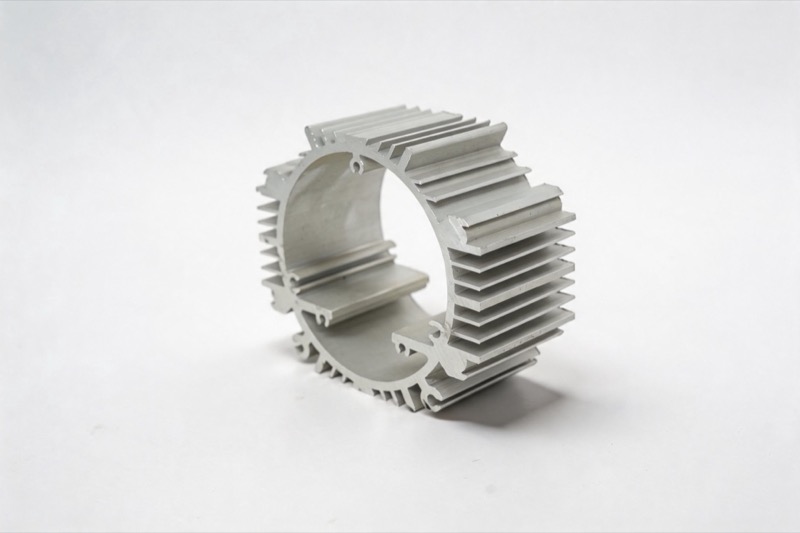
- Heat sinks and electronic enclosures
- Conveyor rails and automation components
- Custom hollow aluminum profiles
- Transportation and battery-system components
The key characteristic of an aluminum extrusion is that its cross-section remains the same along its length. The profile may be cut, drilled, machined, bent, welded, assembled, anodized, powder coated, or processed further after extrusion.
Although process details vary by alloy, profile complexity, and production requirements, the standard aluminum extrusion workflow includes several stages:
1. Billet selection and heating
Aluminum billets are selected according to the required alloy and temper. The billet is heated until it becomes soft enough to flow through the die without melting.
2. Die preparation
The extrusion die is engineered to create the required profile geometry. Die design has a direct impact on profile accuracy, wall-thickness balance, surface quality, and production efficiency.
3. Profile extrusion
A hydraulic ram pushes the heated billet through the die. The emerging material forms a continuous aluminum profile.
4. Cooling and quenching
The profile is cooled using air, water, or another controlled method. Cooling conditions influence the final mechanical properties.
5. Stretching and straightening
The profile is stretched to improve straightness, reduce residual stress, and support dimensional stability.
6. Cutting, aging, and finishing
The extrusion is cut to specified lengths. Depending on the alloy and required temper, it may undergo artificial aging, machining, drilling, punching, bending, anodizing, powder coating, or assembly.
For industrial and architectural buyers, the greatest advantage is often not simply material strength. It is the ability to create a lightweight, repeatable, long-length structural profile that can be integrated into a wider system.
Cast aluminum is produced by melting aluminum alloy and pouring or injecting the molten metal into a mold. Once the metal solidifies, the part is removed, trimmed, inspected, and finished as needed.
Casting allows manufacturers to produce parts with complex three-dimensional geometry that would be difficult, expensive, or impossible to obtain through standard extrusion.
Common cast aluminum products include:
- Automotive transmission housings
- Motor housings
- Gearbox cases
- Pump bodies
- Lighting housings
- Appliance components
- Engine parts
- Industrial brackets
- Valve bodies
- Machinery covers
- Electronic equipment housings
Several casting processes are available, including sand casting, gravity die casting, permanent mold casting, and high-pressure die casting. High-pressure die casting is commonly used for high-volume production because molten metal can be injected into a steel die at high speed and pressure.
The aluminum die casting process usually follows these steps:
1. Mold or die preparation
The die is designed around the final part geometry, including parting lines, gates, runners, vents, ejector pins, and any moving cores.
2. Melting the alloy
Aluminum alloy ingots are melted and prepared for casting. Melt cleanliness and temperature control are important to final part quality.
3. Injection or filling
Molten aluminum is introduced into the die cavity. In high-pressure die casting, the metal is injected under pressure to fill detailed features quickly.
4. Solidification
The metal cools and solidifies inside the die. Cooling rate, wall thickness, gating, and venting all influence part integrity.
5. Ejection and trimming
The casting is removed from the mold. Excess metal from gates, runners, and flash is trimmed.
6. Machining and finishing
The part may undergo machining, deburring, shot blasting, coating, leak testing, impregnation, threading, or other secondary operations.
Casting provides excellent freedom for three-dimensional forms. However, it also requires careful process planning because internal porosity, shrinkage, inclusions, and uneven cooling can affect mechanical properties and pressure tightness.
The following table summarizes the most important differences between aluminum extrusion and aluminum casting.
| Comparison Factor | Extruded Aluminum | Cast Aluminum |
|---|---|---|
| Manufacturing method | Heated billet is forced through a die | Molten alloy is poured or injected into a mold |
| Typical shape | Long profile with a constant cross-section | Complex three-dimensional component |
| Design freedom | Excellent for channels, tubes, rails, frames, and hollow profiles | Excellent for irregular shapes, ribs, bosses, cavities, and compact parts |
| Common alloys | 6060, 6061, 6063, 6005A, 6082, 7075 | A356, A380, ADC12 and other casting alloys |
| Mechanical consistency | Usually high across the profile length | Can vary based on porosity, wall thickness, cooling, and casting quality |
| Surface quality | Often smooth directly after extrusion | Usually requires more finishing for premium appearance |
| Dimensional control | Strong for cross-sectional dimensions and straight profiles | Good for near-net-shape parts, but depends on die design and process control |
| Structural applications | Highly suitable for beams, frames, rails, supports, and enclosures | Suitable when geometry is complex and structural demands are carefully engineered |
| Hollow sections | Efficient and practical with suitable die design | Possible but may require cores and more complex tooling |
| Welding | Often practical for suitable extrusion alloys | Can be challenging if internal gas porosity is present |
| Machining | Generally predictable and efficient | Possible, but local porosity can affect machining results |
| Tooling | Extrusion die required | Casting mold/die required, often more complex |
| Best fit | Continuous profiles and modular assemblies | Complex 3D components and near-net-shape production |
A common buying mistake is assuming that all aluminum parts with a similar alloy name will perform the same way. In practice, performance depends on the alloy, temper, wall thickness, manufacturing process, heat treatment, part geometry, and quality control system.
For many industrial applications, extruded aluminum offers an advantage because common extrusion alloys such as 6061-T6, 6063-T5, 6063-T6, 6005A, and 6082 can provide strong, consistent, and predictable mechanical performance.
Extruded profiles can also be designed with internal webs, ribs, hollow chambers, and optimized wall thicknesses. This allows engineers to place material where it contributes most to stiffness and load-bearing capacity.
For example, a solar mounting rail does not need to be a solid bar. An optimized extruded profile can include internal strengthening ribs and mounting channels while reducing unnecessary weight.
Cast aluminum can also offer good strength, especially when the right alloy and casting route are selected. However, casting quality is highly dependent on process control. Internal pores or shrinkage cavities can reduce fatigue resistance, affect pressure tightness, and create challenges during welding or machining.
High-pressure die casting does not automatically mean poor quality. Modern tooling, vacuum-assisted processes, controlled filling, appropriate gate design, and rigorous inspection can substantially improve outcomes. But buyers should define quality expectations clearly before tooling is finalized.
Choose extruded aluminum when your part needs:
- Long-term structural stability
- Repeated loading or vibration resistance
- High straightness requirements
- A consistent material structure
- Efficient welding or fabrication
- Lightweight hollow-section design
- Long lengths with identical cross-sections
Choose cast aluminum when your part needs:
- Complex three-dimensional geometry
- Integrated mounting points and ribs
- Curved, enclosed, or irregular features
- A compact near-net-shape component
- Reduced assembly of several separate parts
- High-volume repeat production of a detailed component
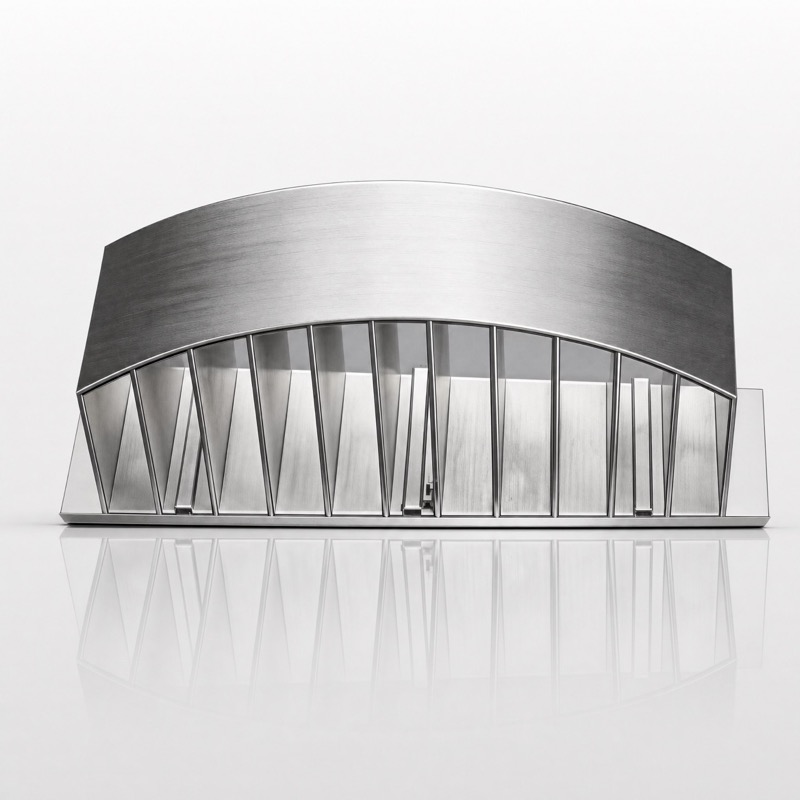
The most reliable way to compare extruded aluminum vs. cast aluminum is to begin with geometry.
Extrusion is the preferred option when the part has a constant or nearly constant cross-section. This is common in architectural systems, industrial equipment, transportation structures, electronics, and renewable-energy products.
Extrusion works especially well for:
- Frames and support structures
- Machine enclosures
- Door and window systems
- Curtain wall profiles
- Conveyor components
- Heat sinks
- Battery trays and rails
- Ladder profiles
- Automotive roof rails
- Truck body structures
- Modular workstations
- Pneumatic and automation framing
The profile can later be cut to length, drilled, tapped, CNC machined, bent, welded, or assembled with fasteners.
From a product-development perspective, extrusion often creates an opportunity to combine several functions into one profile. A single extrusion can include a mounting groove, cable channel, screw port, sealing surface, reinforcement rib, and decorative face.
That can reduce the number of parts, simplify assembly, and improve consistency.
Casting is usually more appropriate when the part needs complex geometry in multiple directions.
A cast aluminum part may include:
- Deep pockets
- Rounded external surfaces
- Reinforcing ribs
- Thick and thin sections
- Integrated bosses
- Threaded inserts
- Enclosed cavities
- Non-linear shapes
- Mounting feet
- Complex internal flow channels
For example, a motor housing may require integrated mounting ears, cooling fins, bearing seats, wire-entry features, and irregular external curves. Manufacturing that component as an extrusion would require extensive machining, multiple fabricated pieces, or an entirely different design approach.
Casting can consolidate these functions into one component.
Many buyers focus first on the cost of the extrusion die or casting mold. That is important, but it is not the full cost picture.
The better question is: Which process produces the required part at the lowest total lifecycle cost?
| Cost Element | Extruded Aluminum | Cast Aluminum |
|---|---|---|
| Initial tooling | Extrusion die cost depends on size and complexity | Die casting mold cost can be higher because tooling is more complex |
| Material utilization | Often efficient for long profiles | Can be efficient for near-net-shape parts, but runners and overflow material must be managed |
| Secondary machining | May be needed for holes, cutouts, threads, and special features | May be reduced if geometry is built into the mold, but precision areas still often need machining |
| Assembly cost | Can be low when one profile replaces multiple fabricated components | Can be low when one casting integrates multiple functions |
| Best production pattern | Long parts, repeatable profiles, flexible cut lengths | High-volume production of detailed three-dimensional parts |
| Revision flexibility | Profile changes normally require die modification or a new die | Mold changes can be more costly and time-consuming |
For low-to-medium-volume custom profiles, extrusion can be attractive because the same profile can be cut into different lengths for multiple product configurations.
For a highly complex component produced in large volumes, die casting may provide better value because many functional features can be formed directly in the die.
Surface quality matters in architectural, consumer, transportation, electronics, and visible industrial applications.
Extruded aluminum commonly provides a clean, linear surface that is well suited for:
- Anodizing
- Powder coating
- Electrophoretic coating
- PVDF coating for architectural use
- Brushing
- Polishing
- Mechanical finishing
- Decorative wood-grain treatment
Alloy selection matters. For example, 6063 is widely valued for architectural profiles because it can provide a smooth surface after extrusion and works well with anodizing and powder coating.
Cast aluminum surfaces can also be coated successfully. However, cast surfaces may require additional preparation because the as-cast texture is typically less smooth than an extruded profile. Parting lines, gates, flash, and surface porosity may also need attention.
For exterior or corrosive environments, buyers should evaluate more than the base metal. They should also specify:
- Alloy grade
- Surface-treatment type
- Coating thickness
- Pretreatment process
- Salt-spray or corrosion-testing requirements
- Color standard
- Gloss level
- Adhesion requirement
- Environmental exposure conditions
A well-designed finish specification can be as important as choosing between extrusion and casting.
Before deciding between extruded aluminum and cast aluminum, ask these questions.
1. Does the part have a continuous cross-section?
If yes, extrusion should be evaluated first.
2. Does the design require complex 3D geometry?
If yes, casting may be the more practical solution.
3. Will the part carry structural loads or repeated vibration?
If yes, request material-property data and evaluate extrusion alloys with the required temper.
4. Does the component require pressure tightness?
If yes, casting quality requirements must address porosity, leak testing, impregnation if needed, and process capability.
5. Will the part be welded?
If yes, discuss alloy selection and manufacturing route before releasing the drawing.
6. Is the surface highly visible?
If yes, define finishing requirements early and request samples.
7. What is the expected annual quantity?
Production volume strongly affects the tooling and unit-cost calculation.
8. Can one profile replace several separate parts?
If yes, extrusion may lower assembly cost and improve reliability.
9. Are there critical tolerance zones?
Identify them clearly on the drawing. Do not rely on general tolerance assumptions.
10. What inspection documents are required?
Consider material certificates, chemical-composition reports, dimensional records, coating-thickness reports, and batch traceability.
In real manufacturing projects, cost overruns often begin when a part is designed without considering how aluminum will flow, cool, move through tooling, and be finished.
For extrusion, designers should aim for:
- Balanced wall thickness where practical
- Reasonable hollow-section geometry
- Avoidance of unnecessarily thin fins
- Features that support die strength
- Symmetrical or well-balanced profiles
- Clear tolerance priorities
- Functional use of internal ribs and webs
For casting, designers should aim for:
- Smooth transitions between thick and thin sections
- Appropriate draft angles
- Rounded corners instead of sharp internal corners
- Controlled wall-thickness variation
- Practical parting-line locations
- Reduced risk of trapped air and shrinkage
- Clearly defined cosmetic and pressure-critical zones
The best aluminum component is not simply the one that looks ideal in a CAD model. It is the one that can be manufactured repeatedly, inspected reliably, assembled efficiently, and used safely in real operating conditions.
For international aluminum sourcing, quality assurance should be discussed before production begins—not after the first shipment arrives.
A professional aluminum supplier should be able to align production and inspection with the product's end use. Depending on the project, buyers may request:
- Alloy chemical-composition verification
- Mechanical-property reports
- Dimensional inspection reports
- First-article inspection records
- Surface-treatment inspection
- Coating-thickness reports
- Hardness testing
- Straightness and twist inspection
- Visual appearance standards
- Packaging requirements
- Lot and batch traceability
- Third-party testing when required
For custom aluminum extrusions, the sample approval stage is especially important. Buyers should review the profile cross-section, wall thickness, surface quality, assembly fit, machining features, and finish before mass production begins.
At Guangdong Dapeng Aluminum Industry Co., Ltd., this type of early technical communication helps reduce avoidable changes later in the project. It also helps ensure that the final aluminum solution matches the buyer's actual application rather than only the initial drawing.
Aluminum is highly recyclable, and both extruded and cast aluminum can incorporate recycled material depending on alloy requirements and production controls.
The environmental impact of an aluminum component depends on more than whether it is extruded or cast. Important factors include:
- Recycled content in the input material
- Energy source used during metal production
- Scrap recovery and remelting practices
- Part weight
- Manufacturing yield
- Product lifespan
- Repairability
- Reuse and end-of-life recycling
Extrusion can support lightweight design because hollow sections and internal ribs can deliver stiffness without using solid material. This can be especially valuable in transportation, solar systems, automated equipment, and modular structures.
Industry data from European Aluminium indicates that the environmental impact of aluminum extrusion in Europe has improved substantially since 2015, with reported reductions in energy use and extrusion-related global-warming potential. The most meaningful project-level improvement, however, usually starts with material-efficient design, verified recycled content, and durable products that remain in service for many years.
Neither extruded aluminum nor cast aluminum is automatically the better choice.
Choose extruded aluminum if your project needs a long, consistent, lightweight profile with reliable structural performance, attractive finishing options, and flexible downstream fabrication.
Choose cast aluminum if your project needs a compact part with complex three-dimensional features, integrated functions, and near-net-shape production.
For many successful products, the best answer is not one process alone. A machine, vehicle, energy-storage system, or industrial assembly may use extruded aluminum for frames and rails while using cast aluminum for housings, brackets, and complex connection points.
If you are developing a custom aluminum product, share your drawing, application requirements, annual quantity, alloy preference, surface-finish requirement, and target market with Guangdong Dapeng Aluminum Industry Co., Ltd. Our technical team can help evaluate whether aluminum extrusion, aluminum casting, or a combined manufacturing approach offers the best path for your project.
In many structural applications, extruded aluminum can provide more predictable strength because extrusion alloys and tempers such as 6061-T6, 6005A, and 6082 are widely used for engineered profiles. Cast aluminum can also be strong, but its final performance depends heavily on alloy selection, part geometry, cooling conditions, and control of porosity.
Not always. Cast aluminum may be cost-effective for high-volume, complex three-dimensional parts because many features can be formed in one operation. Extruded aluminum may be more economical for long profiles, modular structures, and parts that use the same cross-section in different lengths.
Yes. Hollow aluminum extrusion profiles are widely used in window systems, transportation components, frames, heat sinks, battery enclosures, and industrial structures. Hollow geometry can reduce weight while maintaining stiffness.
Both can be used outdoors when the correct alloy and surface treatment are selected. Extruded aluminum is widely used in architectural systems because it can be anodized or powder coated effectively. Cast aluminum also performs well outdoors when surface preparation, coating, and corrosion protection are properly specified.
Some cast aluminum parts can be welded, but welding can be difficult when porosity or gas content is present. Welding requirements should be communicated before manufacturing because alloy choice and casting process can affect weldability. High-integrity casting methods may be needed for parts requiring welding or heat treatment.
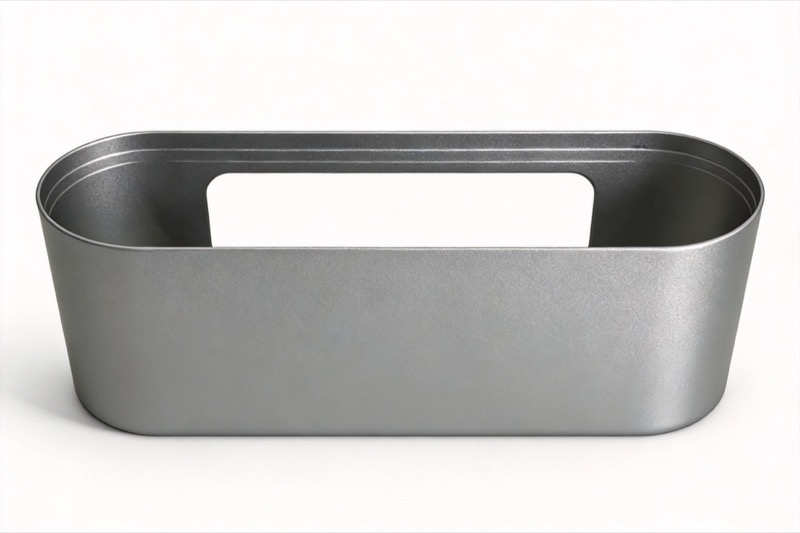
It depends on the enclosure shape. An extrusion is often ideal for a long enclosure with a constant cross-section, integrated heat-dissipation fins, and removable end caps. Casting is often better for a compact enclosure with complex curves, irregular mounting features, and integrated three-dimensional details.
Provide a 2D drawing or 3D model, required alloy and temper, critical tolerances, surface treatment, annual quantity, length or part dimensions, machining requirements, packaging requirements, target application, and any relevant testing or certification needs. A clear specification helps the supplier select the correct manufacturing route and quote accurately.
1. [FONNOV Aluminium — Extruded Aluminum Vs. Cast Aluminum]
2. [Guangdong Dapeng Aluminum — Company Website]
3. [Dapeng Aluminum — Custom Aluminum Profiles and Aluminum Solutions]
4. [Aluminum Extruders Council — Key Aluminum Extrusion Design Considerations]
5. [North American Die Casting Association — Casting Design Education]
6. [NADCA Product Specification Standards for Die Casting]
7. [European Aluminium — Environmental Profile Reports]
8. [European Aluminium — Environmental Profile Report Executive Summary]
9. [Get It Made — Aluminium Die Casting Guide]
10. [AMT Die Casting — High-Integrity Die Casting and Gas Porosity]


