


Views: 218 Author: Dapeng Aluminum Publish Time: 2026-08-28 Origin: Site


Content Menu
● Aluminum Extrusion vs. Aluminum Casting at a Glance
● The Core Difference: Continuous Profile vs. Three-Dimensional Part
>> When extrusion is the stronger option
>> When casting is the stronger option
● Strength, Grain Structure, and Product Performance
● Cost: Look Beyond Tooling Price
● Design Tips That Prevent Expensive Rework
>> For aluminum extrusion projects
>> For aluminum casting projects
● Material, Surface, and Sustainability Considerations
● How to Choose the Right Process
● FAQs
>> 1. Is aluminum extrusion stronger than aluminum casting?
>> 2. Can aluminum extrusion create hollow profiles?
>> 3. Is die casting better for complex parts?
>> 4. Which process is better for aluminum window and door profiles?
>> 5. Can extruded aluminum profiles be customized after extrusion?
>> 6. What information should I provide for an aluminum extrusion quotation?
Aluminum extrusion and aluminum casting are not the same process. Both shape aluminum into functional components, but extrusion pushes a heated solid billet through a die to produce a continuous profile, while casting fills a mold with molten aluminum to create a near-net-shape part.
For buyers of industrial components, architectural systems, transportation parts, and renewable-energy structures, the right choice affects design freedom, mechanical performance, tooling investment, finishing requirements, production efficiency, and total landed cost. At Guangdong Dapeng Aluminum Industry Co., Ltd., we help customers evaluate these factors before production, then provide aluminum profile manufacturing and customized secondary processing based on the application—not simply on the lowest initial tooling quote.
| Factor | Aluminum Extrusion | Aluminum Casting |
|---|---|---|
| Starting material | Heated solid aluminum billet | Molten aluminum alloy |
| How shape is created | Billet is forced through a shaped die | Molten metal is poured or injected into a mold |
| Part geometry | Long profiles with a constant cross-section | Three-dimensional parts with varying geometry |
| Typical products | Frames, rails, heat sinks, enclosures, channels, tubes | Housings, brackets, pump bodies, engine parts, fittings |
| Length | Continuous length, then cut to size | Individual parts, formed one at a time or per cycle |
| Design advantage | Integrates grooves, channels, ribs, and mounting features into one profile | Creates complex internal and external forms that cannot maintain one cross-section |
| Quality focus | Dimensional consistency, straightness, surface quality, temper | Mold filling, shrinkage control, porosity prevention, surface condition |
| Common finishing options | Anodizing, powder coating, electrophoresis, machining, assembly | Machining, painting, coating, polishing, impregnation where required |
The practical rule is simple: select extrusion when the component has the same cross-sectional shape from one end to the other. Select casting when the part needs complex 3D geometry, changing wall sections, enclosed cavities, or localized shapes that cannot travel continuously through an extrusion die.
Aluminum extrusion is a forming process in which a cylindrical billet is heated until it becomes soft and workable—but remains below its melting point. A hydraulic press then forces the billet through a precision steel die. The aluminum exits the die as a continuous profile whose cross-section matches the die opening.
Think of the process like pressing dough through a shaped nozzle. The output can be long, but its cross-section remains consistent along its length.
A typical production route includes:
1. Alloy selection and billet preparation
2. Billet and die heating
3. Press extrusion through the die
4. Air or water cooling
5. Stretching for straightness
6. Cutting to customer-specified length
7. Aging or heat treatment when required
8. Surface finishing and secondary fabrication
Extrusion is widely used for architectural window and door systems, curtain-wall components, solar mounting systems, machine frames, conveyors, electrical enclosures, transportation structures, LED housings, and battery-related assemblies.
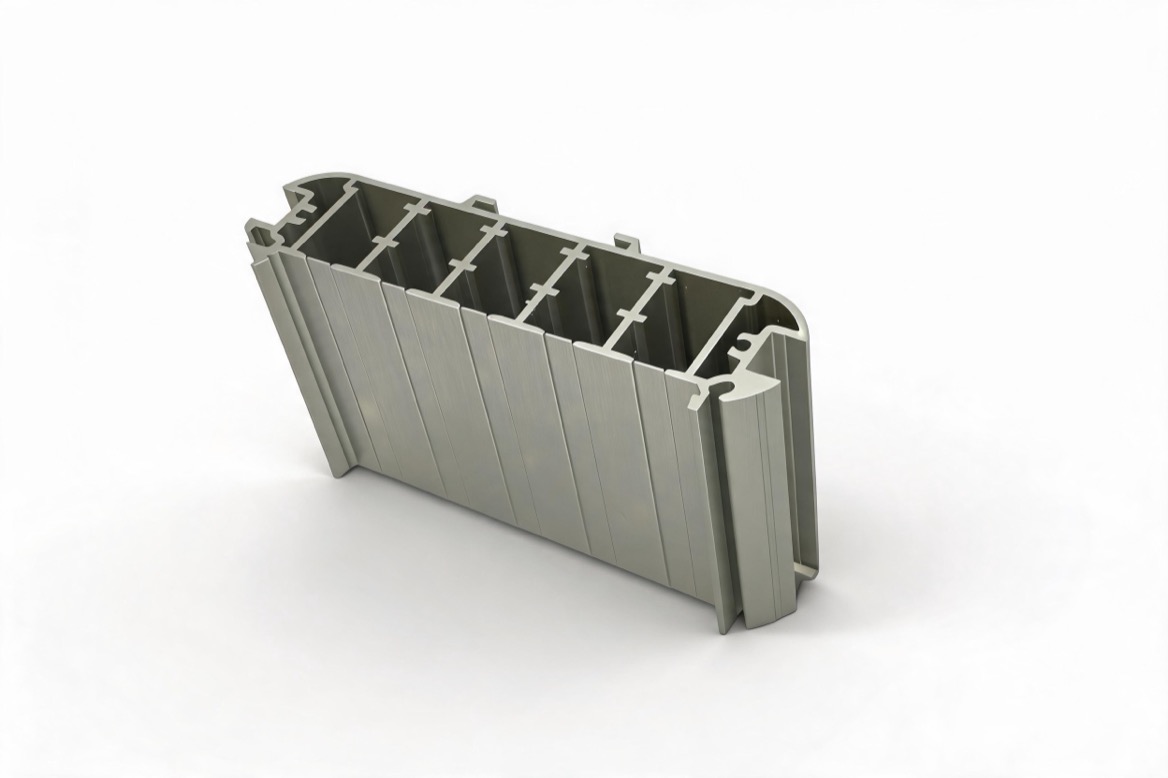
The process can create solid, semi-hollow, and hollow aluminum profiles. It is especially valuable when a customer needs a long part that combines several functions in one section—for example, a rail with fastening slots, a cable channel, a cover groove, and reinforcing ribs.
Aluminum casting creates a part by melting aluminum alloy and filling a mold cavity. Once the metal cools and solidifies, the casting is removed and may be trimmed, machined, coated, inspected, or assembled.
Casting is not one single technique. Common methods include:
- Die casting, where molten metal is injected into a steel die under pressure
- Sand casting, where the cavity is formed in sand
- Permanent mold casting, where reusable metal molds are used
- Gravity casting, where molten metal flows into the mold under gravity
- Low-pressure casting, where controlled pressure helps fill the mold
Casting makes sense when the product is a compact, non-linear component with changing dimensions. Typical examples include gearbox housings, valve bodies, motor housings, pump components, decorative hardware, complex brackets, and automotive parts.
However, casting quality depends heavily on mold design, melt treatment, filling behavior, cooling control, and inspection. In high-pressure die casting, turbulent mold filling can trap air and contribute to porosity. This is why customers should define functional surfaces, sealing areas, pressure-bearing zones, machining requirements, and inspection criteria early in the development process.
The biggest distinction is not merely whether aluminum is "pressed" or "poured." It is the type of geometry each method can produce economically.
Choose aluminum extrusion when your product needs:
- A uniform cross-section over a long distance
- Tight control over the profile's functional features
- Lightweighting through hollow chambers, ribs, and optimized wall thickness
- Long lengths that can be cut into multiple finished parts
- Integrated channels for fasteners, gaskets, glass, wiring, or covers
- A surface suitable for anodizing or powder coating
- Flexible downstream operations such as drilling, CNC machining, punching, bending, and assembly
For example, a photovoltaic mounting rail is a natural extrusion candidate. Its cross-section remains constant, while T-slots, drainage features, stiffening ribs, and connection points can be designed into the profile. The finished length can then be cut, drilled, packed, and exported according to the project requirement.
Choose aluminum casting when your product needs:
- Complex three-dimensional geometry
- Varying thicknesses or non-linear shapes
- Integrated bosses, cavities, mounting points, or curved forms
- A compact part that does not extend in one continuous profile
- Reduced assembly by forming multiple features in a single molded component
- A shape that would require excessive machining or welding if extruded
For example, a pump housing may have curved internal flow paths, mounting ears, bearing seats, and changing wall sections. These features usually make casting more practical than extrusion.
It is inaccurate to say that all extruded aluminum is always stronger than all cast aluminum. Alloy grade, temper, heat treatment, wall design, service load, and manufacturing quality determine real-world performance.
That said, extrusion often offers advantages for load-bearing profiles because the material flows through the die in the extrusion direction. Many structural products also use alloys and tempers designed for extrusion, such as 6063 and 6061, depending on forming, finishing, strength, and corrosion-resistance needs.
Extruded profiles can be aged to achieve specified tempers, such as T5 or T6, after the forming process. The result is a consistent long product that can be engineered around stiffness, weight, fastener access, and corrosion protection.
Casting alloys are selected for fluidity and castability as well as final properties. A well-designed casting can perform exceptionally well, but the manufacturing team must manage risks such as gas porosity, shrinkage porosity, inclusions, and uneven solidification. Porosity can affect machining, sealing, fatigue behavior, and pressure-tightness depending on where it appears in the final part.
For a high-load or safety-critical product, the purchase decision should never be based on process labels alone. Require a clear drawing, material specification, mechanical-property requirement, critical-dimension plan, and appropriate inspection method.
Customers often ask, "Which is cheaper: aluminum extrusion or aluminum casting?" The accurate answer is: it depends on the product design and total manufacturing route.
Extrusion tooling is often more economical for profiles with a consistent cross-section. It also allows one long profile to be cut into many parts, helping reduce material handling and repeated forming steps. Extrusion can also integrate functional details that might otherwise require welding, brackets, or multiple purchased components.
Casting may require more expensive tooling, especially for high-pressure die casting. Yet it can lower downstream assembly cost when it produces a complex, near-net-shape part in fewer operations.
| Cost Driver | Extrusion | Casting |
|---|---|---|
| Tooling | Die cost varies with profile complexity | Mold cost can be substantial, especially for die casting |
| Material yield | Often efficient for long, repeated profiles | Depends on gating, runners, trimming, and process route |
| Secondary machining | Often needed for holes, end features, and localized geometry | Often needed for critical surfaces, threads, and tolerances |
| Assembly reduction | Strong when features can be integrated in the profile | Strong when a complex single-piece part replaces an assembly |
| Design changes | Profile die changes may be more manageable | Mold changes can be expensive and time-consuming |
| Best economic fit | Repeated long-profile applications | Complex 3D parts at an appropriate production volume |
The best sourcing approach is to compare total part cost, not only the die or mold quotation. Include machining, surface treatment, scrap, assembly, packaging, shipping volume, quality risk, and expected annual demand.
A strong aluminum design begins before tooling is ordered. In our experience supporting export projects, the most avoidable delays occur when requirements are incomplete at the quotation stage.
- Keep wall thickness as balanced as practical
- Avoid extremely deep, narrow features unless they are functionally necessary
- Identify dimensions that are truly critical instead of applying tight tolerances everywhere
- Consider how the profile will be cut, drilled, machined, bent, assembled, and packed
- Confirm whether visible surfaces require mill finish, anodizing, powder coating, or other treatment
- Specify alloy and temper based on actual performance needs
Balanced walls, sensible geometry, and minimized extreme features generally improve profile manufacturability. Industry design guidance also recommends reducing difficult narrow "tongues," using reasonable tapers, and minimizing unnecessary asymmetry where possible.
- Maintain reasonable wall transitions to support controlled solidification
- Clearly identify pressure-tight, sealing, cosmetic, and machined surfaces
- Avoid isolated thick sections that can create hot spots
- Confirm draft requirements, parting line location, and gate location with the manufacturer
- Define acceptable cosmetic conditions before mass production
- Plan machining allowances and inspection points early
A supplier should be involved during the design review—not only after the final drawing is released. Early manufacturability feedback can reduce tooling revisions, improve production stability, and make quality expectations measurable.
Aluminum is valued not only for its low density and corrosion resistance, but also for its ability to remain in circulation. The Aluminum Association states that aluminum can be recycled repeatedly, and estimates that around 75% of all aluminum ever produced is still in use.
For extrusion projects, surface treatment often becomes part of the product's functional performance. Options may include:
- Mill finish for further processing or non-visible industrial uses
- Anodizing for enhanced corrosion resistance and a metallic appearance
- Powder coating for durable color, architectural appearance, and weather resistance
- Electrophoresis for a uniform protective finish
- Mechanical finishing for specific decorative or functional requirements
At Guangdong Dapeng Aluminum Industry Co., Ltd., we support industrial and architectural aluminum profiles as well as customized deep-processing services. Our production approach combines material selection, profile design review, extrusion, surface finishing, precision cutting, machining, and export-oriented quality coordination to help customers reduce supply-chain complexity.
Use this quick decision path:
1. Does the part have a constant cross-section?
If yes, start by evaluating extrusion.
2. Does the part require complex 3D cavities, curved forms, or changing geometry?
If yes, casting may be more suitable.
3. Can profile features replace several assembled components?
If yes, extrusion may reduce the total part count.
4. Are sealing performance and internal porosity critical concerns?
If yes, review the casting route, inspection plan, and machining strategy carefully.
5. Will the component require anodizing, long lengths, or repeated cut pieces?
If yes, extrusion is often a strong solution.
6. Is the design still evolving?
Request manufacturability feedback before investing in either a die or a mold.
If you are choosing between aluminum extrusion and aluminum casting—or need a custom aluminum profile for an industrial, architectural, transport, or renewable-energy application—send Guangdong Dapeng Aluminum Industry Co., Ltd. your drawing, material requirement, finish specification, and estimated quantity.
Our technical team can review manufacturability, recommend a suitable aluminum solution, and provide a quotation for extrusion, finishing, deep processing, and export packaging tailored to your project.
Not in every case. Final performance depends on the alloy, temper, heat treatment, part geometry, load direction, and manufacturing quality. Extruded profiles are often well suited to long structural applications, while castings can be engineered effectively for complex components.
Yes. Aluminum extrusion can produce hollow and semi-hollow sections, including tubes, channels, frames, thermal-break-related profiles, and multi-cavity industrial sections.
Die casting is often suitable for complex three-dimensional parts with changing geometry. It is particularly useful where multiple features can be consolidated into one component, but mold cost, porosity control, machining requirements, and production volume must be evaluated.
Extrusion is the standard choice for most window, door, curtain-wall, and architectural framing systems because these products require long lengths and a constant cross-section.
Yes. Profiles can be cut, drilled, milled, punched, tapped, bent, welded, assembled, anodized, powder coated, and packaged to meet project requirements.
Provide a profile drawing, alloy and temper requirement, surface finish, length, tolerance requirements, machining details, expected order quantity, packaging request, and destination market. A 3D model is also helpful for complex secondary processing.
1. [BOR Aluminum USA — Are Aluminum Extrusion and Aluminum Casting the Same Process?]
2. [ASM International — How Are Aluminum Extrusions Made?]
3. [Aluminum Extruders Council — Key Design Considerations]
4. [Aluminum Extruders Council — Aluminum Extrusion Tolerances]
5. [Aluminum Association — Recycling Policy Agenda]
7. [Bonnell Aluminum — Aluminum Casting Process]
8. [Aluminium Guide — Aluminium Extrusion: Alloys, Shapes and Properties]


