
English


Views: 257 Author: Dapeng Aluminum Publish Time: 2026-09-16 Origin: Site


Content Menu
● How the Aluminum Extrusion Process Works
>> 1. Selecting the Aluminum Alloy
>> 3. Extruding Through the Die
>> 4. Cooling, Stretching, and Heat Treatment
>> 5. Finishing and Deep Processing
● Choosing the Right Aluminum Alloy for Extrusion
>> 6063 for Architectural and Visible Profiles
>> 6061 for Industrial Strength and Machining
>> 6005A and 6082 for Demanding Structures
● Aluminum Extrusion Design Rules That Improve Manufacturability
>> Keep Wall Thickness as Consistent as Possible
>> Use Smooth Corners Instead of Sharp Internal Angles
>> Add Ribs Instead of Excessive Solid Mass
>> Design Functional Features into the Profile
>> Specify Tolerances Based on Function
● Quality Control for Custom Aluminum Profiles
>> Documents Buyers Should Request
● From Drawing to Shipment: A Better Custom Extrusion Workflow
>> Step 1: Define the Application
>> Step 2: Provide a Clear Drawing
>> Step 3: Complete a Manufacturability Review
>> Step 4: Confirm Samples and Standards
>> Step 5: Control Production and Delivery
● Applications Across Modern Industries
>> Architectural Aluminum Profiles
>> Industrial Aluminum Profiles
>> Transportation and Mobility Components
>> New-Energy and Solar Applications
● Aluminum Extrusion and Responsible Material Use
● Partner with an Aluminum Profile Manufacturer That Understands Your Project
>> What is the difference between aluminum extrusion and aluminum casting?
>> Which aluminum alloy is best for custom extrusions?
>> Can aluminum extrusion profiles be customized?
>> What surface finishes are available for extruded aluminum?
>> How can I reduce the cost of a custom aluminum extrusion?
>> What information should I provide when requesting a quotation?
>> Are aluminum profiles suitable for outdoor use?
Aluminum extrusion is one of the most practical ways to transform an engineering concept into a lightweight, durable, and repeatable product. From architectural window systems and curtain walls to automation frames, transportation components, solar structures, and new-energy equipment, custom aluminum extrusion profiles make it possible to combine strength, precision, appearance, and manufacturing efficiency in one material solution.
At Guangdong Dapeng Aluminum Industry Co., Ltd., we have seen that successful extrusion projects are rarely decided by the drawing alone. The best results come from early cooperation between the customer's engineering team and an experienced aluminum profile manufacturer. Alloy selection, cross-section design, die feasibility, surface treatment, dimensional control, and secondary processing must work together before mass production begins.
For global buyers, aluminum extrusion is not simply a process for making metal shapes. It is a scalable manufacturing method that can reduce part count, simplify assembly, improve corrosion resistance, and support long-term product performance. This guide explains how aluminum extrusion works, how to specify a custom aluminum profile, and how to make more informed decisions for industrial, architectural, transportation, and energy applications.
Aluminum extrusion is a manufacturing process in which a heated aluminum billet is pressed through a precision-engineered die. The opening in the die determines the cross-sectional shape of the final profile.
A simple way to understand the process is to imagine squeezing toothpaste through a shaped nozzle. The toothpaste exits in the same shape as the nozzle opening. In aluminum extrusion, however, the process uses controlled heat, high pressure, precision tooling, and strict dimensional inspection to produce continuous metal profiles.
The resulting aluminum profile can be cut to the required length and further processed through machining, drilling, punching, bending, welding, assembly, anodizing, powder coating, or other finishing methods.
The key advantage is design freedom. Instead of joining several separate components through welding, screws, or brackets, engineers can often integrate multiple functions into one extruded aluminum section.
Examples include:
- Internal channels for fasteners, wiring, drainage, or insulation
- Screw ports and connection grooves
- Heat-dissipation fins for electronic equipment
- Structural ribs that improve stiffness without adding excessive weight
- Decorative visible surfaces for windows, doors, furniture, and consumer products
- Hollow chambers for lightweight structural performance
This combination of functional integration and efficient production is why aluminum extrusion remains important across many manufacturing sectors.
Although extrusion appears straightforward from the outside, consistent profile quality requires precise control at every production stage. Small variations in billet temperature, die condition, extrusion speed, cooling rate, or straightening can affect surface quality, mechanical properties, and dimensional accuracy.
The process begins with selecting an aluminum alloy that matches the intended application. Aluminum is rarely used in its pure form for structural extrusion because alloying elements can improve strength, corrosion resistance, machining behavior, weldability, and heat-treat response.
For many custom aluminum profile projects, 6xxx series aluminum alloys are widely selected because they provide a useful balance between extrudability, strength, corrosion resistance, and surface-finish quality.
The material decision should consider:
- Required structural load and safety factor
- Corrosion exposure, including coastal or industrial environments
- Surface appearance requirements
- Machining, bending, or welding needs
- Required profile complexity
- Target tolerances
- Production volume and tooling budget
- Applicable project standards and customer specifications
Choosing the wrong alloy can create unnecessary cost, poor surface appearance, difficult extrusion conditions, or performance risks in the final application.
The aluminum billet is heated until it becomes soft enough for controlled plastic deformation. It is not melted. Instead, the billet reaches a carefully controlled temperature range that enables it to flow through the die while retaining the metallurgical conditions required for the final product.
Uniform heating matters. If the billet temperature is inconsistent, the aluminum may flow unevenly through different areas of the die. This can lead to dimensional variation, surface defects, distortion, or inconsistent mechanical properties.
The heated billet is placed in an extrusion press. A ram applies force and pushes the aluminum through the die opening. The die determines whether the profile is solid, semi-hollow, hollow, symmetrical, asymmetrical, simple, or highly complex.
Die design is one of the most important stages in a custom aluminum extrusion project. A profile that looks simple in a CAD drawing may be difficult to extrude if it contains extremely thin walls, sharp internal corners, deep narrow channels, or large differences in wall thickness.
An experienced manufacturer reviews the drawing before die production to identify potential risks and recommend practical improvements.
Once the aluminum profile exits the die, it must be cooled at a controlled rate. Depending on the alloy and temper requirement, the profile may be air-cooled, fan-cooled, mist-quenched, or water-quenched.
After cooling, profiles are typically stretched to improve straightness and relieve internal stress. They are then cut to length and may undergo aging treatment to develop the required mechanical properties.
For example, T5 and T6 tempers are common in extruded aluminum. While the final specification depends on the alloy and product application, heat treatment is often critical for achieving the desired balance of strength, hardness, dimensional stability, and machinability.
Extrusion creates the profile shape, but many projects require additional work before the part is ready for assembly or installation.
Common secondary operations include:
- CNC machining
- Precision cutting
- Drilling and tapping
- Punching
- Milling
- Bending
- Deburring
- Welding
- Assembly
- Anodizing
- Powder coating
- Electrophoretic coating
- Wood-grain transfer or decorative finishing
A manufacturer that can coordinate extrusion and downstream processing can help reduce supply-chain complexity, improve consistency, and minimize handling damage between production stages.
Alloy selection should be based on the product's actual operating conditions, not only on a familiar alloy name. In our experience, many sourcing problems start when a purchase order says only "aluminum profile" without specifying alloy, temper, mechanical expectations, finish, and application requirements.
The table below provides a practical starting point for commonly specified extrusion alloys.
| Alloy | Main Strengths | Typical Applications | Important Considerations |
|---|---|---|---|
| 6063 | Excellent extrudability, smooth finish, good corrosion resistance | Window and door systems, curtain walls, trims, display frames, decorative profiles | Suitable for visible architectural surfaces and complex shapes; moderate strength |
| 6061 | Higher strength, good machinability, strong structural performance | Machinery components, transportation parts, structural frames, brackets | More challenging for highly complex thin-wall profiles than 6063 |
| 6005A | Good structural capacity with practical extrusion performance | Solar mounting systems, rail components, industrial structures | Often useful where stronger performance is needed without choosing a more difficult alloy |
| 6082 | High strength and good corrosion resistance | Heavy-duty transport, marine, structural and load-bearing applications | Better suited for strength-focused designs than fine decorative shapes |
6063 is widely used for architectural aluminum extrusions because it provides a good balance of formability, corrosion resistance, and surface quality. It is particularly suitable where anodizing, powder coating, or decorative appearance is important.
Typical applications include:
- Windows and doors
- Curtain walls
- Office partitions
- Display systems
- Lighting housings
- Decorative trims
- Furniture profiles
For visible surfaces, the alloy is only one part of the result. Die condition, extrusion parameters, handling, polishing, anodizing quality, and protective packaging also influence the final appearance.
6061 is commonly selected when structural strength, machining performance, and robust mechanical properties are priorities. It is used in industrial equipment, transportation parts, machine frames, structural brackets, and engineered assemblies.
However, high-strength alloys may require additional consideration during die design and extrusion. A profile should not be specified only for its theoretical mechanical strength. The geometry, wall thickness, production process, assembly method, and real operating load must all be reviewed together.
For load-bearing applications such as transportation equipment, solar mounting structures, equipment frames, and industrial systems, 6005A and 6082 can provide useful performance options.
These alloys may be suitable when the project requires higher strength, corrosion resistance, and reliable long-term structural behavior. The final decision should be made according to engineering drawings, loading conditions, applicable regulations, joining methods, and environmental exposure.
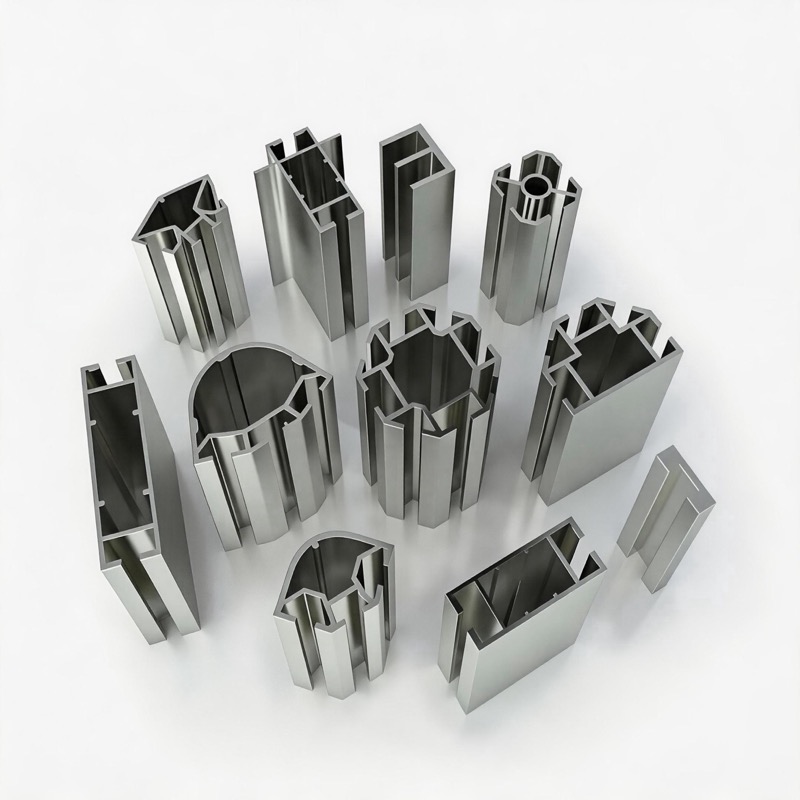
A well-designed aluminum profile can reduce production cost and improve quality before the first billet is heated. Conversely, a design that ignores material flow and die limitations may create unnecessary tooling revisions, longer lead times, surface defects, excessive scrap, or difficult dimensional control.
The following guidelines are especially valuable during the early design stage.
Large differences in wall thickness can cause uneven aluminum flow through the die. Thick areas may cool differently from thin areas, increasing the risk of distortion or dimensional inconsistency.
Where possible, use a relatively uniform wall thickness throughout the section. If the design requires thicker areas for strength or fastening, use gradual transitions rather than abrupt changes.
Sharp corners can restrict metal flow and create stress concentrations. Rounded corners generally support better extrusion performance and improve the durability of the finished product.
This does not mean every feature must be heavily rounded. It means that practical radii should be included where the function allows.
When a profile needs more stiffness, adding a well-positioned rib may be more efficient than increasing the thickness of the entire section.
This approach can help maintain a favorable strength-to-weight ratio while reducing material consumption. It is especially useful for equipment frames, enclosures, transportation components, and modular systems.
One of the greatest benefits of extrusion is the ability to combine several functions into one continuous shape.
For example, a custom industrial aluminum profile may include:
- A fastening groove for assembly
- A cable channel for wiring
- A structural rib for stiffness
- A flat mounting surface for equipment
- A cover-retention feature
- A drainage path or sealing channel
Integrating these details into the die design can reduce secondary operations and simplify the final assembly.
Not every dimension requires the tightest possible tolerance. Over-specifying tolerances can increase production complexity and cost without improving final product performance.
A better approach is to identify which dimensions are critical for fit, sealing, assembly, structural function, or appearance. Then apply tighter control to those areas while allowing standard practical tolerances elsewhere.
This is particularly important for mating parts, precision assemblies, sliding systems, and components with automated installation requirements.
For international buyers, reliable quality means more than receiving a profile that looks correct at first inspection. It means the supplier has a repeatable system for controlling incoming materials, extrusion parameters, dimensions, surface quality, processing accuracy, packaging, and shipment documentation.
At Guangdong Dapeng Aluminum Industry Co., Ltd., quality management is integrated into the production process rather than treated as a final-stage activity. Our modern production base, quality management system, and accumulated manufacturing experience support stable supply for customers requiring industrial aluminum profiles, architectural aluminum profiles, and customized deep-processing services.
A complete inspection plan may include:
- Alloy chemistry verification
- Billet and raw-material traceability
- Profile cross-section measurements
- Wall-thickness checks
- Length, straightness, twist, and flatness inspection
- Surface-defect checks
- Color and coating consistency
- Mechanical-property testing where required
- Machined-hole location and thread checks
- Assembly-fit verification
- Packaging inspection before shipment
The right inspection plan depends on the application. A decorative architectural profile and a precision industrial component should not necessarily use the same acceptance criteria.
For a custom extrusion order, buyers should clearly define the documents required before production and shipment. Depending on the project, these may include:
- Approved technical drawings
- Material specification
- Alloy and temper confirmation
- Sample approval record
- Inspection report
- Mill test certificate
- Surface-treatment specification
- Packing standard
- Production schedule
- Traceability information
- Certificate of conformity, when required
Clear documentation helps prevent misunderstandings between purchasing, engineering, production, inspection, and logistics teams.
Custom aluminum extrusion projects run more smoothly when decisions are made in the right order. The following workflow helps buyers reduce avoidable delays.
Start with the actual use case. Explain whether the profile will be used in a window system, solar frame, conveyor line, vehicle structure, battery enclosure, machinery guard, heat sink, or another application.
The application determines the likely priorities: strength, appearance, corrosion resistance, insulation, conductivity, sealing, weight reduction, machining, or assembly speed.
A production-ready drawing should include critical dimensions, tolerances, alloy, temper, length, surface treatment, quantity, and any downstream processing requirements.
If a 3D model is available, it can also help the manufacturer understand assembly relationships and identify interference risks.
Before die production, the profile should be reviewed for:
- Wall thickness balance
- Hollow-section feasibility
- Tolerance practicality
- Die complexity
- Surface-quality expectations
- Material flow behavior
- Potential distortion risks
- Secondary-processing needs
This stage is where a manufacturer's technical experience creates value. A small design adjustment can often improve yield, reduce tooling complexity, and make the final product more reliable.
For new projects, first-article samples are valuable. They allow the customer to check fit, finish, function, assembly, and appearance before full production begins.
Sample approval should be based on agreed criteria rather than visual judgment alone.
After approval, mass production should follow the confirmed material, process, inspection, and packaging requirements. For export projects, packaging must protect profiles from scratching, deformation, moisture, and transit damage.
A reliable supplier should also communicate clearly about lead time, production progress, shipment arrangement, and required export documentation.
Aluminum extrusion is highly adaptable because it can create complex cross-sections that are lightweight, corrosion-resistant, and ready for further processing.
Architectural profiles are used in windows, doors, curtain walls, sunrooms, facades, railings, partitions, shading systems, and decorative structures.
These applications often require a combination of visual consistency, weather resistance, dimensional precision, and compatibility with glass, gaskets, thermal-break systems, hardware, and installation methods.
Industrial profiles are commonly used in automation equipment, production lines, machine guards, workstations, conveyors, enclosures, shelves, modular frames, and cleanroom systems.
The main advantage is flexible assembly. T-slot and customized industrial profiles can support rapid system construction, modification, and maintenance without extensive welding.
In transportation, aluminum helps manufacturers reduce weight while maintaining structural performance. Extruded profiles can be used in vehicle bodies, rail systems, battery housings, roof structures, cargo systems, marine equipment, and supporting components.
The correct alloy and profile geometry are especially important where vibration, fatigue, impact, weather exposure, and long service life are involved.
Aluminum profiles are widely used in solar mounting systems, battery enclosures, energy-storage cabinets, charging infrastructure, and equipment housings.
These projects often require corrosion resistance, outdoor durability, structural stability, low maintenance, and repeatable installation features. Custom extrusion can integrate mounting slots, cable-routing paths, drainage details, and reinforcement features into a single profile.
Aluminum is valuable not only because of its performance but also because it can be recycled repeatedly. Recycled aluminum requires significantly less energy than primary aluminum production, which makes scrap recovery and responsible material management important considerations in the wider aluminum value chain.
For manufacturers and buyers, responsible sourcing should involve practical actions rather than broad claims. These actions may include improving material yield, reducing unnecessary profile weight, optimizing cut lengths, managing process scrap, selecting durable finishes, and designing components that can remain in service for a long time.
A lightweight profile is not automatically the best choice. The better goal is to use only the material needed to achieve safe, durable, and functional performance.
A dependable extrusion supplier should do more than produce a profile from a drawing. The supplier should understand the application, identify design risks early, control manufacturing quality, support surface finishing and secondary processing, and provide stable delivery for international projects.
Guangdong Dapeng Aluminum Industry Co., Ltd. provides aluminum material and custom aluminum solutions for global industrial customers. Our capabilities cover aluminum profiles, industrial applications, customized dimensions, design styles, surface treatments, and special specifications, supported by a modern production base and ISO 9001 quality management certification.
Whether you are developing an architectural system, industrial machine frame, transportation component, solar mounting structure, or customized aluminum product, our team can help evaluate your drawing and recommend a practical extrusion solution.
Send us your drawings, alloy requirements, finish requirements, quantities, and target application. We will help you turn your profile concept into a manufacturable aluminum extrusion solution.
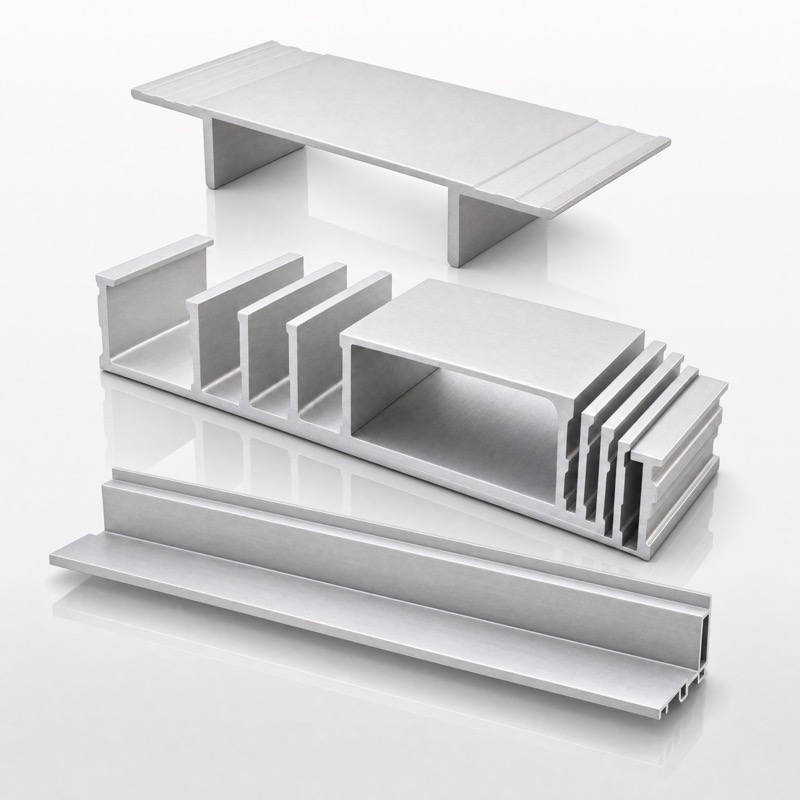
Aluminum extrusion forms a continuous profile by forcing heated aluminum through a die. Aluminum casting fills a mold with molten metal. Extrusion is especially suitable for long parts with a consistent cross-section, such as frames, rails, channels, and structural profiles. Casting is often used for more complex three-dimensional shapes that do not have a constant cross-section.
There is no single best alloy for every project. 6063 is often selected for architectural and visible profiles because of its extrusion performance and surface finish. 6061, 6005A, and 6082 may be more appropriate for applications requiring higher strength or demanding structural performance. The best choice depends on loading, environment, appearance, fabrication needs, and profile complexity.
Yes. Custom aluminum profiles can be designed according to the required cross-section, dimensions, alloy, temper, surface finish, machining details, holes, slots, grooves, cut length, packaging, and assembly needs. A technical review before die production is strongly recommended.
Common finishes include mill finish, anodizing, powder coating, electrophoretic coating, polishing, brushing, wood-grain transfer, and other decorative treatments. The appropriate finish depends on appearance requirements, corrosion conditions, outdoor exposure, maintenance expectations, and project standards.
Cost can often be reduced by simplifying profile geometry, keeping wall thickness more uniform, avoiding unnecessary tight tolerances, selecting a functionally appropriate alloy, optimizing cut lengths, reducing secondary operations, and planning order quantities around efficient production runs. Early design consultation usually provides the greatest cost-saving opportunity.
Provide a technical drawing or 3D model, alloy and temper, required finish, cross-section dimensions, tolerances, cut length, machining requirements, estimated order quantity, end-use application, packaging requirements, destination country, and any required standards or inspection documents.
Yes, aluminum profiles are widely used outdoors because aluminum naturally forms a protective oxide layer. However, the required alloy, surface treatment, coating system, drainage design, fastening method, and maintenance plan should be selected based on the local environment, particularly for coastal, highly humid, or industrially polluted areas.
1. [Bor Aluminum — Exploring the Art and Science of Aluminum Extrusion]
3. [Aluminum Extruders Council — Design Resources]
4. [Aluminum Extruders Council — Aluminum Extrusion Manual]
5. [International Aluminium Institute — Aluminium Recycling and Energy Savings]
6. [European Aluminium — Circular Economy and Aluminum Recycling]


