


Views: 264 Author: Dapeng Aluminum Publish Time: 2026-10-24 Origin: Site


Content Menu
● 6063 vs. 6005A Aluminum Profiles: The Essential Comparison
● Understanding Alloy Chemistry and Temper
>> Why the Alloy Designation Matters
>> Why T5 and T6 Cannot Be Ignored
● 6063-T6 vs. 6005A-T6: Strength and Engineering Limits
>> Stronger Does Not Mean Significantly Stiffer
● Extrusion Complexity, Machining, and Surface Quality
>> When 6063 Aluminum Profiles Make Sense
>> When 6005A Aluminum Profiles Make Sense
● Corrosion Resistance and Anodizing for Outdoor Solar Structures
>> Bonding Must Be Designed Alongside the Finish
● Three Practical Insights That Improve Alloy Selection
>> 1. Diagnose the Failure Mode Before Upgrading the Alloy
>> 2. Check the Connection Before Reducing Wall Thickness
>> 3. Evaluate Thermal Movement Separately from Strength
● Which Alloy Fits Different Solar Mounting Applications?
● Compare Total Installed Cost, Not Just Aluminum Price
● A Five-Step Procurement Workflow for Custom Solar Aluminum Profiles
>> Step 1: Define the Design Basis
>> Step 2: Freeze the Material Specification
>> Step 3: Review the Drawing With the Extruder
>> Step 4: Approve Evidence and Samples
>> Step 5: Validate the Mounting Assembly
● FAQ
>> 1. Is 6005A stronger than 6063 for solar mounting rails?
>> 2. Can 6063-T6 be used for solar panel mounting systems?
>> 3. Will 6005A reduce rail deflection compared with 6063?
>> 4. Which alloy is better for anodizing?
>> 5. Can 6005A replace 6063 without changing the drawing?
>> 6. Does a material certificate prove UL 2703 compliance?
Choosing between 6063 vs. 6005A aluminum profiles for solar panel mounting systems is not simply a question of which alloy is stronger. It is a decision about structural performance, extrusion complexity, corrosion protection, installation efficiency, and total project cost.
6063 is an attractive option for intricate profiles and high-quality surface finishes. 6005A offers higher specified strength in comparable T6 conditions, making it worth evaluating for more demanding load-bearing components. However, stronger aluminum does not automatically produce a stiffer rail or a safer mounting system.
From a manufacturing and procurement perspective, our recommendation is to start with the component's function, then select the alloy, temper, cross-section, and finish together. This guide explains how to make that decision without overlooking the details that determine long-term performance.
Both alloys belong to the heat-treatable aluminum-magnesium-silicon family. They combine relatively low weight with useful corrosion resistance and extrusion capability.
Their practical differences become clearer when you compare complete material specifications rather than alloy names alone.
| Selection factor | 6063 aluminum profiles | 6005A aluminum profiles |
|---|---|---|
| Main advantage | Extrusion flexibility and decorative finishing | Higher specified strength in comparable T6 conditions |
| Typical design priority | Complex channels, surface quality, moderate loads | More demanding load-bearing sections |
| Elastic modulus | Approximately 69 GPa | Approximately 70 GPa |
| Density | Approximately 2.70 g/cm³ | Approximately 2.70 g/cm³ |
| Decorative anodizing | Particularly suitable | Suitable, but appearance should be sample-approved |
| Potential limitation | Lower strength may require section changes | Thin, intricate geometry may be harder to manufacture |
| Best purchasing approach | Verify temper, geometry, and load capacity | Verify product category, thickness, and guaranteed properties |
Neither alloy is universally better. The best aluminum alloy for solar mounting rails depends on what actually governs the design: yielding, deflection, local buckling, connections, or manufacturing constraints.
Although both are 6xxx-series alloys, their composition limits differ. These differences influence their response to heat treatment, extrusion behavior, mechanical properties, and finishing characteristics.
Do not treat 6005 and 6005A as interchangeable purchasing descriptions. Specify 6005A explicitly when that is the material used in the approved design.
Similarly, avoid accepting "6000-series aluminum" as a complete specification. That description does not establish the strength or performance of the delivered profiles.
The temper describes the material's processing condition.
- T5 means cooling from an elevated-temperature shaping process followed by artificial aging.
- T6 means solution heat treatment followed by artificial aging.
- T66 identifies a higher mechanical-property level achieved through special process control.
A comparison between 6063-T5 and 6005A-T6 combines an alloy difference with a temper difference. It can be relevant commercially, but it should not be presented as an alloy-only comparison.
Purchase orders should identify the alloy, temper, applicable standard, and required mechanical properties.
Published European extrusion data illustrate why 6005A-T6 is often considered for higher-strength applications.
| Published product category | Minimum 0.2% proof strength | Minimum tensile strength |
|---|---|---|
| 6063-T6 extruded profile, wall thickness ≤10 mm | 170 MPa | 215 MPa |
| 6005A-T6 open profile, wall thickness ≤5 mm | 225 MPa | 270 MPa |
| 6005A-T6 hollow profile, wall thickness ≤5 mm | 215 MPa | 255 MPa |
These figures are published specification examples, not universal values for every extrusion. The referenced datasets also use different editions of the underlying standards. Confirm the current contractual requirements before ordering.
For the listed open-profile categories, 225 MPa is approximately 32% higher than 170 MPa. That indicates additional resistance to permanent deformation, not an automatic 32% increase in allowable mounting span.
Design resistance still depends on safety factors, section geometry, holes, connections, and the governing structural rules.
The elastic moduli of 6063 and 6005A are very similar.
Consequently, changing an otherwise identical rail from 6063-T6 to 6005A-T6 will generally produce little change in elastic bending deflection.
This distinction matters because a solar mounting rail may satisfy strength requirements yet deflect beyond the project's serviceability limit.
When deflection governs, increasing section depth, improving the cross-section, or reducing support spacing may achieve more than changing alloys.
6063 is especially attractive when a design combines several detailed features:
- Narrow attachment channels.
- Integrated cable-management grooves.
- Complex hollow chambers.
- Visible surfaces requiring consistent appearance.
- Tight-fitting interfaces with clamps or connectors.
Its established suitability for decorative anodizing is another advantage where rooftop appearance matters.
However, excellent extrusion capability does not make every thin-wall design practical. Die strength, dimensional tolerances, wall balance, and straightness still require manufacturing review.
6005A deserves consideration when the profile needs higher specified strength and its geometry remains practical to extrude.
Potential candidates include structural rails, support members, and brackets with demanding load requirements.
The opportunity is not simply to replace one alloy with another. It is to redesign the component around the available strength while retaining adequate stiffness and connection capacity.
For both alloys, specify machined-hole positions, burr limits, cut-length tolerances, and critical mating dimensions. An acceptable tensile result cannot compensate for a clamp channel that does not fit.
Both alloys offer useful corrosion resistance. Nevertheless, outdoor durability depends on exposure conditions and detailing as much as alloy selection.
Coastal salts, trapped moisture, dissimilar-metal contact, and damaged finishes can create localized problems.
A practical corrosion-control specification should address:
1. Environmental exposure.
2. Surface-treatment type and acceptance criteria.
3. Drainage and water-trapping details.
4. Fastener and connector compatibility.
5. Cut edges and machined surfaces.
6. Inspection and maintenance requirements.
6063 generally has an advantage for decorative anodized appearance. That does not mean 6005A cannot be anodized successfully or that 6063 automatically lasts longer outdoors.
For either alloy, approve representative finished samples rather than relying on color descriptions alone.
Anodized surfaces should not be assumed to provide reliable electrical contact at an arbitrary bolted joint.
The mounting system needs an appropriate bonding arrangement, including compatible clamps, lugs, or other approved components.
In markets using UL 2703, the relevant evaluation concerns the mounting-system configuration—not merely the alloy certificate.
Do not equate an anodized aluminum extrusion with a certified mounting assembly.
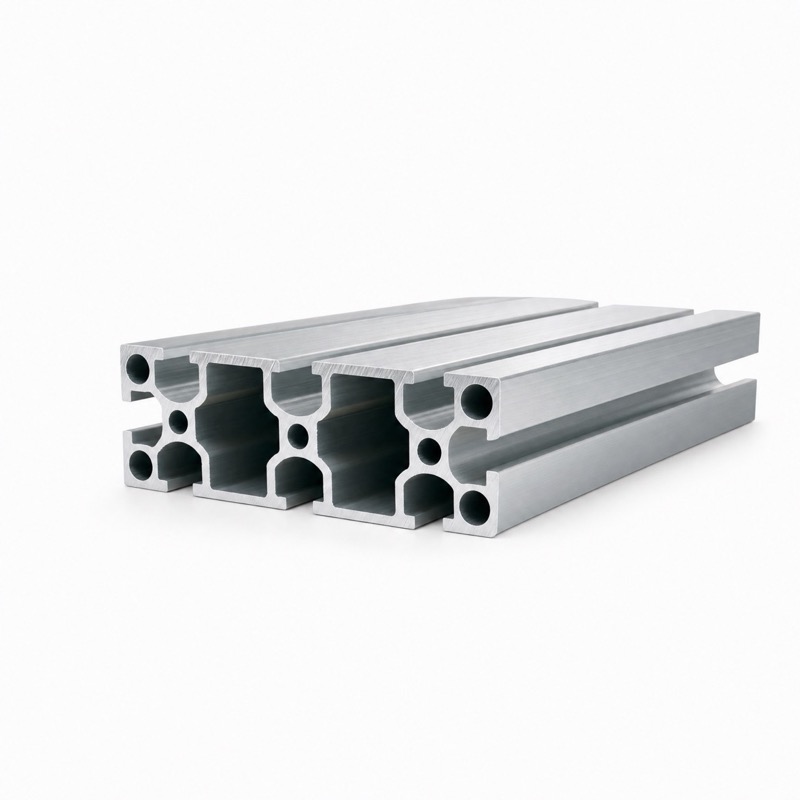
Consider a hypothetical rooftop rail that meets its bending-strength requirement but exceeds the permitted deflection.
Replacing 6063-T6 with 6005A-T6 without changing the section would not substantially solve that problem because their elastic moduli are nearly identical.
The more useful options may include:
- Increasing rail depth.
- Redistributing material within the section.
- Shortening the support span.
- Revising the attachment layout.
Conversely, if the same rail is strength-limited and has sufficient stiffness, higher-strength 6005A may offer a useful design route.
This is an illustrative engineering scenario, not a reported customer installation.
Higher material strength can encourage aggressive lightweighting. However, mounting systems frequently contain localized load paths around clamp channels, bolt holes, and splices.
Reducing wall thickness may introduce new limitations:
- Local flange bending.
- Bolt bearing or tear-out.
- Thread stripping.
- Channel-lip deformation.
- Local buckling.
- Installation damage.
An alloy upgrade is therefore an opportunity for controlled optimization, not permission to reduce every wall proportionally.
Check the complete connection using the actual fasteners, installation torque, and production geometry.
Aluminum expands and contracts with temperature changes.
Using an illustrative expansion coefficient of approximately 24 × 10⁻⁶/K, a six-meter rail exposed to a 60°C temperature change would move approximately 8.6 mm if unrestrained.
This is a simplified calculation, not a prescribed expansion-joint spacing.
The design must determine how movement is accommodated through splices, slots, support details, and installation procedures. Selecting a stronger alloy does not remove thermal expansion.
| Application or design condition | Sensible starting point | Essential verification |
|---|---|---|
| Intricate rooftop rail | 6063 | Strength, deflection, extrusion feasibility |
| Higher-load structural rail | Evaluate 6005A-T6 | Section resistance, stiffness, connections |
| Visible decorative component | 6063 | Approved finish and exposure suitability |
| Mid-clamp or end-clamp | Either, depending on design | Grip, local deformation, bolt interaction |
| Coastal installation | Either with suitable detailing | Finish, drainage, compatible hardware |
| Weight-optimized member | Evaluate 6005A | Buckling, deflection, minimum practical walls |
These are screening recommendations, not substitutions for structural calculations.
Project location, module dimensions, support spacing, wind exposure, and snow conditions can change the preferred solution.
A component suitable for one installation should not automatically be transferred to another site.
A lower price per kilogram does not necessarily produce a lower-cost mounting system.
Compare quotations using the same functional requirements and include:
- Finished weight per meter.
- Die and tooling charges.
- Extrusion and finishing costs.
- Cutting, drilling, and machining.
- Packaging and freight.
- Required supports and fasteners.
- Installation time.
- Inspection and replacement risk.
6005A may create savings where its strength enables a validated reduction in material or other system components. Those savings are not guaranteed.
6063 may remain more economical where complex geometry and manufacturing efficiency matter more than additional strength.
For recycled-content or carbon comparisons, request product-specific documentation. Neither alloy designation establishes a product's environmental footprint.
Provide the installation location, applicable design rules, module layout, support spacing, and project loads.
Separate serviceability requirements from ultimate-strength requirements.
State the alloy, temper, product category, applicable standard, and required mechanical properties.
Clarify whether the profile is open or hollow and which thickness range applies.
Check wall distribution, corner radii, tolerances, straightness, machining access, and finishing requirements.
Identify dimensions that directly affect clamp engagement or assembly.
Request chemistry and mechanical-property reports, dimensional inspection records, finish checks, and traceability information.
Verify that the evidence represents the supplied material, not an unrelated catalog sample.
Confirm rail, splice, clamp, and attachment performance using the approved configuration.
Material documentation and system validation serve different purposes; a complete procurement package needs both where applicable.
6063 aluminum profiles are a strong candidate when extrusion complexity, finish quality, and manufacturing practicality drive the design. 6005A-T6 deserves evaluation when higher specified strength can improve a load-bearing component.
The correct choice depends on the complete assembly. Strength, stiffness, corrosion protection, electrical bonding, and installation details must work together.
Guangdong Dapeng Aluminum Industry Co., Ltd. focuses on aluminum-profile development, manufacturing, export, and customized processing. To discuss your solar mounting requirements, send your section drawings, target alloy and temper, project loads, finishing specification, annual quantity, and destination market.
Request a comparison quotation for 6063 and 6005A based on equivalent functional requirements—not simply an alloy-name price comparison.
In comparable T6 conditions, published specifications generally give 6005A higher minimum strength. Exact values depend on profile category, wall thickness, and the applicable material standard.
Yes, when the profile and complete mounting assembly satisfy the project's structural, durability, and electrical requirements. Alloy selection alone does not establish suitability.
Not significantly for an identical cross-section under the same elastic loading. Their elastic moduli are very similar. Geometry and support spacing usually have greater influence.
6063 is particularly suitable for decorative anodizing. Both alloys can be considered for anodized outdoor components, but finish quality and exposure requirements should be verified through specifications and samples.
Not automatically. Review extrusion feasibility, dimensional tolerances, finishing, connections, and system approvals before substitution. Obtain approval from the responsible designer.
No. A material certificate documents specified material characteristics. UL 2703 addresses mounting-system requirements involving components and configurations, including bonding and grounding considerations.
1. [Hydro — Technical Datasheet: Extruded Products, Alloy EN AW-6063, Revision 4, March 2023]. Basis for 6063 composition, temper definitions, mechanical properties, elastic modulus, density, and comparative finishing characteristics. [hydro]
2. [Dalsteel Metals — Aluminium Alloy 6005A-T6 Extrusion Datasheet]. Basis for the stated 6005A open- and hollow-profile strength values, physical properties, extrusion considerations, and specification limitations. [dalsteel.com]
3. [UL Solutions — PV Mounting Systems Certification]. Basis for the discussion of mounting-system evaluation, electrical bonding and grounding, and the scope of UL 2703. [ul]
4. Company description supplied by Guangdong Dapeng Aluminum Industry Co., Ltd. Basis for the company introduction and stated business scope; no independently verified project results or certifications are claimed.
5. Editorial engineering analysis. The hypothetical deflection example, connection-review workflow, application screening table, and cost framework are interpretations of the material-property distinctions above, not reported field-test results. [dalsteel.com]


