


Views: 257 Author: Dapeng Aluminum Publish Time: 2026-11-11 Origin: Site


Content Menu
● 6061 vs 6063 T-Slot Aluminum: Quick Comparison
● 6061-T6 vs 6063-T6: Understanding Strength Data
>> Compare the Same Product Form and Specification
● Strength vs Stiffness: The Most Important Framing Distinction
>> Practical Design Insight: Geometry Can Beat an Alloy Upgrade
● Extrusion Geometry and T-Slot Compatibility
>> Why 6063 Works Well for Complex Profiles
>> Matching Outer Dimensions Is Not Enough
● Surface Finish, Anodizing, and Corrosion Resistance
>> When Appearance Favors 6063
>> Neither Alloy Eliminates Environmental Design Requirements
● Machining, Fastening, and Welding
>> Machining: Where 6061 Often Has an Advantage
>> Fasteners Can Determine Assembly Performance
>> Welding Requires a Different Strength Assessment
● Which Alloy Fits Your Application?
● A Five-Step Method for Selecting T-Slot Aluminum
>> 1. Define Loads and Acceptable Movement
>> 2. Obtain the Actual Section Properties
>> 3. Check Strength and Connections Separately
>> 4. Confirm Manufacturability and Finish
>> 5. Compare Complete Delivered Cost
● An Export Buyer's Checklist for Aluminum Extrusions
● Work with Guangdong Dapeng Aluminum Industry Co., Ltd.
>> Is 6061 stronger than 6063 aluminum?
>> Is 6061 T-slot aluminum stiffer than 6063?
>> Is 6063 suitable for load-bearing frames?
>> Which alloy is better for anodizing?
>> Can I replace a 6063 profile with 6061?
>> Is 6063 always cheaper than 6061?
Choosing between 6061 vs 6063 T-slot aluminum starts with one question: what must your frame actually do? For strength-critical components, 6061-T6 often offers an advantage. For complex extrusion shapes, attractive anodized surfaces, and modular framing, 6063 is frequently the more practical choice.
However, stronger aluminum does not automatically create a stiffer frame. Profile geometry, unsupported span, connection design, and manufacturing tolerances can matter more than the alloy designation.
At Guangdong Dapeng Aluminum Industry Co., Ltd., our focus spans aluminum profile development, manufacturing, export, and customized processing. From that manufacturing perspective, the best specification connects material properties with the complete assembly—not simply the highest strength figure.
This guide explains how to make that decision.
Both alloys belong to the heat-treatable aluminum-magnesium-silicon family. Their differences become important when balancing structural performance, extrusion complexity, machining, and appearance.
| Selection factor | 6061 T-slot aluminum | 6063 T-slot aluminum |
|---|---|---|
| Main advantage | Higher strength in comparable tempers | Excellent extrudability and surface quality |
| Elastic stiffness | Approximately comparable to 6063 | Approximately comparable to 6061 |
| Complex cross-sections | Feasible, but requires careful process assessment | Generally well suited to intricate profiles |
| Machining | Often preferable for substantial machining | Suitable with appropriate tooling and parameters |
| Decorative anodizing | Suitable, with appearance dependent on processing | Frequently preferred for decorative finishes |
| Typical selection priorities | Strength-critical members and machined features | Modular frames, enclosures, and visible structures |
| Purchasing consideration | Confirm availability of the required profile | Confirm temper, geometry, and certified properties |
My starting recommendation is straightforward: compare actual profile drawings and certified properties before comparing alloy names.
Published aluminum strength figures often disagree because they describe different tempers, thicknesses, product forms, or reporting conventions.
A typical value describes representative performance. A specified minimum establishes a different purchasing requirement. Neither should be substituted for the other.
For example, Hydro's North American extrusion datasheets list the following minimum properties within their stated thickness ranges:
| Mechanical property | 6061-T6 / T6511 | 6063-T6 |
|---|---|---|
| Minimum tensile strength | 260 MPa | 205 MPa |
| Minimum 0.2% offset yield strength | 240 MPa | 170 MPa |
| Basic interpretation | Higher resistance to permanent deformation | Lower strength, but potentially sufficient for the design |
These are extrusion-specific reference values, not universal figures for every product sold under either designation. The applicable standard, thickness range, and inspection certificate must govern your order.
An alloy designation without a temper is incomplete.
T5 describes material cooled from an elevated-temperature shaping process and artificially aged. T6 describes material solution heat-treated and artificially aged.
Comparing 6061-T6 with 6063-T5 therefore mixes two variables: alloy chemistry and processing condition.
For a meaningful 6061 vs 6063 aluminum extrusion comparison, specify:
- Alloy and temper.
- Applicable material standard.
- Relevant wall thickness.
- Required minimum mechanical properties.
- Testing and documentation requirements.
The critical distinction is that strength and stiffness describe different behaviors.
Yield strength indicates when permanent deformation begins. Elastic stiffness determines how much a member bends before that point.
Both alloys have an elastic modulus around 69 GPa. Consequently, identically shaped 6061 and 6063 profiles generally show similar elastic deflection under identical loading and support conditions.
For a simply supported beam carrying a central point load:
δ=PL3/48EI
Here, P is load, L is span, E is elastic modulus, and I is the cross-section's second moment of area.
Consider two profiles with the same span and loading. If the second profile provides twice the relevant I, its calculated elastic deflection is approximately half, assuming comparable E.
Changing alloy alone will not deliver that improvement.
When a machine frame bends too much, investigate:
1. A deeper profile in the bending direction.
2. A shorter unsupported span.
3. Additional supports or diagonal bracing.
4. Stiffer connections and mounting interfaces.
This distinction prevents buyers from paying for higher strength when their actual problem is excessive movement.
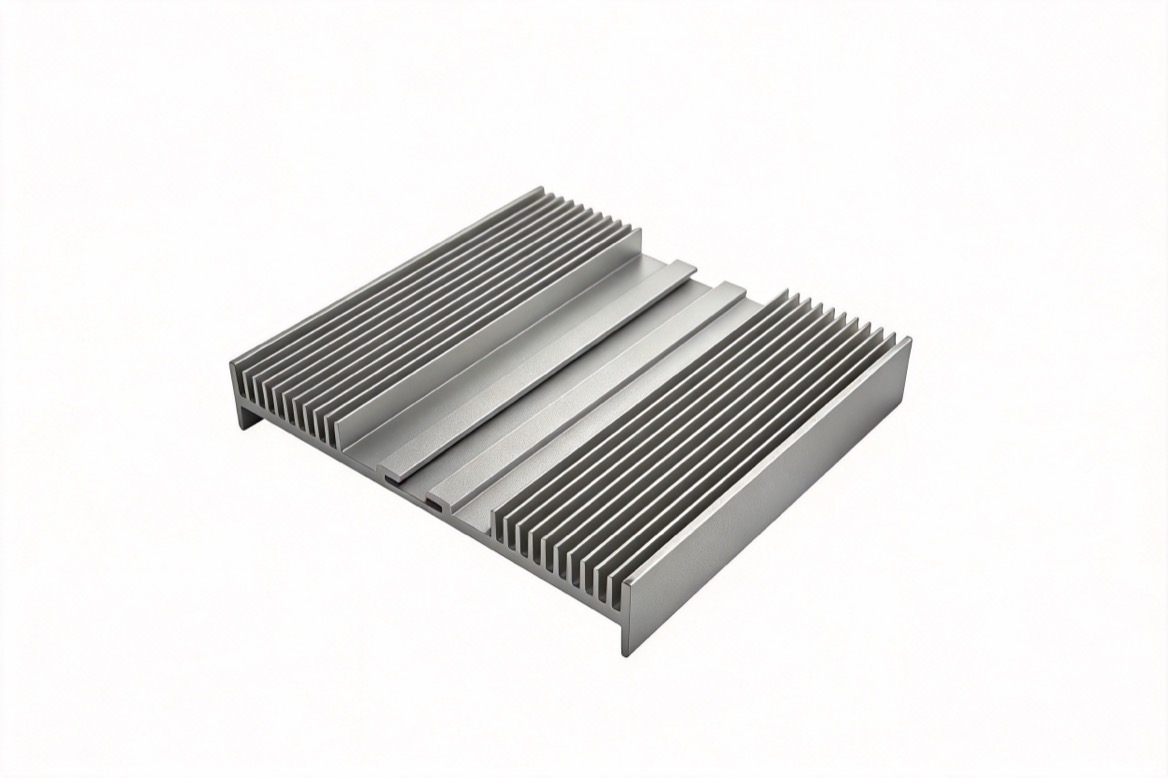
T-slot aluminum extrusions contain features that complicate manufacturing:
- Narrow slot openings.
- Thin internal webs.
- Hollow chambers.
- Screw ports.
- Multiple visible surfaces.
6063's good extrudability makes it attractive for these geometries. However, this does not mean every proposed shape can be manufactured economically or held to any requested tolerance.
6061 can also be extruded into T-slot profiles. Its feasibility should be assessed against wall thickness, section complexity, die design, production volume, and dimensional requirements.
Two profiles labeled "40 × 40" may have different slot openings, internal cavities, wall thicknesses, and section properties.
Likewise, profiles from different framing systems may not accept the same accessories.
Before approving a substitution, compare:
- Slot opening and internal cavity dimensions.
- T-nut engagement geometry.
- Center-bore diameter.
- Bracket and connector compatibility.
- Cut-length, straightness, and twist tolerances.
The profile drawing—not its nominal size—should control compatibility.
6063 is frequently selected for decorative anodizing because it combines good surface quality with a favorable anodizing response.
That makes it useful for visible machine enclosures, exhibition structures, architectural components, and customer-facing workstations.
6061 can also be anodized. However, alloy chemistry, extrusion condition, surface preparation, and finishing parameters can influence the result.
For appearance-sensitive orders, approve a physical finish sample. Define color, gloss, visible-face requirements, and acceptable surface defects rather than relying on "clear anodized" alone.
Both alloys offer useful corrosion resistance, but actual performance depends on exposure and assembly details.
For outdoor, coastal, or chemically demanding applications, review:
- Coating specification and maintenance.
- Drainage and moisture-trapping joints.
- Contact with dissimilar metals.
- Cleaning chemicals.
- Protection of damaged or machined surfaces.
An anodized finish is part of the protection strategy, not a guarantee against every corrosion mechanism.
6061 is commonly preferred when profiles require substantial machining, including precision pockets, mounting faces, and extensively machined interfaces.
6063 remains machinable, but cutting tools, chip evacuation, lubrication, and deburring deserve attention.
For either alloy, inspect critical features after machining and finishing when coating buildup could affect fit.
A frame's usable capacity may be limited by its connections rather than its members.
Possible governing issues include bracket movement, bolt preload loss, thread stripping, and local deformation near slot features.
Use compatible hardware, supplier-supported tightening instructions, and suitable connection arrangements. Do not assume a higher-strength alloy automatically increases every joint's rated capacity.
Both alloys are weldable, but welding can reduce strength in the heat-affected region of heat-treatable aluminum.
Do not apply unwelded T6 properties directly to a welded frame without an appropriate engineering assessment.
Mechanical assembly can avoid weld-related strength changes, although its joints still require verification.
The following examples are selection scenarios, not claims about completed customer projects.
| Application | Sensible starting point | Main verification |
|---|---|---|
| Machine guard or light enclosure | 6063 | Panel support, connections, and finish |
| Adjustable assembly workstation | 6063 | Working loads and deflection |
| Heavily machined structural member | 6061-T6 | Certified strength and machining tolerances |
| Conveyor support | Either | Span, section properties, and joint behavior |
| Precision equipment frame | Either | Deflection, thermal movement, and mounting stability |
| Visible architectural assembly | 6063 | Finish approval and exposure conditions |
A precision frame is especially instructive: higher yield strength may offer little benefit if alignment is controlled by elastic deflection or connection movement.
Document load magnitude, direction, support positions, and unsupported spans.
Specify allowable deflection. Include acceleration, vibration, or repeated loading where relevant.
Request the profile drawing, mass per meter, and second moments of area about both principal axes.
Check which axis resists the applied bending load. Rotating an asymmetric profile can materially change performance.
Verify member stress, deflection, and connection capacity.
Where relevant, also assess buckling, fatigue, local slot deformation, and anchoring. A single static load rating does not answer every design question.
Review tolerances, machining access, finish requirements, and accessory fit before tooling or production approval.
First-article inspection can reveal problems that a material certificate cannot.
Evaluate the finished assembly, not simply the price per kilogram.
Include tooling, machining, finishing, hardware, packaging, freight, and inspection. A slightly more expensive profile may reduce total cost if it eliminates secondary operations or simplifies assembly.
Cross-border purchasing requires clear acceptance criteria.
A useful request for quotation should include:
- Dimensioned drawings and revision numbers.
- Alloy, temper, and material standard.
- Order quantity and cut lengths.
- Critical dimensions and tolerances.
- Surface treatment and approved appearance requirements.
- Machining drawings and accessory interfaces.
- Required material and inspection records.
- Protective packaging and delivery requirements.
Keep material verification and dimensional inspection separate. A tensile test does not confirm slot compatibility, and an accurate profile does not prove the specified temper.
For repeat orders, request traceability between supplied batches and the agreed inspection documentation.
Guangdong Dapeng Aluminum Industry Co., Ltd. develops, manufactures, and exports aluminum profiles for industrial, architectural, transportation, and new-energy applications, with customized deep-processing services.
For a useful project discussion, send your profile drawing, intended application, load requirements, finish specification, order quantity, and destination.
Ask our team to review alloy options, extrusion feasibility, machining requirements, inspection scope, and export packaging. Where structural calculations are required, define the engineering responsibility before production approval.
In comparable T6 extrusion conditions, 6061 generally has higher tensile and yield strength. Confirm the applicable specification and thickness range rather than comparing unrelated online figures.
Not substantially when geometry is identical. Their elastic moduli are similar. Profile depth, section properties, span, and connections usually offer more effective ways to reduce deflection.
Yes, where calculations confirm adequate performance. Commercial T-slot systems use 6063-T6, but suitability depends on the complete frame design, not the alloy alone.
6063 is frequently preferred for decorative anodizing and visible surfaces. Both alloys can be anodized, and an approved sample remains important for appearance-sensitive projects.
Not automatically. Verify geometry, accessory compatibility, section properties, temper, tolerances, and connection performance before approving the substitution.
No. Price depends on profile availability, geometry, order volume, tooling, processing, finish, and delivery conditions. Compare quotations for equivalent finished requirements.
1. [Hydro — Alloy 6061: Extruded Mechanical and Physical Property Limits]. Basis for the 6061 extrusion strength values and thickness-dependent qualifications. [hydro]
2. [Hydro — Alloy 6063, revised June 2026]. Basis for the 6063-T6 extrusion strength values, extrudability, and anodizing discussion. [hydro]
3. [Hydro — Extruded Products: Alloy EN AW-6063]. Supports temper definitions and the importance of specification- and thickness-specific mechanical properties. [hydro]
4. [80/20 — Using the Deflection Calculator]. Supports evaluating profile deflection using loading, support conditions, and section properties. [8020]
5. [80/20 — 20-2020 T-Slotted Profile]. Commercial example of a 6063-T6 T-slot extrusion with published mechanical and geometric information. [8020]
6. [Hydro — Architectural Aluminum Channel]. Supports comparative machining, surface protection, corrosion, and fabrication considerations. [hydro]
7. [The Aluminum Association — Designing Aluminum Structures: Frequently Asked Questions]. Supports distinguishing welded-region strength from unwelded heat-treated properties. [aluminum]


