


Views: 255 Author: Dapeng Aluminum Publish Time: 2026-10-13 Origin: Site


Content Menu
● 6061-T6 vs. 6082-T6 Aluminum: Quick Comparison
● What Makes 6061-T6 and 6082-T6 Different?
>> Alloy Chemistry and Structural Performance
● Mechanical Properties: Compare Equivalent Data
>> Minimum Strength Versus Typical Strength
>> Higher Strength Does Not Mean Higher Stiffness
>> Fatigue Requires Component-Level Evaluation
● CNC Machinability: What Changes in Production?
>> Milling, Turning, and Chip Control
>> Thin Walls and Deep Pockets
● Extruded Profiles Versus Solid Machining Stock
● Corrosion Resistance, Anodizing, and Welding
>> Corrosion Protection in Service
>> Anodizing and Appearance Consistency
>> Welding Changes the Strength Basis
● Practical Engineering Example: A Lightweight Mounting Bracket
>> Case 1: Deflection Controls the Design
>> Case 2: Yield Strength Controls the Design
>> Case 3: Flatness Controls Production Yield
● How to Choose Between 6061-T6 and 6082-T6
>> Step 1: Define the Component's Requirements
>> Step 2: Specify the Actual Product
>> Step 3: Validate the Manufacturing Route
>> Step 4: Compare Finished-Part Cost
>> Step 5: Approve Samples Before Scaling
● Request a Manufacturing Review from Guangdong Dapeng Aluminum Industry
>> Is 6082-T6 Stronger Than 6061-T6?
>> Which Alloy Is Better for CNC Machining?
>> Will 6082-T6 Make My Component Stiffer?
>> Should I Specify T6 or a Stress-Relieved Temper?
>> Can 6061-T6 and 6082-T6 Be Welded?
>> Can I Substitute 6082-T6 for 6061-T6?
Choosing between 6061-T6 and 6082-T6 aluminum for CNC-machined structural components involves more than comparing tensile strength. Both alloys offer low weight, corrosion resistance, and practical machinability. However, their differences in specified strength, extrusion behavior, material availability, and finishing can affect manufacturing cost and component reliability.
The practical starting point is straightforward: 6061-T6 suits many general-purpose machined structures, while 6082-T6 deserves consideration when higher specified strength is valuable. Neither automatically produces a stiffer, more accurate, or more economical component.
From a manufacturing perspective, I would begin with the part's failure mode, stock form, and fabrication route—not the alloy name alone. For Guangdong Dapeng Aluminum Industry Co., Ltd., this connects material selection with its focus on aluminum profile development, production, export, and customized processing.
The following comparison provides a starting point for CNC-machined brackets, mounting plates, structural connectors, and extrusion-based assemblies.
| Selection factor | 6061-T6 aluminum | 6082-T6 aluminum |
|---|---|---|
| Main advantage | Balanced fabrication characteristics | Often higher specified structural strength |
| CNC machining | Suitable for milling, turning, and drilling | Also suitable for structural machining |
| Chip management | Chip breaking may require attention | Chip breaking may require attention |
| Corrosion resistance | Good general corrosion resistance | Good general corrosion resistance |
| Welding | Weldable; local strength decreases | Weldable; local strength decreases |
| Anodizing | Suitable, with appearance qualification | Suitable, with appearance qualification |
| Dimensional stability | Depends on stock and processing | Depends on stock and processing |
| Procurement | Widely used general-purpose alloy | Particularly established in Europe |
| Typical selection priority | Fabrication flexibility and sourcing | Verified strength requirements |
The most important qualification is specification. Properties depend on product form, thickness, temper, and the governing material standard. A typical plate value should not be compared directly with a minimum extrusion value.
Both belong to the heat-treatable 6000 series and use magnesium and silicon as important alloying elements.
6061 also contains controlled copper and chromium additions. 6082 contains more manganese and generally a higher silicon range. These chemistry differences influence strengthening, microstructure, and manufacturing behavior.
For example, Hydro's extrusion datasheets list these composition ranges:
| Element, weight % | 6061 | 6082 |
|---|---|---|
| Silicon | 0.40–0.80 | 0.70–1.30 |
| Magnesium | 0.80–1.20 | 0.60–1.20 |
| Copper | 0.15–0.40 | 0.10 maximum |
| Manganese | 0.15 maximum | 0.40–1.00 |
Chemistry explains why the alloys differ, but it does not replace finished-product mechanical testing.
T6 means solution heat-treated and artificially aged. This treatment develops strength through precipitation hardening.
However, T6 does not mean "stress-relieved for precision machining." For substantial material removal, buyers should also investigate appropriate stretched, stress-relieved tempers.
6061-T651 is relevant to certain rolled products, while T6511 is encountered in extruded products. Applicable designations depend on stock form and specification; they should not be substituted casually.
Published aluminum property tables can appear contradictory because they describe different products.
Hydro's extrusion datasheets provide the following minimum values for their listed T6/T6511 categories:
| Extruded material category | Minimum tensile strength | Minimum 0.2% yield strength |
|---|---|---|
| 6061-T6/T6511, listed thickness categories | 260 MPa | 240 MPa |
| 6082-T6/T6511, 5–150 mm categories | 310 MPa | 260 MPa |
| 6082-T6/T6511, above 150–200 mm category | 280 MPa | 240 MPa |
These are reference values from specific datasheets, not universal design allowables. Confirm the applicable thickness category, current specification, and material certificate before releasing a structural design.
This comparison also reveals a useful limitation: 6082's strength advantage can narrow as section size changes.
Yield strength describes the onset of permanent deformation. Elastic stiffness describes how much a component deflects before yielding.
Both alloys have similar elastic moduli. Consequently, replacing 6061-T6 with 6082-T6 without changing geometry generally provides little improvement in elastic deflection.
For a flexible support bracket, increasing section depth or adding ribs may be more effective than changing alloy.
For a compact component approaching its yield limit, higher certified yield strength may be useful.
Do not select 6082 simply because a tensile table makes it look stronger.
Fatigue performance also depends on:
- Load spectrum and cycle count.
- Hole placement and fillet radii.
- Surface roughness and machining marks.
- Welds and local stress concentrations.
- Corrosion exposure and finishing.
A structural component can fail near a sharp pocket corner or loaded fastener hole even when its nominal stress appears acceptable.
Both 6061-T6 and 6082-T6 are practical CNC machining materials.
Neither should be treated as a universal winner for cycle time. Cutting behavior depends on the actual stock, tool geometry, operation, coolant delivery, and machine rigidity.
Hydro specifically notes that chips can be difficult to break for these alloys. Turning and drilling may therefore need suitable chip-breaking geometry or adjusted machining strategies.
A sensible process-development sequence is:
1. Start with the cutting-tool supplier's aluminum recommendations.
2. Validate chip evacuation in deep holes and enclosed pockets.
3. Inspect built-up edge, burrs, and surface condition.
4. Measure dimensions after unclamping.
5. Optimize settings using the actual production stock.
This is more defensible than promising that one alloy always machines faster.
For thin-walled CNC-machined aluminum components, distortion may matter more than strength.
Quenching, straightening, and subsequent machining can leave or redistribute internal stresses. Removing material asymmetrically may cause a plate or profile to bow.
Useful controls include:
- Selecting appropriate stress-relieved stock.
- Roughing before final finishing.
- Balancing material removal where geometry permits.
- Avoiding excessive fixture pressure.
- Checking dimensions in the free state.
Stress relief reduces risk; it does not guarantee distortion-free machining.
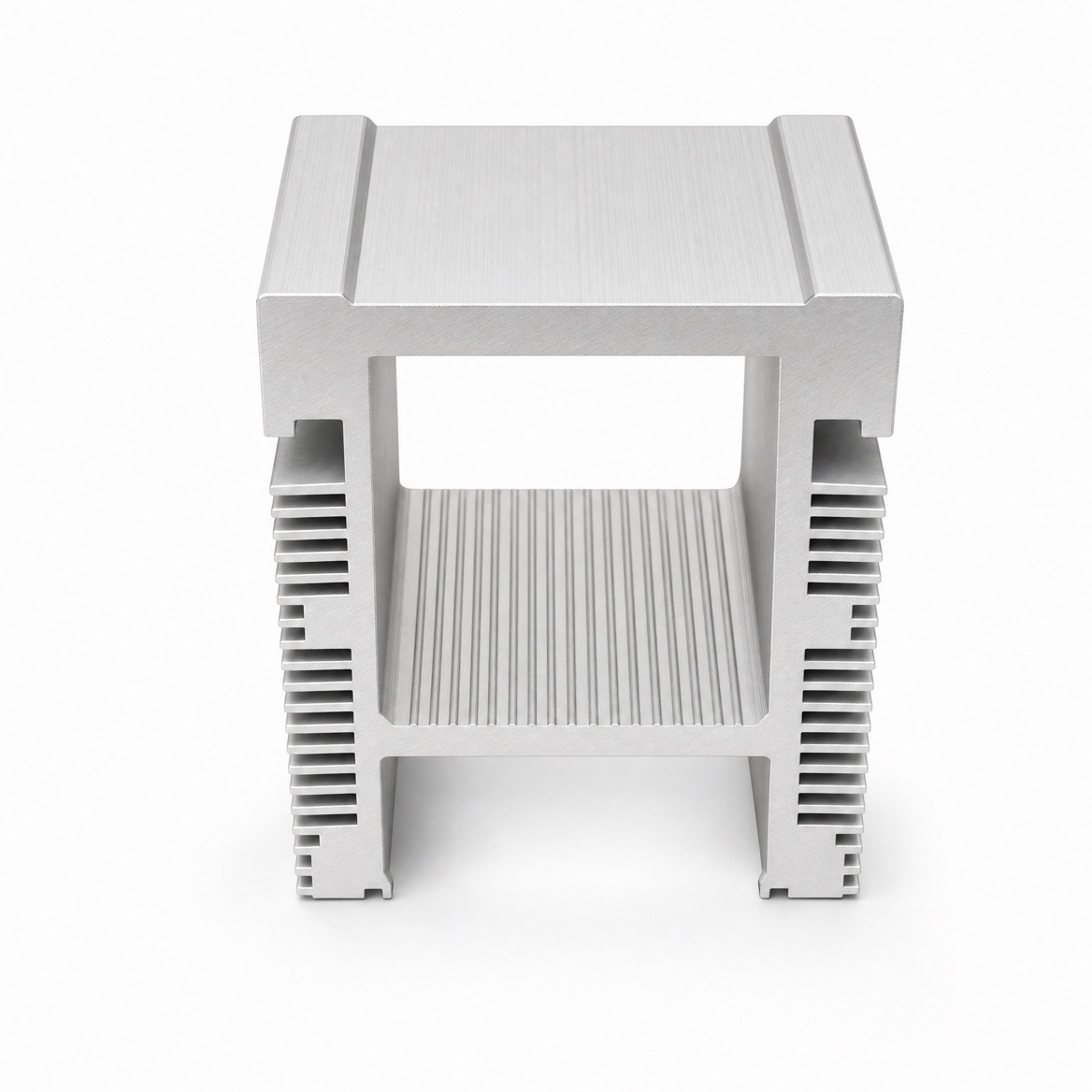
For repetitive structural parts, the stock route can change the economics substantially.
A custom extrusion may incorporate ribs, channels, or mounting features before machining begins. CNC operations can then focus on interfaces, holes, pockets, and critical dimensions.
Compare these options:
| Production route | Potential benefit | Main qualification |
|---|---|---|
| Machine from solid stock | Design flexibility and fewer tooling commitments | Material removal and machining time |
| Machine from standard extrusion | Existing profile availability | Geometry may require compromises |
| Machine from custom extrusion | Lower removal volume for repeat production | Tooling, volume, tolerances, and qualification |
6082 extrusion feasibility deserves particular attention for thin or complex sections. Hydro notes that T6 may not be available for certain thin-wall sections because of quenching limitations.
For Dapeng's profile-focused manufacturing model, early discussion of section geometry can therefore be as important as alloy selection.
Both alloys provide good general corrosion resistance. Neither is immune to aggressive environments.
Assess salt exposure, trapped moisture, dissimilar-metal contact, and cleaning chemicals. A component's drainage and fastener arrangement can influence corrosion performance as much as its alloy designation.
Where aluminum contacts dissimilar metals, consider suitable isolation and protective measures.
Both alloys can be anodized, including protective and decorative treatments.
However, "anodizable" does not guarantee identical color or cosmetic quality. Alloy chemistry, temper, surface preparation, and machining can affect appearance.
For visible assemblies, approve samples made from the intended production stock and finishing process.
Specify coating requirements and dimensional acceptance after finishing, especially for:
- Bearing seats.
- Threaded features.
- Sliding interfaces.
- Precision locating surfaces.
Avoid assuming that different alloys or batches will match visually.
Both alloys are weldable, but welding reduces strength in the affected region of T6 material.
Do not calculate a welded assembly using unwelded T6 properties throughout. Joint design, filler selection, welding procedure, and applicable structural requirements need separate review.
Post-weld heat treatment may be possible in some cases, but it is not an automatic production solution. Dimensional distortion and assembly compatibility must also be considered.
For some structures, a bolted connection may avoid thermal strength changes, although fastener loading and fatigue still require evaluation.
Consider a CNC-machined bracket supporting industrial equipment. This is an illustrative selection exercise, not a documented customer project.
The bracket remains below its yield limit but bends too much.
Switching to 6082-T6 is unlikely to solve the problem because stiffness is similar. Investigate deeper sections, ribs, shorter unsupported spans, or improved mounting geometry.
The available envelope is fixed, and calculated stress approaches the allowable limit.
6082-T6 may provide useful additional margin if the supplied product has higher certified yield strength. Confirm thickness-specific properties and apply the relevant design factors.
The bracket passes strength calculations but distorts after machining.
Review stock condition, stress relief, pocket symmetry, and fixturing first. Changing alloy without changing the manufacturing process may leave the problem unresolved.
The lesson is simple: identify the limiting requirement before upgrading the material.
Document static loads, fatigue exposure, deflection limits, service temperature, and environmental conditions.
Also identify critical fits, flatness requirements, and whether welding occurs after machining.
State alloy, temper, product form, dimensions, and applicable standard.
"6082-T6 aluminum" alone is not a complete purchasing specification. Nor is "6061 equivalent."
Check extrusion feasibility, machining allowance, stress-relieved stock availability, finishing, and inspection requirements.
For heavily pocketed parts, discuss dimensional stability before ordering material.
Evaluate more than price per kilogram:
- Stock availability and delivery.
- Tooling and minimum order quantities.
- Material utilization.
- Machining and deburring time.
- Finishing and inspection.
- Scrap, rework, and replacement risk.
There is no universal rule that 6061 or 6082 is always cheaper. Request comparable quotations for the same finished requirements.
Use first articles to confirm machining behavior, free-state dimensions, coating appearance, and critical interfaces.
For load-critical components, dimensional inspection alone does not establish structural suitability. Engineering verification must match the application.
Guangdong Dapeng Aluminum Industry Co., Ltd. focuses on aluminum profile development, production, export, and customized processing for architectural and industrial applications.
To discuss a 6061-T6 or 6082-T6 structural component, send:
- A dimensioned drawing and 3D model.
- Intended application and load requirements.
- Required alloy, temper, and standard.
- Critical tolerances and surface finish.
- Expected quantity and delivery destination.
Ask Dapeng to confirm available material conditions, profile feasibility, processing scope, and inspection documentation before quotation approval. This creates a clearer path from material selection to a manufacturable component.
Often, yes, when comparing equivalent structural products. However, thickness and specification matter. Some large-section categories show a reduced advantage, so use certified product-specific properties.
Both are suitable. Choose according to structural requirements, stock availability, chip control, dimensional stability, and validated machining results—not a blanket machinability ranking.
Not substantially with unchanged geometry. Both have similar elastic stiffness. Section shape and mounting conditions usually offer more leverage over deflection.
For heavy material removal or tight flatness requirements, investigate an appropriate stress-relieved temper. The correct designation depends on whether the stock is plate, bar, or extrusion.
Yes. However, the affected region loses strength. The welded assembly requires its own design basis and qualified fabrication approach.
Not automatically. Obtain engineering approval and check product standard, dimensions, strength, finishing, welding, and procurement requirements. Similar alloy families do not establish full interchangeability.
1. [Hydro — Alloy 6061 technical datasheet]. Source for chemistry, extrusion minimum mechanical properties, machining guidance, corrosion resistance, and temper information. [hydro]
2. [Hydro — Alloy 6082 technical datasheet, revision February 2019]. Source for composition, thickness-dependent strength, machining guidance, quenching limitations, anodizing, and welding effects. [hydro]
3. [Hydro — 6061 Aluminum]. Source for fabrication characteristics, structural applications, T651 treatment, and post-weld strength changes. [hydro]
4. [Susanne Koch, Hydro — A Quick Guide to Understanding Aluminum Temper Designations], published June 9, 2020. Source for temper definitions, precipitation hardening, and the relationship between treatment and fabrication. [shapesbyhydro]
5. [Gabrian International — 6061 Aluminum Alloy: Properties]. Supplementary source for typical 6061-T6 physical and mechanical properties, including elastic modulus; typical values are distinguished from specified minima. [gabrian]
6. [Hydro — 6082 Alloy]. Supplementary source for structural positioning and comparative fabrication considerations. [hydro]


