


Views: 288 Author: Dapeng Aluminum Publish Time: 2026-10-29 Origin: Site


Content Menu
● 2024 vs. 7075 Aluminum: Key Differences at a Glance
● How Alloy Chemistry and Temper Affect Aerospace Performance
>> 2024 Aluminum: Copper-Based Strengthening
>> 7075 Aluminum: Higher Strength Through Zinc and Magnesium
● Strength, Stiffness, and Weight: What Actually Changes?
>> Where 7075's Higher Strength Helps
>> Why Higher Strength Does Not Mean Higher Stiffness
● Fatigue and Fracture: Avoid the "One Winner" Shortcut
● CNC Machining 2024 vs. 7075 Aluminum
>> Machinability and Surface Finish
>> Cutting Parameters Must Match the Setup
● Why Residual Stress Can Matter More Than Alloy Choice
>> A Practical Distortion-Control Workflow
● Corrosion, Surface Treatment, and Joining
>> Neither Alloy Should Be Treated as Corrosion-Proof
>> Surface Treatment Must Be Included in the Tolerance Plan
● Three Engineering Insights That Improve Material Selection
>> 1. Separate Strength-Limited and Stiffness-Limited Designs
>> 2. Treat Product Form as a Design Decision
>> 3. Compare Cost per Accepted Part
● How to Specify Aerospace Aluminum for Procurement
● Discuss Your Aluminum Component Requirements with Dapeng
>> Is 7075 aluminum stronger than 2024 aluminum?
>> Is 2024 aluminum always better for fatigue-critical parts?
>> Which alloy holds tighter machining tolerances?
>> What is the difference between 7075-T651 and T7351?
>> Can aerospace parts use extruded 2024 or 7075 aluminum?
>> Should these alloys be heat treated after final machining?
Choosing between 2024 vs. 7075 aluminum for precision aerospace machining starts with the component's failure risks—not simply its maximum tensile strength. Both alloys support lightweight aircraft structures, but they offer different balances of strength, damage tolerance, corrosion performance, and manufacturing stability.
7075 generally provides higher strength in commonly compared tempers. Meanwhile, 2024 remains an important option where fatigue crack growth and damage tolerance influence material selection. Neither alloy automatically delivers tighter tolerances: stock condition, grain direction, machining sequence, and inspection methods also matter.
At Guangdong Dapeng Aluminum Industry Co., Ltd., our manufacturing perspective centers on application: define what the part must survive, then evaluate the alloy, temper, product form, and processing route together.
The following values are representative manufacturer-published properties, not guaranteed procurement minimums or aerospace design allowables. Actual requirements vary with thickness, orientation, product form, and specification.
| Comparison point | 2024-T351 aluminum | 7075-T651 aluminum |
|---|---|---|
| Alloy family | Aluminum-copper-magnesium | Aluminum-zinc-magnesium-copper |
| Typical tensile strength | Approximately 469 MPa | Approximately 572 MPa |
| Typical yield strength | Approximately 324 MPa | Approximately 503 MPa |
| Typical elastic modulus | Approximately 73.1 GPa | Approximately 71.0 GPa |
| Main selection advantage | Established damage-tolerant structural applications | High strength for heavily loaded components |
| Machining consideration | Good machining characteristics | Suitable for machining with appropriate process control |
| Corrosion consideration | Protective treatment commonly required | Protection required; temper strongly influences stress-corrosion behavior |
| Alternative temper consideration | Select according to product specification | T7351 improves stress-corrosion resistance at reduced strength |
These figures illustrate an important distinction: 7075's substantial strength advantage does not produce a comparable stiffness advantage.
For final selection, compare the exact material specifications rather than treating every 2024 or 7075 product as interchangeable.
2024 belongs to the 2xxx family. Copper and magnesium contribute to its heat-treatment response and structural performance.
Its established aerospace use reflects a useful combination of strength, machining characteristics, and damage-tolerance performance in selected conditions. However, copper-containing aluminum alloys require careful corrosion protection.
For precision-machined components, 2024-T351 is a relevant plate condition. It combines solution heat treatment, stress relief by stretching, and natural aging.
7075 belongs to the 7xxx family. Zinc, magnesium, and copper support its high-strength heat-treated conditions.
T651 material is artificially aged and stress-relieved by stretching. T7351 uses an overaged condition to improve resistance to stress-corrosion cracking, with a corresponding reduction in strength.
This means "7075 aluminum" is not a complete engineering specification. Choosing T651 rather than T7351 changes the performance balance and must follow the approved design requirements.
7075-T651 is attractive when yielding controls the design—for example, in highly loaded fittings, brackets, or structural connections.
Higher allowable strength may permit a smaller cross-section. However, that opportunity exists only when other constraints allow it.
Before reducing material thickness, evaluate:
- Deflection and alignment.
- Local buckling.
- Fastener bearing and joint loads.
- Fatigue and fracture requirements.
- Minimum manufacturable wall thickness.
A stronger alloy cannot compensate for an unstable geometry.
The elastic moduli of 2024 and 7075 are similar. Consequently, two identically shaped components will not show dramatically different elastic deflection simply because one uses 7075.
From a manufacturing viewpoint, this matters for thin walls. Switching to 7075 does not eliminate workpiece deflection under cutting or clamping forces.
Geometry, support, and tool engagement often matter more than the difference between these alloys.
A common oversimplification says 2024 always offers better fatigue performance than 7075. That statement ignores how fatigue is measured.
Fatigue crack initiation, crack growth, and fracture toughness describe different behaviors. Their rankings can change with temper, loading direction, surface condition, environment, and stress level.
2024-T3 has demonstrated advantages over 7075-T6 in particular fracture-toughness comparisons. That does not establish a universal ranking for every aerospace component.
For fatigue-critical aluminum parts, request data that match:
1. The specified alloy and temper.
2. The relevant product thickness.
3. Longitudinal, transverse, or short-transverse orientation.
4. The actual load spectrum.
5. Surface treatment and environmental exposure.
The practical lesson is straightforward: static tensile strength alone cannot establish service life or inspection intervals.
Both alloys can be precision machined. Manufacturer literature identifies good machining characteristics for 2024, while 7075 is widely used for high-strength machined products.
Neither alloy guarantees a particular surface finish or cycle time.
For both materials, process development should address:
- Sharp cutting edges and suitable aluminum-cutting geometry.
- Chip evacuation from pockets and holes.
- Controlled tool engagement.
- Coolant or lubrication compatible with downstream processing.
- Burr removal without damaging critical edges.
Avoid choosing the alloy from a generic machinability score alone. Deep pockets, interrupted cuts, and thin walls can dominate actual production performance.
There is no universal spindle speed or feed rate for aerospace aluminum machining.
Tool diameter, flute count, machine capability, workholding, and engagement all influence the usable cutting conditions.
For a new component, qualify the roughing process separately from finishing. Then verify dimensional repeatability, tool condition, and surface integrity before releasing production quantities.
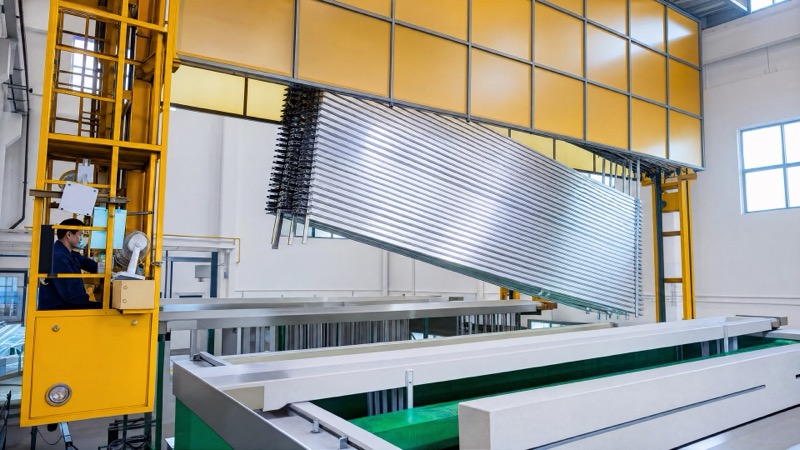
Residual stresses remain in material after processes such as quenching, forming, and machining. Removing material changes the balance of those stresses, potentially causing distortion.
Stress-relieved T351 and T651 stock reduces this risk, but does not eliminate it.
NASA guidance specifically emphasizes mechanical stress relief where possible and careful consideration of grain orientation and residual stress in machined wrought aluminum components.
For a thin-walled aerospace housing or pocketed bracket:
1. Confirm the stock condition. Verify alloy, temper, thickness, and traceability before cutting.
2. Plan blank orientation. Relate grain direction to critical loads and features.
3. Rough progressively. Avoid unnecessary one-sided material removal where geometry permits a more balanced sequence.
4. Leave finishing allowance. Establish it through trials rather than a fixed universal rule.
5. Release and remeasure. Check the part without excessive fixture restraint after roughing.
6. Finish and inspect. Verify final dimensions under the specified measurement conditions.
Do not introduce an informal thermal "stress-relief" cycle. Additional heating can change the material condition and requires an approved process.
Both 2024 and 7075 require an application-specific corrosion strategy.
For 7075, stress-corrosion cracking deserves particular attention when sustained tensile stress combines with a corrosive environment. T73 and T7351 conditions improve resistance compared with T6 and T651, but they are not substitutes without engineering approval.
Design reviews should consider trapped moisture, drainage, dissimilar-metal contact, and difficult-to-protect internal surfaces.
Anodizing and other protective systems can affect dimensions, surface texture, and mating features.
Specify:
- The approved treatment and acceptance requirements.
- Masking for threads, bores, and electrical contact areas.
- Whether dimensions apply before or after finishing.
- Any fatigue-sensitive surface restrictions.
Machining first and deciding on protection afterward creates avoidable rework risk.
Conventional fusion welding is generally unsuitable as a default assembly method for these high-strength alloys. Specialized joining methods require separate qualification.
Consider an illustrative bracket comparison—not a reported customer project.
If the bracket fails a yield-strength check, 7075 may offer a useful advantage. If it fails a deflection check, changing the alloy alone is unlikely to solve the problem.
Increasing section depth or changing rib geometry may be more effective.
This distinction prevents unnecessary material upgrades that leave the original problem unresolved.
Plate, bar, extrusion, and forging are not automatically interchangeable, even when the alloy number matches.
Their grain structure, directional properties, residual stresses, and applicable specifications differ.
An extrusion may reduce machining waste for a suitable constant-section design. Plate may better suit a deeply pocketed component. Either route still requires confirmation against the drawing and approved material requirements.
For an aluminum-profile manufacturer, this is an essential boundary: industrial extrusion capability alone does not establish aerospace material qualification.
Raw material price is only one cost element.
A useful purchasing comparison includes:
- Material certification and testing.
- Blank size and machining waste.
- Roughing and finishing time.
- Distortion-related rework.
- Surface treatment.
- Final inspection and rejected parts.
Request quotations for the same specification, documentation package, and acceptance criteria. Otherwise, a lower-priced offer may represent a different supply requirement rather than genuine savings.
A strong request for quotation removes ambiguity before production starts.
Include the following:
| Requirement | Information to provide |
|---|---|
| Material | Exact alloy, temper, and approved specification |
| Product form | Plate, bar, extrusion, or forging |
| Geometry | Drawing revision, model, and critical dimensions |
| Orientation | Grain-direction requirements where applicable |
| Quality | Required certification, testing, and inspection records |
| Finishing | Coating, masking, and final dimensional requirements |
| Supply | Quantity, delivery schedule, packaging, and traceability |
For flight-critical components, confirm all customer-mandated supplier approvals and quality requirements. A general quality-management statement does not establish approval for a particular aerospace program.
Guangdong Dapeng Aluminum Industry Co., Ltd. focuses on aluminum-profile development, manufacturing, export, and customized processing.
Send our team your drawing, intended application, alloy and temper requirements, annual quantity, and inspection expectations for a project-specific feasibility discussion.
For aerospace inquiries, identify mandatory specifications and approvals at the outset. Any quotation should clearly confirm available product forms, manufacturing scope, documentation, and qualification boundaries before an order proceeds.
In commonly compared conditions, 7075-T651 has higher tensile and yield strength than 2024-T351. However, final design comparisons must use approved values for the exact product, thickness, and orientation.
No. Fatigue initiation, crack growth, and fracture toughness are different properties. Compare relevant data under the intended load spectrum, environment, surface condition, and material orientation.
Neither inherently guarantees tighter tolerances. Stock residual stress, geometry, workholding, thermal conditions, machining sequence, and inspection control determine achievable consistency.
Both are stress-relieved by stretching. T7351 is overaged to improve stress-corrosion resistance compared with T651, while sacrificing some strength. Substitution requires engineering approval.
Potentially, provided the specified product form, properties, inspection requirements, and supplier qualifications are satisfied. An extrusion cannot automatically replace plate or forging.
Not as a default. Heat treatment can cause distortion and alter properties. Follow the engineering drawing and approved process; NASA's aluminum heat-treatment specification generally places heat treatment before final machining unless otherwise specified.
1. Kaiser Aluminum. "Sheet Coil & Plate Alloy 2024." Technical data covering representative mechanical properties and machining characteristics. [online.kaiseraluminum]
2. Kaiser Aluminum. "Rod & Bar Alloy 7075." Technical data covering T6/T651 and T73/T7351 properties, corrosion ratings, and product specifications. [online.kaiseraluminum]
3. Kaiser Aluminum. "Sheet Coil & Plate Alloy 7075." Technical data covering composition and physical properties. [online.kaiseraluminum]
4. NASA Marshall Space Flight Center. "MSFC-STD-3029A." Guidance addressing stress corrosion, mechanical stress relief, residual stress, and grain orientation in wrought aluminum. [standards.nasa]
5. NASA. "Process Specification for the Heat Treatment of Aluminum Alloys," PRC-2002, Revision J. Requirements addressing heat-treatment sequencing and distortion. [nasa]
6. Tecnalia research record. "Residual Stress and Distortion Modeling on Aeronautical Aluminum Components," 2020. Research addressing machining sequence and residual-stress-driven distortion. [scienceportal.tecnalia]
7. California State University ScholarWorks. Archived "Standard Alloy 7075-T651" technical document. Comparative discussion of 2024-T3 and 7075-T6 fracture toughness. [scholarworks.calstate]


