
English


Views: 236 Author: Dapeng Aluminum Publish Time: 2026-08-18 Origin: Site


Content Menu
● 6061 vs. 6063 Aluminum at a Glance
>> Why engineers choose 6061 aluminum
>> Common 6061 aluminum applications
>> Important limitation of 6061 extrusion
>> Why designers choose 6063 aluminum
>> Common 6063 aluminum applications
● Chemical Composition: Why the Alloys Perform Differently
● Strength Comparison: 6061-T6 vs. 6063-T5 and 6063-T6
● Surface Finish and Anodizing Performance
>> Select 6063 when appearance is critical
>> Select 6061 when performance is critical
● Extrusion Design Insight: Alloy Choice Starts with Profile Geometry
● Corrosion Resistance and Outdoor Use
● How to Choose Between 6061 and 6063 Aluminum
● Work With a Professional Aluminum Extrusion Partner
>> Is 6061 aluminum stronger than 6063 aluminum?
>> Which aluminum alloy is better for anodizing?
>> Can 6061 and 6063 aluminum both be extruded?
>> Is 6063 aluminum suitable for outdoor applications?
>> Which is better for CNC machining: 6061 or 6063?
>> Can 6063 replace 6061 in structural applications?
>> Does aluminum temper matter when comparing 6061 and 6063?
When customers ask us to compare 6061 vs. 6063 aluminum, the most important point is that neither alloy is universally "better." The correct choice depends on whether your project prioritizes structural strength, machining performance, extrusion complexity, surface appearance, corrosion exposure, or finishing quality.
At Guangdong Dapeng Aluminum Industry Co., Ltd., we work with customers across construction, industrial equipment, transportation, and new-energy applications. From an extrusion manufacturer's perspective, the best material decision starts before tooling is approved: it requires matching the alloy and temper to the actual load conditions, profile geometry, fabrication method, and visible surface requirements.
Both 6061 and 6063 belong to the 6xxx aluminum alloy series. Their principal alloying elements are magnesium and silicon, which allow them to be heat treated for improved mechanical properties. Both can offer good corrosion resistance, good weldability, and broad suitability for extruded aluminum profiles.
However, their performance priorities differ.
| Property | 6061 Aluminum | 6063 Aluminum |
|---|---|---|
| Common industry description | Structural aluminum alloy | Architectural aluminum alloy |
| Typical strength level | Higher | Medium |
| Extrudability | Good | Excellent |
| Surface finish | Good | Excellent |
| Anodizing appearance | Acceptable to good | Excellent and more uniform |
| Machinability | Good | Fair to good |
| Complex profile suitability | Moderate | Excellent |
| Typical applications | Structural frames, transportation components, machine parts | Window frames, doors, curtain walls, display systems, heat sinks |
| Common tempers | T4, T6 | T5, T6 |
In practical terms, 6061 aluminum is usually selected for strength-focused parts, while 6063 aluminum is often selected for decorative, architectural, and complex-profile extrusion projects.
6061 is a precipitation-hardenable aluminum alloy that contains relatively higher amounts of magnesium, silicon, copper, and chromium than 6063. This composition helps it achieve stronger mechanical performance after heat treatment.
For many buyers, 6061-T6 aluminum is the best-known condition because it offers a strong balance of strength, machinability, corrosion resistance, and weldability. Typical published values for 6061-T6 include an ultimate tensile strength of approximately 310 MPa and yield strength around 276 MPa, though actual results depend on product form, thickness, processing route, and applicable specification.
6061 is often the preferred option when the aluminum part must carry load, resist deformation, or support repeated mechanical use.
Common advantages include:
- Higher tensile and yield strength than standard 6063 extrusion grades
- Good performance for structural and load-bearing components
- Good machining behavior for CNC drilling, milling, tapping, and precision fabrication
- Good weldability for many industrial applications
- Reliable corrosion resistance in normal atmospheric environments
- Broad availability in bars, plates, rods, angles, tubes, and selected extrusion profiles
6061 is widely used in industrial and transportation-related projects, including:
- Machine frames and automation equipment
- Structural brackets and support arms
- Jigs, fixtures, and precision-machined components
- Truck, trailer, and rail-related parts
- Solar mounting structures and support systems
- Marine fittings, subject to design-specific corrosion evaluation
- Industrial ladders, platforms, and workstations
- High-strength angles, channels, and solid profiles
From a production point of view, 6061 can be extruded, but it is generally less forgiving than 6063 when the profile has very thin walls, deep cavities, sharp details, or highly complex cross-sections.
This does not mean a complex 6061 profile is impossible. It means the extrusion die design, metal flow balance, quenching process, dimensional tolerances, and production yield may require more attention. For some projects, a customer may obtain better total value by using 6063 for the profile and redesigning the section geometry to achieve the required stiffness.
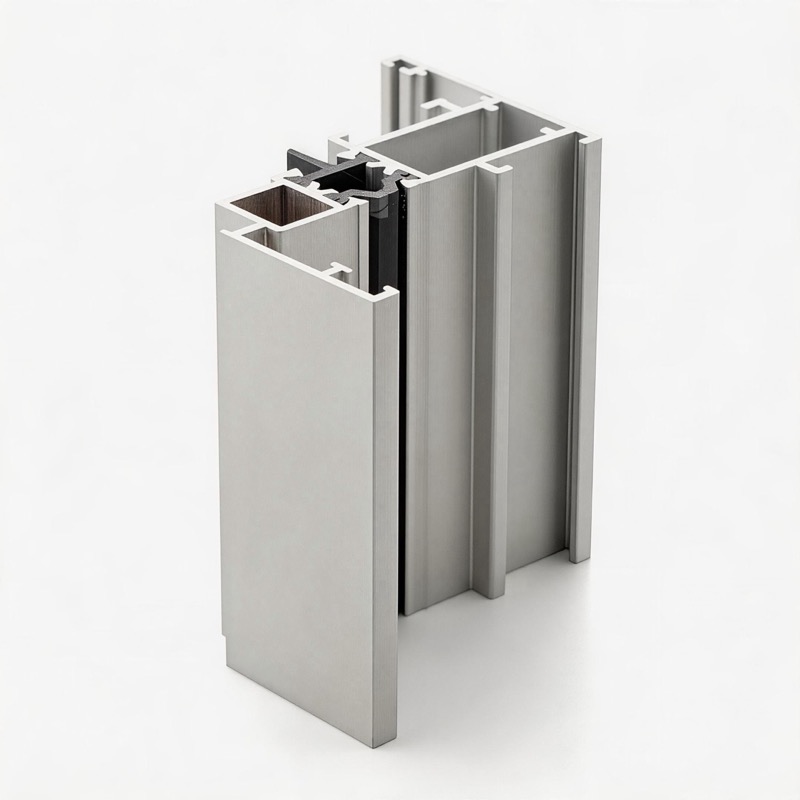
6063 is commonly known as architectural aluminum because it combines good corrosion resistance with excellent extrudability and a smooth surface suitable for anodizing, powder coating, electrophoretic coating, and other decorative treatments.
Compared with 6061, 6063 is generally softer and easier to push through an extrusion die. That makes it particularly suitable for intricate shapes, thin-wall profiles, and visible products where surface consistency matters.
For exterior building systems and consumer-facing aluminum components, visual quality is often as important as mechanical performance. This is where 6063 has a clear advantage.
Key benefits include:
- Excellent extrudability for complex aluminum profile designs
- Smooth surface quality after extrusion
- Excellent response to anodizing
- Good corrosion resistance for outdoor and architectural use
- Good suitability for powder coating and decorative finishes
- Lower resistance to extrusion deformation than 6061
- Efficient production of detailed custom aluminum profiles
6063 is frequently used for:
- Aluminum windows and doors
- Curtain wall profiles
- Architectural trims and decorative sections
- Handrails and guardrail systems
- Solar-frame components
- LED lighting housings
- Heat sinks
- Furniture frames
- Display systems and retail fixtures
- T-slot aluminum profiles
- Interior partitions and modular office systems
For a visible anodized profile, especially one with a brushed, champagne, black, bronze, or clear finish, 6063 is normally the first alloy to evaluate.
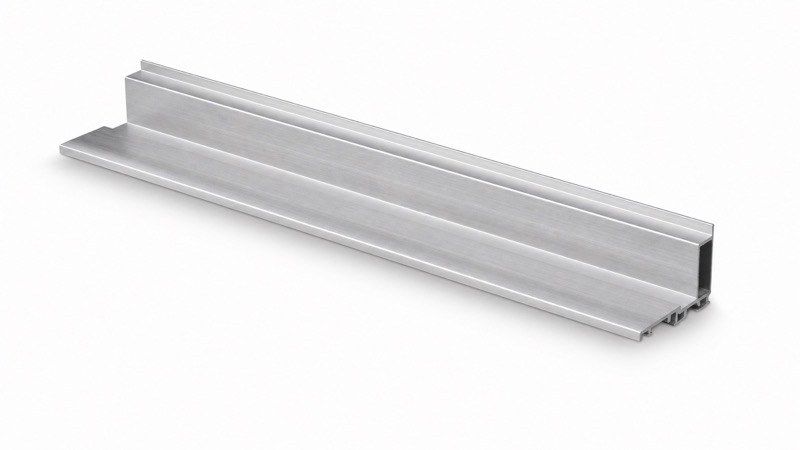
The difference between 6061 and 6063 begins with chemistry. Both alloys use magnesium and silicon to form magnesium silicide during heat treatment. However, 6061 generally contains more magnesium and more copper, while 6063 has a composition optimized for extrusion and appearance.
| Element | 6061 Aluminum Typical Specification Range | 6063 Aluminum Typical Specification Range |
|---|---|---|
| Magnesium | 0.8–1.2% | 0.45–0.9% |
| Silicon | 0.4–0.8% | 0.2–0.6% |
| Copper | 0.15–0.4% | Maximum 0.1% |
| Chromium | 0.04–0.35% | Maximum 0.1% |
| Iron | Maximum 0.7% | Maximum 0.35% |
| Aluminum | Balance | Balance |
The higher magnesium and copper content in 6061 contributes to its stronger heat-treated condition. Meanwhile, the lower alloying content and controlled chemistry of 6063 help support smoother extrusion flow and superior finishing results.
For buyers, the lesson is simple: material chemistry directly affects manufacturability, mechanical strength, appearance, and processing cost.
A meaningful 6061 vs. 6063 aluminum comparison must include temper. Alloy designation alone is not enough. The temper describes how the material was cooled, aged, or heat treated after forming.
| Alloy and Temper | Typical Tensile Strength | Typical Yield Strength | Best Use |
|---|---|---|---|
| 6061-T6 | Around 310 MPa | Around 276 MPa | Structural and machined components |
| 6063-T5 | Approximately 145–186 MPa | Varies by section and specification | Architectural extrusions and general profiles |
| 6063-T6 | Approximately 205–245 MPa | Varies by section and specification | Higher-performance architectural or industrial profiles |
6061-T6 is usually stronger than 6063-T5, which is one reason it is widely used in structural applications. However, a stronger alloy is not automatically the better commercial choice.
For example, a lightweight aluminum enclosure or window profile may not need 6061-T6 strength. Using 6063 can provide better extrusion quality, more consistent finishing, lower tooling risk, and a more attractive final product.
Surface treatment should be considered at the alloy-selection stage, not after extrusion is complete.
6063 is widely favored for anodized aluminum because it can deliver a cleaner and more uniform visual finish. This is important for architectural systems, furniture, electronics housings, and any project where end users will see the aluminum surface closely.
6061 can also be anodized. However, its additional alloying elements can make color and surface appearance less consistent, particularly on visible decorative sections. This does not prevent its use in anodized products, but it requires realistic visual expectations and process validation.
6063 is usually the stronger choice for:
- Clear anodized window and door profiles
- Black, bronze, champagne, or colored anodized sections
- Decorative aluminum trims
- High-visibility furniture and display profiles
- Smooth powder-coated architectural extrusions
- Consumer-facing product housings
6061 is generally more suitable when:
- Mechanical strength is the primary requirement
- The component will be CNC machined
- The profile will be hidden after assembly
- Surface variation is acceptable
- The product must withstand higher static or dynamic loads
In our experience, many sourcing problems occur because customers select an alloy before confirming whether the profile can be produced efficiently.
A profile with thin walls, narrow internal channels, large hollow cavities, unequal wall thicknesses, or sharp transitions may be ideal for 6063 but challenging in 6061. This is especially important for custom aluminum extrusion projects.
Before finalizing a drawing, review these factors with your extrusion supplier:
1. Wall thickness: Extremely thin walls may increase extrusion difficulty and distortion risk
2. Profile symmetry: Asymmetrical profiles can create uneven metal flow and dimensional variation
3. Hollow sections: Multi-void or deep-cavity designs require sophisticated die engineering
4. Tolerance requirements: Tighter tolerances may require additional process control or machining
5. Surface finish: Decorative anodizing often favors 6063
6. Post-processing: CNC machining, bending, welding, punching, and assembly affect alloy selection
7. End-use load: Calculate actual service loads instead of selecting a high-strength alloy by default
A practical example is an industrial equipment enclosure. If the part is primarily a lightweight cover with integrated channels, snap-fit details, and a visible anodized surface, 6063 may offer the best result. If the same section must support a heavy motor or act as a structural crossbeam, 6061 or a redesigned reinforced profile may be more appropriate.
Both alloys can provide good corrosion resistance because aluminum naturally forms a protective oxide layer. Yet real-world corrosion performance depends on much more than alloy grade.
Important factors include:
- Salt spray or marine exposure
- Industrial pollution
- Contact with dissimilar metals
- Standing water and poor drainage
- Surface pretreatment quality
- Coating or anodizing specification
- Installation design and maintenance conditions
6063 is often chosen for outdoor architectural products because it is easy to anodize and coat. A well-controlled surface treatment can significantly improve long-term appearance and corrosion protection.
For coastal, marine, or highly corrosive environments, material selection should not rely on a simple "6061 vs. 6063" comparison. The project should consider coating thickness, fastener isolation, drainage design, sealing methods, and relevant corrosion-testing requirements.
Use this decision guide when selecting an aluminum extrusion alloy.
Choose 6061 aluminum if you need:
- Higher strength and stiffness
- Better performance in machined parts
- Structural load-bearing capability
- Industrial brackets, supports, fixtures, or transportation parts
- A material suitable for demanding mechanical applications
Choose 6063 aluminum if you need:
- Complex custom extrusion profiles
- Better surface smoothness
- Premium anodizing or powder-coating results
- Window, door, curtain wall, lighting, display, or furniture profiles
- Efficient production of decorative or architectural aluminum sections
For export projects, we recommend confirming alloy, temper, dimensions, tolerances, mechanical-property requirements, surface finish, packaging method, and inspection criteria before mass production. This reduces approval delays and helps ensure that the delivered aluminum profiles match the intended installation and market requirements.
The right alloy is only one part of a successful aluminum profile project. The final result also depends on die design, billet quality, extrusion control, aging process, surface treatment, fabrication capability, quality inspection, and export packaging.
Guangdong Dapeng Aluminum Industry Co., Ltd. provides industrial aluminum profiles, architectural aluminum profiles, and customized deep-processing services for international customers. Whether you need high-strength 6061 aluminum components or precision-finished 6063 extrusions, our technical team can help evaluate your drawings, recommend a suitable alloy and temper, and develop a production solution aligned with your application.
Contact Guangdong Dapeng Aluminum Industry Co., Ltd. today to discuss your custom aluminum extrusion project, request technical support, or obtain a quotation.
Yes. In commonly used tempers, especially 6061-T6, 6061 generally offers higher tensile and yield strength than 6063-T5. This makes 6061 a frequent choice for structural, load-bearing, and machined components.
6063 is usually better for decorative anodizing because it typically produces a smoother and more uniform surface appearance. It is widely used for architectural profiles, trims, window frames, and visible aluminum products.
Yes. Both can be extruded, but 6063 is generally easier to extrude into intricate shapes and thin-wall profiles. 6061 may require more careful die design and process control, particularly for complex sections.
Yes. 6063 is commonly used in outdoor architectural systems because of its corrosion resistance and strong compatibility with anodizing and powder coating. Performance still depends on surface treatment, design, drainage, and environmental exposure.
6061 is generally preferred for CNC machining because its higher strength and hardness can support more stable machining performance. The best option still depends on the part geometry, tolerance, finish, and production volume.
Sometimes, but not automatically. If the load is moderate and the profile geometry provides sufficient stiffness, 6063 may work well. For safety-critical or highly loaded applications, engineers should verify the design using the required mechanical-property data and relevant standards.
Yes. Temper has a major impact on strength and formability. A comparison between 6061-T6 and 6063-T5 is more meaningful than comparing alloy names alone, because the heat-treatment condition changes the final mechanical performance.
- [Aluminum Association — Aluminum Alloy Designation System]
- [United Aluminum — 6061 Aluminum Alloy: Information and Specifications]
- [MatWeb / ASM — Aluminum 6061-T6 Material Data Sheet]
- [MatWeb / ASM — Aluminum 6063-T5 Material Data Sheet]
- [Aluminum Anodizers Council — Specifying Anodized Aluminum]
- [Aluminum Extruders Council — Frequently Asked Questions]


