


Views: 212 Author: Dapeng Aluminum Publish Time: 2026-08-29 Origin: Site


Content Menu
● Steel vs. Aluminum at a Glance
● Weight: Aluminum's Defining Advantage
>> Why extrusion changes the equation
● Strength, Stiffness, and Load Capacity
>> When steel is usually the better choice
>> When aluminum can be the smarter structural choice
● Corrosion Resistance and Service Life
>> Practical corrosion-control steps for aluminum projects
● Cost: Look Beyond Price per Kilogram
● Aluminum Extrusion vs. Steel Fabrication
>> What custom aluminum extrusion can deliver
● How to Choose Between Steel and Aluminum
>> Step 1: Define the load and stiffness requirement
>> Step 2: Evaluate the operating environment
>> Step 3: Calculate the weight impact
>> Step 4: Review fabrication and assembly
>> Step 5: Compare total project cost
>> Step 6: Validate with samples and technical review
● Sustainability and Recycling Considerations
● Common Steel vs. Aluminum Applications
>> Building and architectural systems
>> Industrial equipment and automation
>> Transportation and new-energy systems
● Work With an Aluminum Profile Manufacturer
>> Is aluminum stronger than steel?
>> Why is aluminum preferred for lightweight structures?
>> Does aluminum rust like steel?
>> Is aluminum more expensive than steel?
>> Can aluminum profiles replace welded steel frames?
>> Which aluminum alloy is best for extruded profiles?
>> Is recycled aluminum energy efficient?
Choosing between steel and aluminum is not simply a question of which metal is stronger or cheaper. It is a design, manufacturing, lifecycle, and performance decision. The right material depends on the loads a product must carry, the environment it will face, the weight limits of the final assembly, the fabrication method, and the expected service life.
For global buyers of industrial aluminum profiles, architectural aluminum systems, transportation components, and custom-fabricated parts, aluminum often creates value where lower mass, corrosion resistance, precise extrusion geometry, and clean surface appearance matter. Steel remains indispensable for highly rigid structures, high-load frameworks, and applications where material cost is the dominant priority.
At Guangdong Dapeng Aluminum Industry Co., Ltd., we work with customers who need more than raw aluminum sections. They need an aluminum alloy solution that can be engineered, extruded, finished, fabricated, packed, and delivered reliably for real-world use. This guide compares steel vs. aluminum in practical terms, helping engineers, sourcing teams, contractors, distributors, and product developers make a better material decision.
Steel and aluminum are both essential engineering materials, but they behave very differently. Steel generally provides higher stiffness and high absolute strength. Aluminum offers much lower density, strong corrosion resistance, excellent formability, and outstanding flexibility for complex extruded profiles.
| Comparison Factor | Aluminum | Steel |
|---|---|---|
| Density | About 2.7 g/cm³ | About 7.75–8.05 g/cm³ |
| Relative weight | Roughly one-third the weight of steel | Significantly heavier |
| Stiffness | Lower elastic modulus, about 69 GPa | Higher elastic modulus, typically 190–210 GPa |
| Corrosion resistance | Naturally forms a protective oxide layer | Carbon steel typically requires coatings or protection |
| Strength | Varies widely by alloy and temper | Often higher in absolute terms |
| Strength-to-weight efficiency | Excellent for lightweight structures | Strong, but heavier per unit volume |
| Extrusion design freedom | Excellent for complex cross-sections | More limited for comparable profile geometry |
| Welding and repair | Requires appropriate methods and expertise | Often simpler to weld and repair |
| Upfront material cost | Often higher | Often lower for standard grades |
| Recycling potential | Highly recyclable; recycled aluminum needs far less energy than primary production | Highly recyclable and widely recovered |
The key point is simple: steel is not automatically better because it is stronger, and aluminum is not automatically better because it is lighter. Material selection should begin with the performance requirements of the finished product.
Aluminum's density is approximately 2.7 g/cm³, while steel commonly falls near 7.85 g/cm³. In practical terms, aluminum is about one-third as dense as steel. That difference can transform product performance, handling cost, installation methods, logistics, and energy use during operation.
For a transportation frame, solar mounting structure, warehouse workstation, ladder, vehicle body component, or modular industrial enclosure, reducing weight can create measurable commercial benefits:
- Lower fuel or energy consumption during product use.
- Easier manual handling during installation.
- Reduced demand on lifting equipment and support structures.
- Lower freight weight for international shipment.
- More payload capacity in trucks, rail systems, trailers, and specialized vehicles.
- Faster assembly when profiles are designed for efficient joining.
However, lower weight does not mean that an aluminum part can always replace a steel part at the same dimensions. Aluminum has lower stiffness, so a direct "same-size substitution" may lead to excessive deflection. The solution is often better profile design, not simply more material.
A steel flat bar or tube may be suitable for a simple structural need. But aluminum extrusion allows engineers to place material precisely where it contributes the most to performance.
An optimized industrial aluminum profile can integrate:
- Internal ribs for higher stiffness.
- Hollow chambers to reduce weight.
- Screw ports and fastening channels.
- Cable-management paths.
- Sealing grooves.
- Heat-dissipation fins.
- Decorative faces and concealed joints.
- Assembly features that reduce secondary machining.
This design freedom can allow a well-engineered aluminum extrusion to achieve the required stiffness and function while using less total material and reducing the number of separate components.
The phrase "steel is stronger than aluminum" is broadly true only when used without context. Steel commonly delivers higher tensile strength and higher stiffness than many general-purpose aluminum alloys. But aluminum alloys cover a wide performance range, and heat treatment can substantially improve their mechanical properties.
According to ASM International, soft, high-purity aluminum can have a yield strength near 10 MPa, while some heat-treated commercial high-strength aluminum alloys can exceed 550 MPa in yield strength. This illustrates why material selection must be based on the specific alloy, temper, thickness, profile geometry, and loading condition—not the word "aluminum" alone.
Steel's major advantage is stiffness. Its elastic modulus is typically around 190–210 GPa, compared with roughly 69 GPa for aluminum. A steel member therefore deflects less than an aluminum member of identical shape and dimensions under the same load.
Steel is often preferable when the project requires:
- Very high structural rigidity with limited space for larger sections.
- Heavy static loads or concentrated impact loads.
- Large building frames and primary structural members.
- Heavy machinery bases and high-load support structures.
- Low initial material cost for standard fabricated components.
- High-temperature resistance beyond the practical range of a selected aluminum alloy.
Aluminum is often preferable when the project requires:
- Lower structural weight without sacrificing functional strength.
- Corrosion resistance in humid, coastal, outdoor, or industrial environments.
- Long profiles with customized cross-sectional features.
- Modular assembly using T-slots, channels, grooves, or concealed fasteners.
- Repeated installation, relocation, or reconfiguration.
- A clean architectural or consumer-facing appearance.
- Anodized, powder-coated, electrophoresis, wood-grain, or customized surface finishes.
The best engineering decision is normally not "steel versus aluminum" in isolation. It is the right alloy and profile design for the load path, environment, assembly method, and total ownership cost.
Corrosion is one of the most important differences between aluminum and ordinary carbon steel. Aluminum naturally develops a thin oxide layer that protects the material surface from further oxidation in many normal environments. This makes aluminum a strong choice for windows, doors, curtain walls, solar frames, transport equipment, outdoor machinery covers, marine-adjacent projects, and exposed industrial assemblies.
Carbon steel, by contrast, can rust when moisture and oxygen are present. It often requires painting, galvanizing, powder coating, or another protective treatment. Those systems can perform well, but they add manufacturing steps, inspection requirements, maintenance needs, and possible future repair work.
It is important to avoid oversimplification. Aluminum is corrosion resistant, not corrosion-proof. Certain environments—including alkaline conditions, trapped moisture, severe chemical exposure, and direct contact with dissimilar metals—can create corrosion risks. For example, galvanic corrosion may occur when aluminum is connected directly to certain metals in the presence of an electrolyte.
1. Select an alloy appropriate for the intended environment.
2. Use anodizing, powder coating, or other specified finishes where added protection or appearance is needed.
3. Prevent water from becoming trapped in profile cavities and joints.
4. Use suitable isolators, washers, coatings, or fasteners for mixed-metal assemblies.
5. Define realistic cleaning and maintenance requirements for coastal, polluted, or high-humidity locations.
6. Confirm the final finish specification before mass production, especially for architectural projects.
For international projects, this is where supplier experience matters. A profile that performs well in a dry indoor installation may require a different alloy, wall thickness, coating system, or assembly detail for a tropical climate, coastal building, photovoltaic installation, or industrial plant.
Steel generally has a lower initial material cost than aluminum. That can make steel appear to be the immediate economic choice, especially for simple components where weight, corrosion, appearance, and installation efficiency are less important.
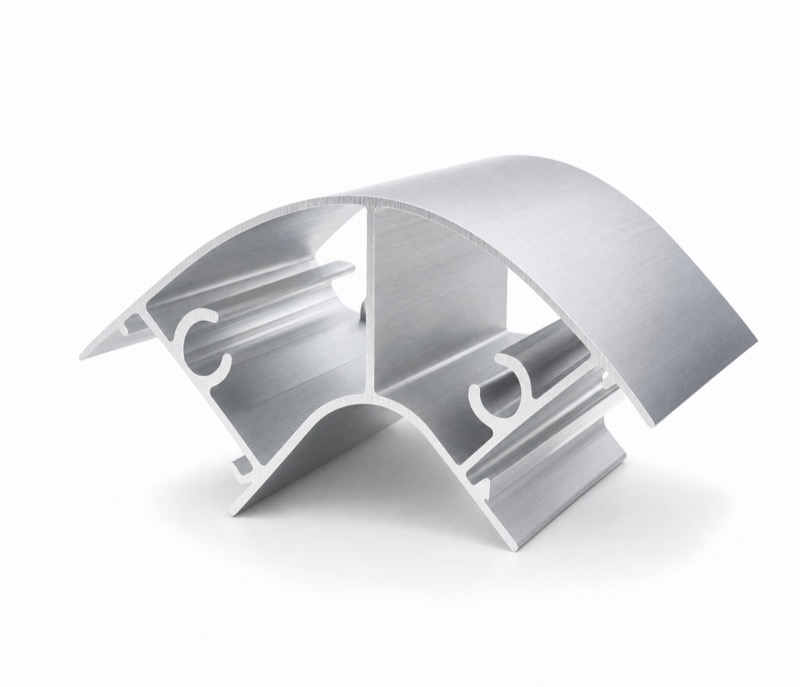
But comparing only the price per kilogram can lead to the wrong purchasing decision. Aluminum is lighter, so a part may need fewer kilograms to perform its intended function. A custom aluminum extrusion may also combine multiple component functions into one profile, reducing fabrication, fastening, inventory, and assembly time.
A more useful comparison is total installed and lifecycle cost.
| Cost Factor | Aluminum Consideration | Steel Consideration |
|---|---|---|
| Raw material | Often higher per kilogram | Often lower per kilogram |
| Shipping | Lower weight can reduce freight costs | Higher mass can raise logistics cost |
| Fabrication | Extrusion can integrate multiple functions | Welding and fabrication may be economical for simple structures |
| Surface protection | Natural corrosion resistance; optional finishing | Often needs paint, plating, or galvanizing |
| Installation | Lighter components can simplify handling | May require more lifting capacity |
| Maintenance | Often lower in corrosive environments | Coating damage and rust may require attention |
| End-of-life value | Strong recycling value | Strong recycling value |
For example, a steel frame may have the lowest purchase price. But an aluminum extrusion system can become more cost-effective if it reduces installation time, eliminates corrosion-related repainting, lowers transport weight, and supports faster modular assembly.
The manufacturing route should influence your material decision. Steel is commonly cut, bent, welded, rolled, drilled, and coated. Aluminum can be fabricated using those methods as well, but aluminum extrusion adds a major advantage: the ability to create a customized constant cross-section in one continuous process.
A single industrial aluminum profile may replace several steel components such as brackets, covers, fasteners, channels, and reinforcement pieces. This can support:
- Cleaner product appearance.
- Fewer assembly operations.
- More consistent dimensional control.
- Reduced welding distortion.
- Simplified inventory management.
- Better integration of functional details.
- Faster repeatable production at scale.
At Guangdong Dapeng Aluminum Industry Co., Ltd., our production capabilities are designed around the full aluminum profile process: alloy selection, die development, extrusion, surface treatment, deep processing, quality control, and export-oriented packaging. This allows customers to source standard aluminum profiles, architectural profiles, and project-specific fabricated solutions from a manufacturing partner focused on consistency and practical application performance.
A reliable material decision begins with a structured evaluation. Before requesting a quotation, define the actual performance requirements rather than asking only for "the cheapest metal."
Clarify the expected static load, dynamic load, impact exposure, span length, deflection limit, and safety factor. If stiffness is critical, steel may offer a compact solution. If lightweight performance is important, a redesigned aluminum profile may meet the same functional target.
Consider moisture, salt exposure, UV radiation, chemical contact, indoor or outdoor use, temperature range, cleaning methods, and expected maintenance conditions. Corrosion exposure can change the economics of the project significantly.
Ask how the material affects transportation, installation, payload, user handling, and support structures. In moving systems, every kilogram may affect operating cost and product performance.
Determine whether the product needs welding, machining, drilling, bending, modular connectors, integrated channels, visible surfaces, or quick installation. Aluminum extrusion may reduce complexity when the cross-section has multiple functional features.
Include material, tooling, processing, coatings, scrap rate, packaging, freight, installation labor, maintenance, and expected service life. The lowest unit price is not always the lowest long-term cost.
For important projects, review drawings, tolerance requirements, mechanical expectations, finish samples, and assembly methods before mass production. A supplier should help identify manufacturability risks early, before tooling and production begin.
Both steel and aluminum are recyclable and can contribute to circular material systems. The environmental comparison depends on factors such as recycled content, energy source, transportation distance, product service life, and recovery at end of life.
Aluminum's major advantage appears in recycling: recycled aluminum requires dramatically less energy than producing primary aluminum. The International Aluminium Institute reports that recycled aluminum requires approximately 8.3 gigajoules per tonne, compared with 186 gigajoules per tonne for global primary aluminum production in 2019—a reduction of about 95.5%.
Steel is also extensively recycled. The World Steel Association estimates that global end-of-life steel scrap recycling is around 85%, according to figures cited by ResponsibleSteel.
For buyers, the practical conclusion is not that one material is universally "green." Instead, specify the factors that matter to your project:
- Required recycled content, where available.
- Product durability and expected service life.
- Repairability and reuse potential.
- Weight reduction during product operation.
- End-of-life disassembly and material recovery.
- Packaging efficiency and shipping distance.
- Documentation requested by the project owner or local market.
Aluminum is widely used for window frames, doors, curtain walls, railings, louvers, sunshades, partitions, ceiling systems, and decorative trims. Its corrosion resistance, finish options, precise extrusion capability, and modern appearance make it particularly suitable for visible building elements.
Steel is frequently used for primary building structures, reinforcement, heavy framing, and applications requiring high stiffness or heavy load capacity in limited cross-sectional space.
Industrial aluminum profiles are ideal for machine guards, workbenches, conveyor frames, automated production lines, equipment enclosures, inspection stations, storage systems, and modular cleanroom structures. Their slot-based design supports rapid reconfiguration without extensive welding.
Steel remains common for machine bases, high-vibration frames, heavy-duty equipment stands, and structures exposed to large concentrated loads.
Aluminum supports lightweight vehicle bodies, trailers, rail components, battery enclosures, charging infrastructure, solar mounting systems, and mobility equipment. Reducing weight can improve efficiency and payload capacity.
Steel continues to play an essential role in safety-critical structures, chassis components, and applications requiring high rigidity, high impact performance, or cost-efficient mass production.
The strongest outcome often comes from early collaboration between the buyer's engineering team and the aluminum manufacturer. Share the application, drawings, loading conditions, target market, finish requirements, tolerance expectations, assembly details, and annual volume. This allows the supplier to recommend a suitable alloy, profile structure, die approach, surface treatment, and processing plan.
Guangdong Dapeng Aluminum Industry Co., Ltd. provides industrial aluminum profiles, architectural aluminum profiles, and customized deep-processing services for overseas customers. Our team supports projects that require stable extrusion quality, professional technical communication, controlled production processes, and export-ready service.
Send us your drawing, sample, or application requirements to discuss a custom aluminum profile solution for your next project.
Steel is generally stronger and stiffer than aluminum when comparing common grades of similar dimensions. However, high-strength aluminum alloys can provide strong performance, and aluminum's lower weight often gives it a better strength-to-weight advantage. The final result depends on the alloy, temper, wall thickness, profile design, and loading condition.
Aluminum has a density of approximately 2.7 g/cm³, roughly one-third that of steel. This helps reduce product weight, freight weight, installation effort, energy use in moving equipment, and demand on supporting structures.
Aluminum does not rust in the same way as carbon steel. It naturally forms a protective oxide layer that helps resist corrosion. However, aluminum can still corrode under unsuitable environmental or assembly conditions, especially when moisture is trapped or incompatible metals are in direct contact.
Aluminum often costs more per kilogram than standard steel. However, the total project cost may be competitive or lower when aluminum reduces weight, shipping expense, corrosion protection needs, fabrication steps, installation time, or maintenance requirements.
In many modular, lightweight, corrosion-sensitive, or frequently reconfigured applications, yes. Industrial aluminum profiles can replace welded steel frames for machine enclosures, workstations, conveyors, automation equipment, and modular partitions. For very high-load or high-stiffness applications, steel may remain the better solution.
The best alloy depends on the application. Common extrusion alloys are selected based on mechanical strength, corrosion resistance, surface-finish requirements, machining needs, and project environment. A technical review of the drawing and use case is the best way to determine the appropriate material.
Yes. The International Aluminium Institute reports that recycled aluminum requires about 8.3 gigajoules of primary energy per tonne, compared with 186 gigajoules per tonne for primary aluminum production, representing an energy saving of about 95.5%.
1. [Bor USA — Steel vs Aluminum: Comparing Strength and Weight]
2. [ASM International — Aluminum and Aluminum Alloys Subject Guide]
4. [Aluminum Association — Sustainability and Recycling]
5. [ResponsibleSteel — Analysing the Role of Scrap in Steelmaking Through the Years]


