


Views: 220 Author: Dapeng Aluminum Publish Time: 2026-09-22 Origin: Site


Content Menu
● Aluminum Extrusion vs. Casting: Core Differences
● Aluminum Extrusion Process Explained
>> 2. Die Design and Extrusion
>> 3. Cooling, Stretching, and Cutting
>> 4. Fabrication and Surface Treatment
● Aluminum Casting Process Explained
>> Why Casting Supports Complex Shapes
● Strength and Mechanical Performance
● Cost Comparison: Extrusion vs. Casting
● Design Checklist Before Selecting a Process
● Quality Control Matters More Than Process Labels
● Choosing the Right Aluminum Manufacturing Partner
● FAQs
>> 1. Is aluminum extrusion cheaper than aluminum casting?
>> 2. Can extruded aluminum have complex shapes?
>> 3. Is cast aluminum stronger than extruded aluminum?
>> 4. Which aluminum alloy is commonly used for extrusion?
>> 5. Which aluminum alloy is commonly used for die casting?
>> 6. Can aluminum extrusion be machined after production?
>> 7. How can porosity affect aluminum castings?
>> 8. Can extrusion and casting be used together in one product?
When customers ask us to compare aluminum extrusion vs. casting, the most useful answer is not that one process is universally better. The right choice depends on the part's geometry, production volume, structural load, finishing requirements, tolerance needs, and total lifecycle cost.
At Guangdong Dapeng Aluminum Industry Co., Ltd., we work with aluminum profiles for industrial, architectural, transportation, and new-energy applications. From a manufacturing perspective, aluminum extrusion is usually the stronger choice for long parts with a consistent cross-section, while aluminum casting is often better for compact components with complex three-dimensional geometry. The key is to choose the process early—before tooling, prototyping, and sourcing decisions lock in unnecessary cost.
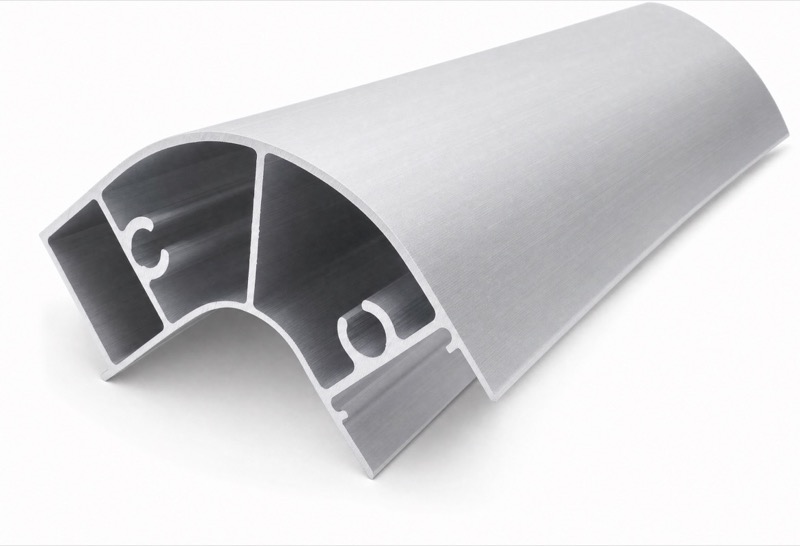
Aluminum extrusion is a forming process in which a heated aluminum billet is pushed through a precision die. The aluminum exits the die as a continuous profile with a fixed cross-sectional shape, similar to toothpaste passing through a shaped nozzle.
After extrusion, the profile is cooled, stretched, cut to length, and—when required—heat treated, machined, anodized, powder coated, assembled, or fabricated into a final component.
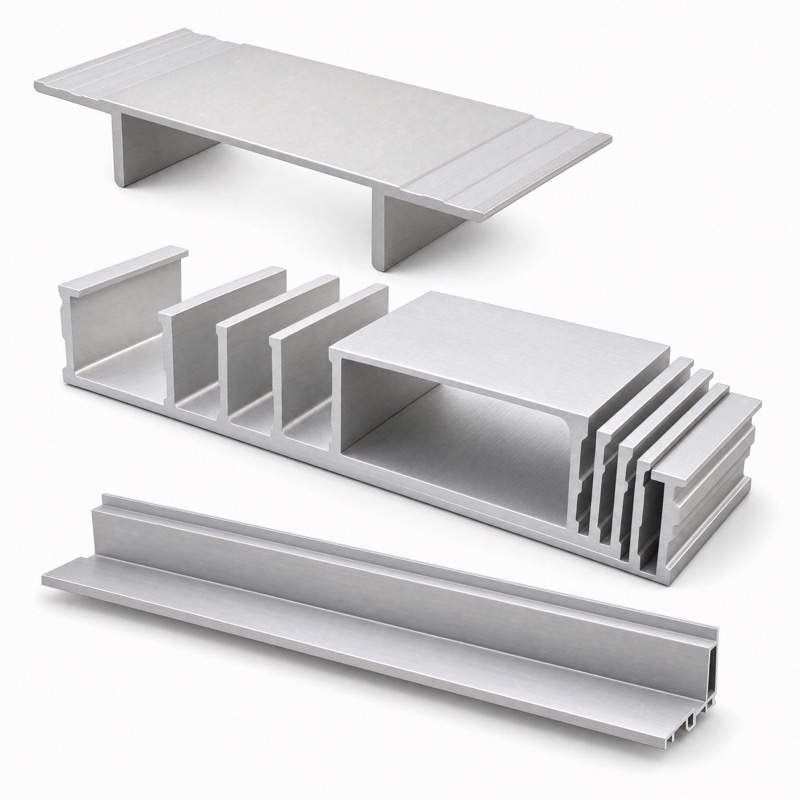
This process is particularly suitable for products such as:
- Industrial aluminum frames
- T-slot aluminum profiles
- Aluminum channels and angles
- Heat sinks
- Window and door profiles
- Curtain-wall components
- Solar panel mounting rails
- Transportation structural profiles
- Battery-pack housings
- Conveyor-system components
- Customized aluminum tubes and bars
The defining feature of an extruded aluminum profile is its uniform cross-section. A profile may be supplied in different lengths, but the cross-sectional design remains consistent along its length.
For example, a 6-meter aluminum rail with internal ribs, screw ports, drainage channels, and a decorative outer surface can be produced efficiently through extrusion. This would be difficult and often uneconomical to make as a single casting.
Aluminum casting is a manufacturing process in which aluminum alloy is melted and poured or injected into a mold cavity. Once the alloy cools and solidifies, the mold releases a near-net-shape component.
Casting includes several methods, such as:
- High-pressure die casting
- Low-pressure die casting
- Gravity die casting
- Sand casting
- Permanent mold casting
- Investment casting
Among these, high-pressure die casting is widely used for high-volume production of detailed metal parts. In this process, molten aluminum alloy is injected into a reusable steel die under pressure. The process can create complex features, including ribs, bosses, curved surfaces, holes, mounting points, and irregular wall sections.
Typical aluminum casting applications include:
- Motor housings
- Automotive transmission cases
- Pump bodies
- Gearbox covers
- Lighting housings
- Appliance parts
- Electronic enclosures
- Engine components
- Complex brackets
- Machinery bodies
- Hardware with integrated fastening features
Casting is especially valuable when the product cannot be represented by one continuous profile shape. If a component has different cross-sections in multiple directions, intricate internal cavities, curved walls, or integrated mounting features, casting may reduce the need for extensive machining and assembly.
The table below provides a practical comparison between aluminum extrusion and casting for procurement teams, engineers, and product designers.
| Comparison Factor | Aluminum Extrusion | Aluminum Casting |
|---|---|---|
| Basic process | Heated solid billet is pushed through a die | Molten aluminum is poured or injected into a mold |
| Material state | Aluminum remains solid but softened during forming | Aluminum is melted before entering the mold |
| Best geometry | Long parts with a constant cross-section | Complex, compact, three-dimensional parts |
| Typical product form | Profiles, rails, tubes, channels, frames, heat sinks | Housings, brackets, cases, covers, irregular parts |
| Cross-section | Uniform along the full length | Can vary in multiple directions |
| Tooling cost | Usually lower for standard and moderate-complexity profiles | Often higher, especially for die-casting molds |
| Secondary processing | May require machining, drilling, tapping, bending, or assembly | Can integrate many features directly into the mold |
| Mechanical consistency | Often strong and uniform along the profile length | Depends heavily on alloy, casting method, wall thickness, and porosity control |
| Production volume | Suitable from prototypes to large-volume profile supply | Usually most economical at medium-to-high production volumes |
| Surface options | Anodizing, powder coating, electrophoresis, brushing, polishing | Painting, powder coating, machining, plating, polishing |
| Typical alloy families | Frequently 6xxx series, such as 6063 and 6061 | Frequently aluminum-silicon die-casting alloys, such as A380 or ADC12 |
| Design limitation | Cannot create changing cross-sections in one continuous profile | Complex shapes are possible, but draft angles and wall-thickness rules matter |
The most important distinction is straightforward: extrusion creates length efficiently, while casting creates shape complexity efficiently.
A reliable aluminum extrusion supplier controls the process from billet selection through final inspection. Although production parameters vary by alloy, profile complexity, and finishing requirements, the main workflow usually follows several stages.
The process begins with an aluminum billet, which is a solid cylindrical piece of aluminum alloy. The billet is heated to a temperature that makes it plastic enough to form without melting.
For extrusion alloys, the 6xxx series is widely used because it provides a balance of strength, corrosion resistance, machinability, weldability, and finishing performance. Aluminum 6063 is commonly selected for architectural and decorative profiles, while 6061 is often chosen for more demanding industrial and structural applications.
The heated billet is loaded into the extrusion press. A hydraulic ram pushes the material through a steel die containing the desired profile opening.
The die design determines the final profile shape. It can include:
- Hollow chambers
- Screw ports
- Internal ribs
- Heat-dissipation fins
- Snap-fit details
- Cable-management channels
- Drainage paths
- Decorative lines
- Assembly grooves
The result is a continuous aluminum profile. The same die can produce the same cross-section repeatedly, allowing stable production across many lengths and batches.
After leaving the die, the profile is cooled with air or water. It is then stretched to improve straightness and cut to the customer's specified length.
At this stage, experienced manufacturers monitor dimensional stability, twist, bow, surface marks, wall thickness, and profile straightness. These details matter greatly for architectural systems, automated equipment frames, solar mounting structures, and precision assembly applications.
Extruded aluminum does not need to remain a simple straight bar. It can be transformed through downstream services such as:
- Precision cutting
- CNC machining
- Drilling and tapping
- Punching
- Bending
- Welding
- Assembly
- Anodizing
- Powder coating
- Electrophoresis
- Wood-grain transfer finishing
For many buyers, this integrated fabrication capability is what turns a raw aluminum extrusion into a production-ready solution.
Casting begins with molten aluminum alloy. The metal is prepared, treated, and introduced into a mold cavity designed around the final part geometry.
In high-pressure die casting, the alloy is forced into a steel die under pressure. This makes it possible to fill thin walls, ribs, bosses, and detailed geometric features before the material solidifies.
Casting is valuable because it can combine multiple functions into a single part. A cast housing, for example, may include:
- Integrated screw bosses
- Mounting flanges
- Cooling ribs
- Curved external surfaces
- Internal cavities
- Cable-routing features
- Branding marks
- Structural ribs
- Bearing seats
If the same part were made from an extruded profile, it might require several machining steps, welded subcomponents, additional fasteners, or separate fabricated pieces.
This is why casting is common for compact mechanical parts, motor bodies, pump housings, automotive components, and electronics enclosures.
Casting delivers impressive geometric freedom, but it also requires careful engineering. Part designers need to consider:
- Draft angles for mold release
- Wall-thickness consistency
- Shrinkage during solidification
- Gate and runner locations
- Ejection points
- Surface-finish expectations
- Machining allowances
- Internal porosity risk
- Tooling investment
- Annual production volume
Porosity is one of the most important quality considerations in cast aluminum. Gas entrapment, shrinkage, oxides, and process conditions can create internal voids. These voids may reduce tensile strength, ductility, thermal performance, pressure tightness, or fatigue resistance if not properly controlled.
For components that must be pressure-tight, highly weldable, heavily loaded, or subject to repeated fatigue cycles, the casting process and inspection plan should be discussed in detail before production begins.
A common question is: Is extruded aluminum stronger than cast aluminum?
The answer depends on the alloy, temper, wall thickness, part design, heat treatment, and manufacturing controls. However, extruded aluminum often provides more predictable mechanical performance for long structural parts because its grain structure is elongated in the extrusion direction and the material is generally dense and consistent.
Extruded 6061 and 6063 profiles are often specified where designers need a combination of:
- Moderate-to-high strength
- Corrosion resistance
- Good machinability
- Stable profile geometry
- Weldability
- Reliable anodizing performance
- Long-span structural capability
Casting alloys are selected differently. Aluminum-silicon alloys are widely used because silicon improves fluidity and reduces shrinkage tendency, helping molten metal fill complex mold cavities and thin-wall features.
However, mechanical performance in castings can be affected by local wall thickness, cooling rate, porosity, inclusions, and solidification behavior. This does not mean cast aluminum is unsuitable for demanding applications. It means the part must be designed and manufactured around the actual service environment.
Choose aluminum extrusion when your part is long, load-bearing, straight, modular, or repeatedly assembled.
Choose aluminum casting when your part is compact, geometrically complex, integrated, and produced in sufficiently high volume to justify specialized tooling.
Cost should never be judged only by the price per kilogram of aluminum. The more meaningful question is the total landed and lifecycle cost of the finished component.
Extrusion costs are influenced by:
- Alloy selection
- Profile complexity
- Die design
- Order quantity
- Profile weight per meter
- Wall thickness
- Tolerance requirements
- Fabrication steps
- Surface treatment
- Packaging and export logistics
For many projects, extrusion tooling is more accessible than die-casting tooling. This makes extrusion attractive for custom profiles, pilot orders, medium-volume industrial projects, and product designs that may still evolve.
Extrusion can also reduce material waste when a long profile is cut into multiple usable parts.
Casting costs are influenced by:
- Mold design and manufacturing
- Casting method
- Alloy choice
- Part size and wall thickness
- Cycle time
- Annual volume
- Secondary machining
- Inspection requirements
- Surface finishing
- Scrap rate and yield
High-pressure die casting often requires a significant initial mold investment. Yet, when annual production volume is high and the component is complex, casting can lower per-part cost by integrating features that would otherwise require machining, welding, fastening, or assembly.
Imagine a battery-system enclosure component.
If the product is a long rail with a constant cross-section, cable channels, cooling fins, and mounting grooves, extrusion is likely the more economical and technically suitable route.
If the product is a compact battery connector housing with irregular mounting ears, internal cavities, curved exterior walls, and several integrated bosses, casting may be more efficient at scale.
The best decision is based on the complete part architecture—not only the material price.
Before requesting a quotation, engineering teams should prepare a clear design brief. This helps a manufacturer recommend the most suitable route and avoids redesign after tooling begins.
Use the following checklist:
1. Define the functional load. Identify static loads, vibration, impact, fatigue, pressure, thermal cycling, and environmental exposure.
2. Assess the geometry. Determine whether the part has a constant cross-section or changing geometry in multiple directions.
3. Estimate annual volume. Tooling economics are different for a few hundred pieces, several thousand pieces, and hundreds of thousands of pieces.
4. Specify the alloy and performance target. Define required strength, hardness, corrosion resistance, conductivity, weldability, and finish.
5. Identify critical tolerances. Not every dimension needs the same tolerance. Mark the dimensions that affect assembly, sealing, alignment, or movement.
6. Plan the finishing process. Consider anodizing, powder coating, painting, machining, polishing, or other finishing requirements early.
7. Review assembly requirements. Determine whether features can be integrated into the profile or casting to reduce welding, fasteners, and labor.
8. Consider logistics. Long extrusions can optimize material use but may require careful packing and container loading. Compact castings may reduce shipment length but increase unit weight.
This early review often identifies opportunities to simplify the part, reduce machining, shorten lead time, and improve consistency.
Whether you choose aluminum extrusion or aluminum casting, quality depends on manufacturing discipline. A well-designed process without effective inspection can still create unstable results.
For aluminum extrusion projects, buyers should verify:
- Incoming billet and alloy controls
- Die maintenance procedures
- Dimensional inspection methods
- Straightness and twist standards
- Surface-defect control
- Heat-treatment capability
- Fabrication accuracy
- Coating adhesion and color consistency
- Packaging protection for export shipments
For aluminum casting projects, buyers should verify:
- Alloy chemistry control
- Melt treatment and degassing procedures
- Mold-temperature control
- Process-parameter management
- Porosity inspection methods
- X-ray or non-destructive testing where needed
- Pressure-leak testing for sealed parts
- Machining capability
- Traceability and batch records
A stable supplier should be able to discuss not only the manufacturing process, but also the inspection plan, acceptance criteria, corrective-action process, and documentation needed for your market.
The best supplier is not simply the one offering the lowest quotation. A strong manufacturing partner helps customers make better technical and commercial decisions before production begins.
For global buyers, valuable supplier capabilities include:
- Technical support for profile or part design
- Experience with industrial and architectural applications
- Custom die development
- Aluminum extrusion and deep-processing capability
- CNC machining and fabrication support
- Surface-treatment options
- Export-ready packaging
- Quality documentation
- Stable delivery planning
- Responsive communication in international projects
At Guangdong Dapeng Aluminum Industry Co., Ltd., our focus is to provide aluminum alloy solutions that match the actual application—not merely supply material. Whether your project requires industrial aluminum profiles, architectural extrusions, customized fabrication, or export-oriented packaging, the right process selection is the first step toward a more reliable final product.
Aluminum extrusion vs. casting is a design decision, not just a purchasing decision.
Choose aluminum extrusion when you need long, straight, lightweight parts with a uniform cross-section, structural performance, flexible finishing options, and efficient customization.
Choose aluminum casting when you need highly complex three-dimensional geometry, integrated functional features, near-net-shape production, and sufficient volume to support dedicated tooling.
In many advanced products, the best answer may even be a hybrid solution: use extruded aluminum for rails, frames, heat sinks, and structural members, then use cast aluminum for complex connectors, housings, mounting nodes, or mechanical interfaces.
Need help selecting between a custom aluminum extrusion and an aluminum casting solution? Share your drawing, target application, alloy requirement, estimated quantity, finishing needs, and destination market with Guangdong Dapeng Aluminum Industry Co., Ltd. Our technical team can help evaluate manufacturability, processing options, and cost-efficient production routes before tooling begins.
It depends on the part design and production volume. Aluminum extrusion often has lower initial tooling cost and is cost-effective for long profiles with uniform cross-sections. Aluminum casting can become more economical for high-volume production of complex components that would otherwise require extensive machining and assembly.
Yes. Aluminum extrusion can create sophisticated cross-sections with internal chambers, ribs, screw ports, channels, fins, and assembly grooves. However, the cross-section must remain consistent along the profile length.
Neither process is automatically stronger in every application. Extruded aluminum often offers more consistent mechanical performance for long structural profiles, while cast aluminum can provide excellent performance when the alloy, wall thickness, mold design, and porosity control are properly managed.
The 6xxx series is widely used for extrusion. Aluminum 6063 is common for architectural profiles because of its surface-finishing and corrosion-resistance characteristics. Aluminum 6061 is frequently used for industrial and structural applications requiring higher strength.
Aluminum-silicon casting alloys are common because they flow well into molds and help control shrinkage. A380 and ADC12 are widely used in die-casting applications, including housings, brackets, automotive parts, and electronic enclosures.
Yes. Extruded aluminum can be cut, drilled, tapped, milled, punched, bent, welded, and assembled. These secondary operations make aluminum extrusion suitable for customized industrial systems and finished components.
Porosity can create internal voids in a casting. Depending on its severity and location, it can reduce strength, ductility, pressure tightness, fatigue resistance, and thermal performance. Process control, mold design, alloy treatment, and inspection are essential for managing this risk.
Yes. Many products combine both processes. For example, an equipment frame may use extruded aluminum rails, while cast aluminum parts are used for joints, housings, brackets, or connection nodes with more complex geometry.
1. [FONNOV Aluminum — Difference Between Extrusion & Die-Casting]
2. [European Aluminium — Extruded Products]
3. [Bonnell Aluminum — Aluminum Casting Process]
4. [Wevolver — Aluminum Die Casting: Process, Alloys, and Design Guide]
7. [North American Die Casting Association — Die Casting vs. Metal Extrusion]


